38 works in this view — arrow keys or swipe to move between them.
Dance in Art
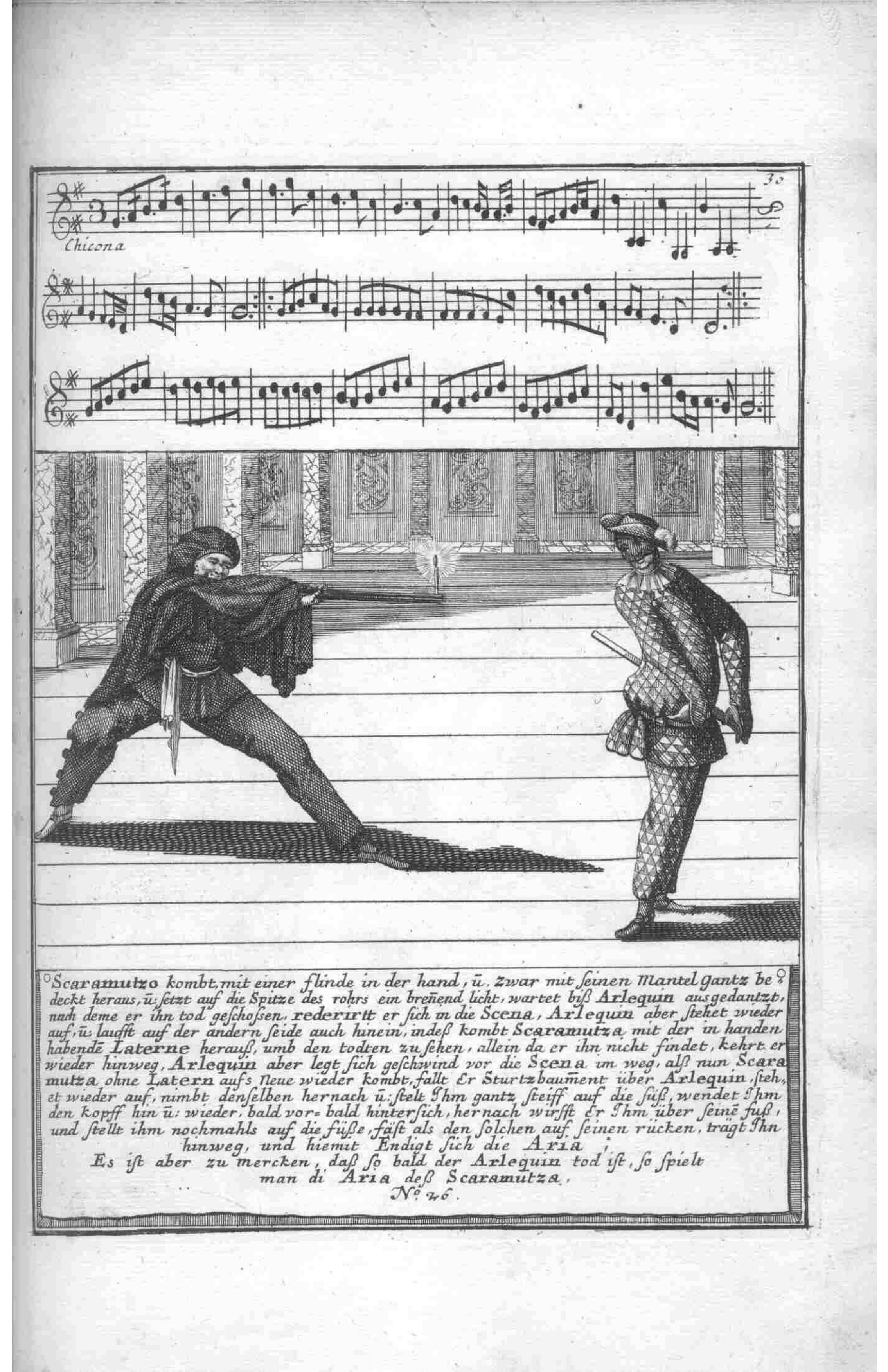
Combat/Duel — Plate 19
Gregorio Lambranzi
- Medium:
- Copper-plate engraving
- Dance:
- Notation/Choreography
- Era:
- 1700s (Enlightenment/Minuet Era)
- Collection:
- Nuova e curiosa scuola de' balli theatrali (1716)
- Source:
- Library of Congress
- Rights:
- Public domain — free to use, share and adapt.
- Recorded as:
- Public Domain
Lambranzi's plates are among the only visual records of how professional dancers actually moved and posed in the early 18th century. This plate specifically documents the technique and aesthetic of male theatrical dancing during the late Baroque period, when virtuosity, turning, elevation, and dramatic gesture were prized. For dance historians and performers, this engraving is direct evidence of a lost vocabulary—the specific arm placements, the angle of the lunge, the relationship between two male bodies in theatrical space.
What you are looking at
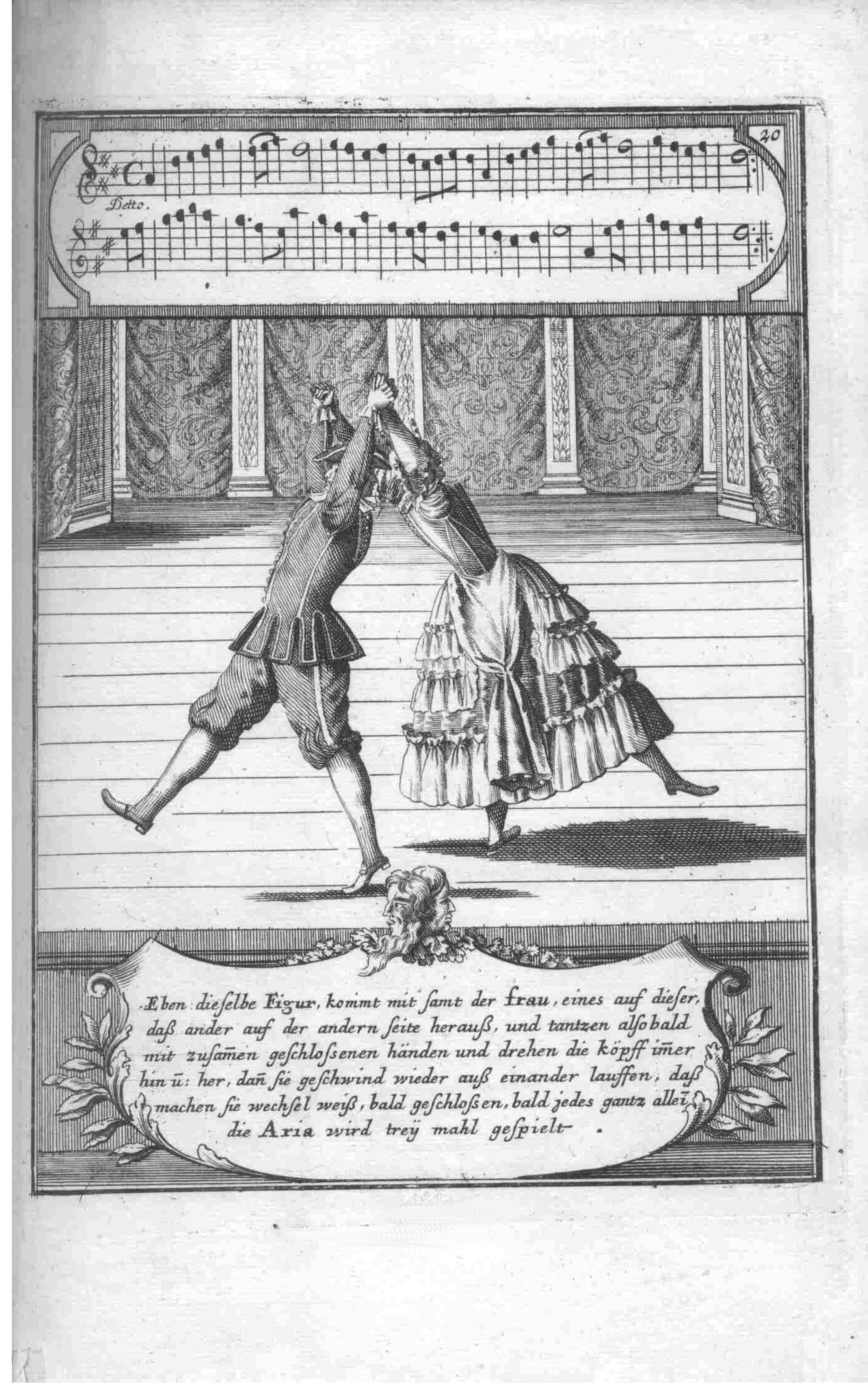
Two male dancers face each other on a wooden stage floor before a grand interior with classical columns and ornate damask wall hangings. Both wear period costumes of the early 18th century: close-fitting jackets, breeches, and plumed hats. The figure on the left lunges forward with an extended arm, his body angled sharply, while the figure on the right steps back, raising his arm defensively or responsively. The composition captures a moment of combat or dramatic confrontation—both dancers are airborne or at the height of dynamic extension, their legs bent and extended in exaggerated athletic poses. The engraver has frozen a single instant of rapid, theatrical action. Musical notation appears at the top of the plate, indicating that this choreography was accompanied by a specific score. Below the scene, a German verse caption explains the movement.
The dancing
Both figures are in asymmetrical, off-balance positions with pronounced flexion of the legs and torso rotation. The lunging dancer thrusts his weight forward onto a bent leg, torso angled, one arm extended; the retreating dancer mirrors this dynamic with his own defensive posture. Neither dancer is in a closed hold or formal frame—they are separated, moving through space with high energy and large gestures. The poses suggest trained technique: the weight is well-managed despite the apparent disorder, the legs are turned out, and the line of the body is controlled even at full extension. The footwork and the precision of the hand positions indicate these are virtuosic, codified movements rather than naturalistic combat.
The dance depicted
This is a theatrical dance from the late Baroque tradition, almost certainly from the comedic or dramatic intermezzi and stage ballets common in the early 18th century. The gestures and poses—lunging, parrying, retreating—suggest a formal dance vocabulary applied to mimetic action (feigned combat or a dramatic duel). The music notation indicates this was a choreographed solo or duo performed to a specific instrumental piece. The German text and Nuremberg publication place this firmly in the German-speaking world's embrace of Italian theatrical dance forms. The precise technique and theatrical context indicate this is not social or social courtship dancing, but rather a specialized performance genre for trained dancers on the professional stage.
How it was made
This is a copper-plate engraving, a printmaking technique that allowed fine detail and wide circulation. The engraver has used close parallel lines (hatching) to create depth, shadow, and texture in the fabric, floor, and architectural elements. The medium's precision allowed the artist to render the intricate pleats of the costume and the exact angle of the dancers' bodies with clarity. As one of 50 plates in a published manual, this engraving was designed to be studied by dancers, choreographers, and theater practitioners across Europe—it was not a unique artwork but a reproducible instructional document. The technique implies an educated, literate audience capable of reading both musical notation and engraved imagery.
About this work
This engraving is Plate 19 from Gregorio Lambranzi's *Nuova e curiosa scuola de' balli theatrali* (Nuremberg, 1716), one of the most important surviving sources for early 18th-century theatrical dance. It documents a choreographed male duet involving feigned combat or a duel, pairing musical notation with a frozen moment of high-energy, asymmetrical movement. The work sits at the intersection of dance notation, theatrical costume history, and the martial mimicry that was a staple of Baroque stage performance. It belongs in a gallery of dance art because it is simultaneously a work of visual art and a functional document of how dancers moved, trained, and performed in this period.
Lambranzi's manual is one of the few richly illustrated sources for dance before the 19th-century photograph. It records not choreography in the modern sense, but rather specific figures, positions, and moment-by-moment tableaux that a trained dancer could recognize and reconstruct. The engraving is not merely a picture of dancers; it is a transcript of movement, as precise and intentional as a musical score.
How to look at it
Study the precise moment the engraver has chosen to freeze: both dancers are at the height of their extension or jump, neither in a stable position. This is not a static pose but the climax of a rapid sequence. Notice how the bodies are asymmetrical and off-center, yet controlled—the weight is managed, the limbs are shaped, the line is intentional even in apparent disorder. Compare the position of the arms and legs to the architectural frame (the columns, the floor line) to appreciate how the dancers are using space and how the engraver is using orthogonal perspective to place the movement convincingly in the stage box. The plumed hats, the precise tailoring of the jackets, and the position of the heels are all elements of an elaborate theatrical vocabulary—nothing in this image is casual or uncodified.
The artist
Gregorio Lambranzi was an Italian ballet master active in the early 18th century, based in Nuremberg. He compiled and published the *Nuova e curiosa scuola de' balli theatrali* (New and Curious School of Theatrical Dances) in 1716, with engravings by Gottfried Taubert and others. The work represents the Baroque synthesis of Italian theatrical dance, German engraving tradition, and the desire to codify and teach dance through visual and musical notation. Lambranzi's manual was one of the most influential dance publications of its era, reprinted and adapted throughout Europe, and remains a primary source for understanding how dance was conceptualized and transmitted in the early 18th century.
The period
The early 18th century was a period of rapid professionalization and codification in European dance. The minuet had become the dominant courtly dance, but theatrical dance—performed by trained professionals on stage—was increasingly elaborate and technical. Male dancers, in particular, were valued for their ability to perform large allegro movements, jumps, and turns, often in dramatic or comic contexts. The tradition of commedia dell'arte influence on theatrical dance was still strong, and choreographers frequently created pieces based on dramatic scenarios, including dances of combat, seduction, and comic business. Lambranzi's manual emerged during a period when dance was beginning to be theorized and documented with the same rigor as music—the inclusion of notation alongside visual representation was innovative and influential.
Where it lives
This plate is part of the *Nuova e curiosa scuola de' balli theatrali*, published in Nuremberg in 1716 by Christoph Weigel. The Library of Congress holds a copy of this work. Each plate pairs a musical score with a choreographed figure or sequence, making the publication a hybrid of music, visual art, and instructional manual.
Dance in this work
Questions about this work
How do I know this is an engraving and not a drawing?
The fine parallel lines (hatching and cross-hatching) used to create shadow and texture are characteristic of engraving rather than drawing or painting. The precision and the fine detail visible in the fabric folds and facial features are also easier to achieve in engraving, a technique that allowed very fine lines. The fact that this is Plate 19 of a published book is another indicator: engravings were the standard method for reproducing images in printed books of this period.
Was this a real fight, or a staged dance?
It was a staged dance designed to look like a fight. The musical notation at the top confirms this is choreography set to music—a real duel would not be accompanied by a composed score. The precision of the poses, the tailored theatrical costumes, and the classical stage setting all indicate this is a professional theatrical performance, not actual combat. The tradition of theatrical dances depicting combat, seduction, or dramatic action was a major part of Baroque stage entertainment.
Why is there music notation at the top?
The music notation indicates the specific instrumental piece (likely for a small ensemble: violin, oboe, or harpsichord) that accompanied this choreography when it was performed. Lambranzi's manual was designed to teach both musicians and dancers how a particular dance piece went—the music and the movement were inseparable. A dance master or choreographer would use both the notation and the engraved figure to reconstruct the movement.
What does the German text at the bottom say?
The caption describes the action of the dance and the technique depicted. It explains that in this figure, the dancers close together with locked hands and turn their heads over their shoulders, swiftly swinging back and forth to make each other dizzy, which is why the aria (song) is played three times.
More Notation/Choreography artwork