39 works in this view — arrow keys or swipe to move between them.
Dance in Art
Solo Dancer — Plate 20
Gregorio Lambranzi
- Medium:
- Copper-plate engraving
- Dance:
- Notation/Choreography
- Era:
- 1700s (Enlightenment/Minuet Era)
- Collection:
- Nuova e curiosa scuola de' balli theatrali (1716)
- Source:
- Library of Congress
- Rights:
- Public domain — free to use, share and adapt.
- Recorded as:
- Public Domain
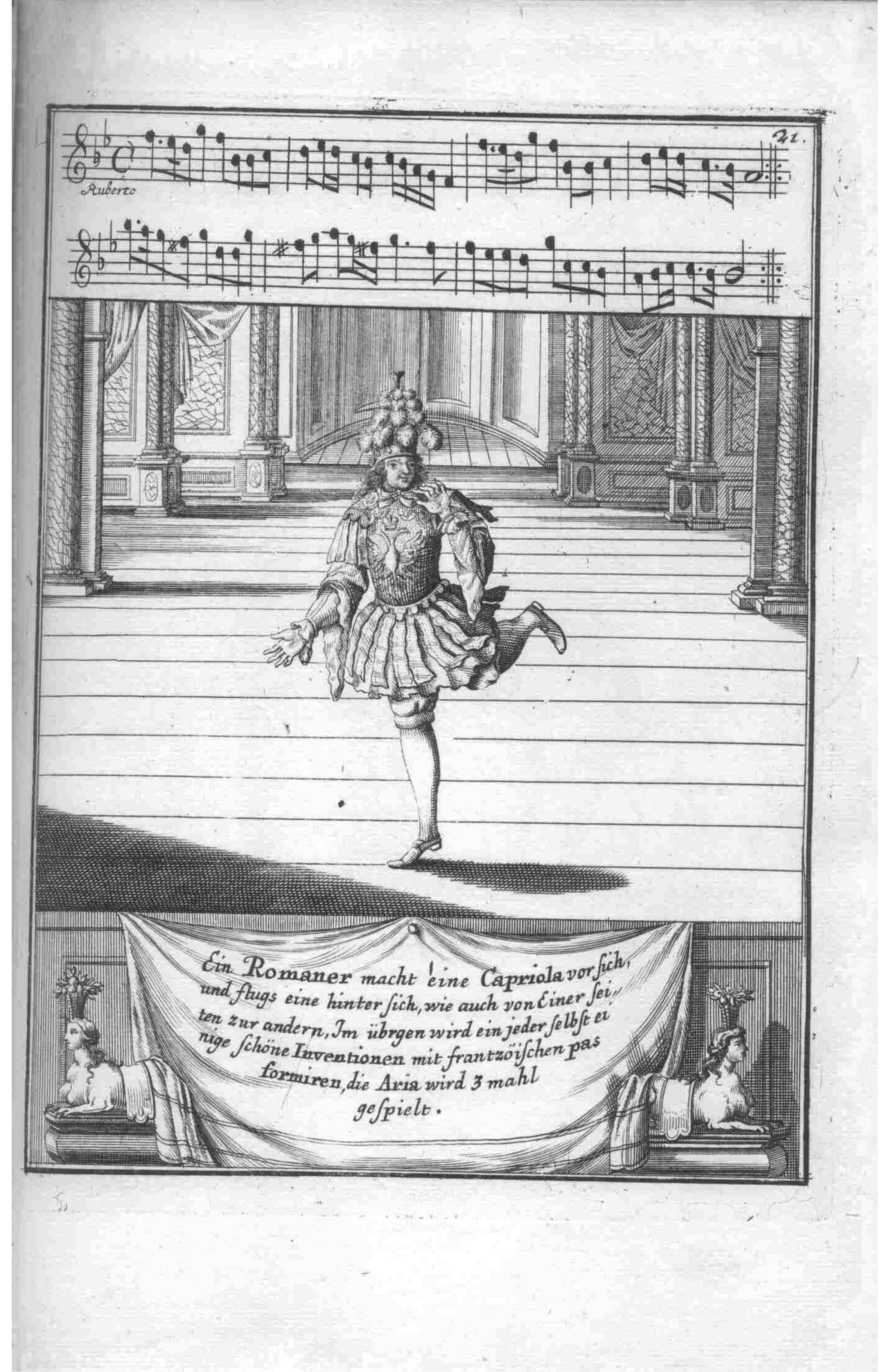
Lambranzi's work is one of the only visually detailed surviving documents of how professional theatrical dance actually looked in the early 18th century. A dancer or historian can see exactly what costume was worn, how the body was positioned, what the music looked like, and how the movement was understood and notated—making this manual invaluable for reconstructing historical practice. The capriole (a jump with a beating change of feet) documented here became a foundational step in classical ballet, so this image shows an ancestor of modern technique at the moment it was being standardized and published for international circulation.
What you are looking at
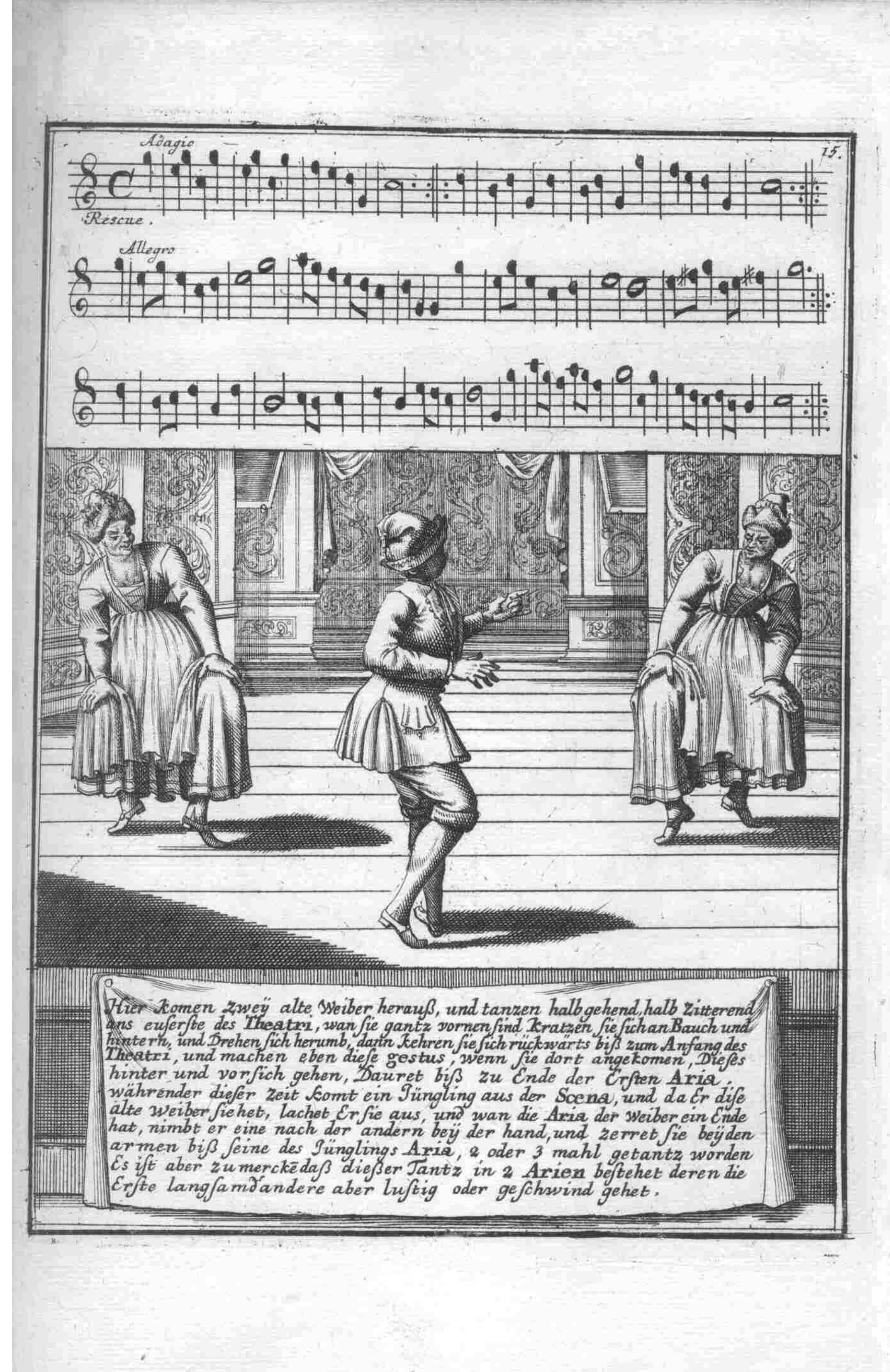
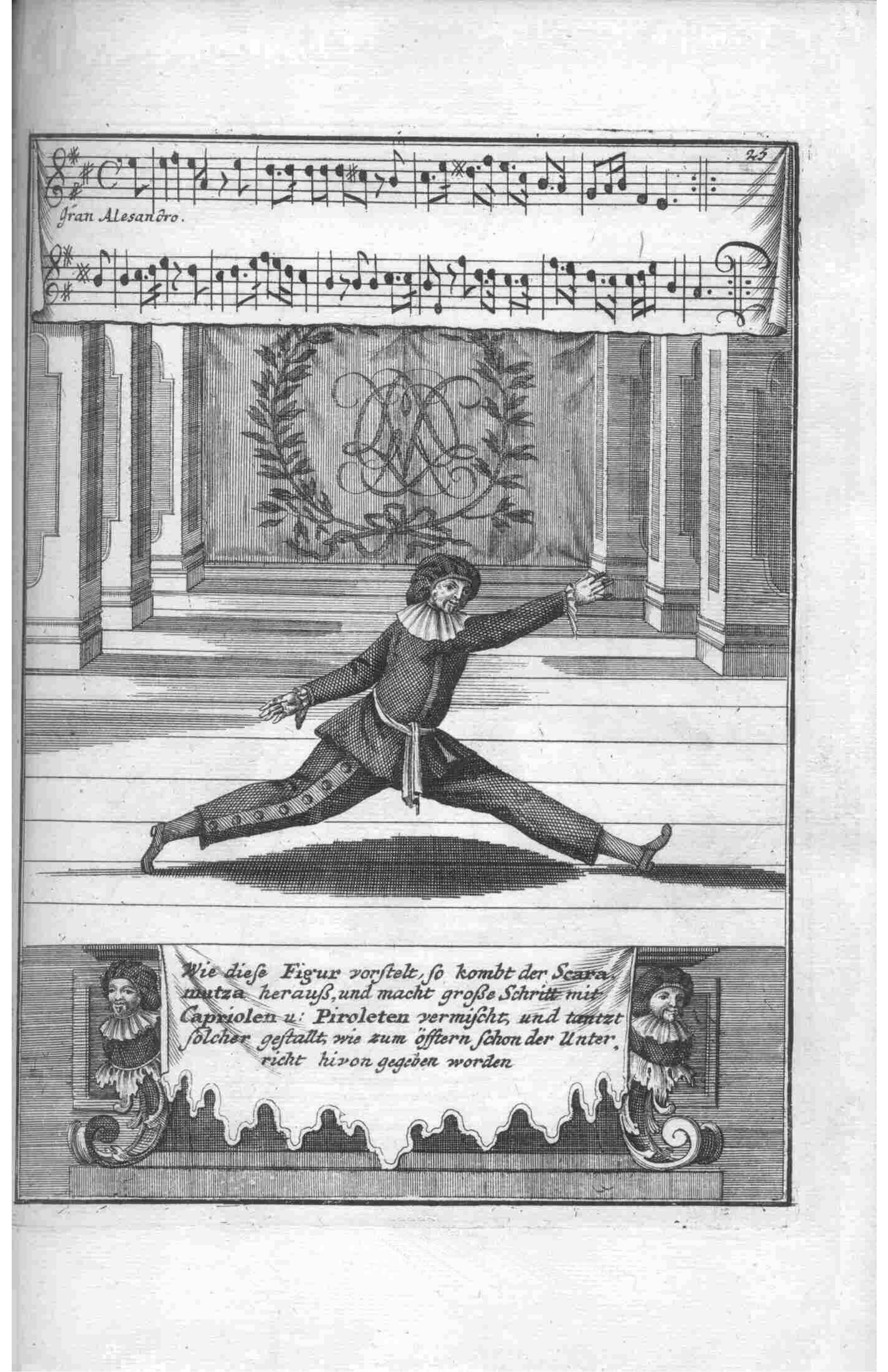
A solo male dancer in ornate theatrical costume stands center stage in an elegant interior, captured mid-leap or suspension. He wears a heavily embroidered doublet with decorative sleeves, a plumed headdress, and a voluminous pleated skirt—the distinctive costume of court theatrical dance. The stage is framed by classical columns, swags of curtaining at top and sides, and an architectural backdrop suggesting a palazzo interior with a domed chamber visible in the distance. The dancer's body is airborne, one leg extended behind, the opposite arm reaching forward in a gesture of courtly elegance. At the top of the print, two staves of musical notation labeled 'Ruberto' provide the choreography's accompanying melody. Below the stage scene, a German caption on a draped banner identifies this as a Roman capriole figure, explaining that a Roman makes this leap and also dances 'eine schöne' [a beautiful figure] by changing feet in the air, noting the aria will be played three times.
The dancing
A single male dancer occupies the stage in a distinctly theatrical vertical pose. His weight appears suspended, with one leg extended behind him in a balletic line, the torso erect and composed, and his arms in an open, gestural frame—one arm extended forward and the other away, creating a sense of courtly address or presentation. The body demonstrates control and geometric precision rather than momentum or naturalism. The headdress crowns the figure, and the elaborate costume's voluminous proportions dwarf the body, making the dance about decoration and decorum as much as athletic display.
The dance depicted
This engraving depicts a theatrical court dance, specifically identifying the figure as a 'Capriole Romana' (Roman capriole)—a term found in early 18th-century European theatrical dance manuals. The German inscription confirms this is a jump in which the dancer changes feet in the air, a technical feat central to court ballet spectacle. This is theatrical dance of the early 18th century, danced by male professionals in courts and theaters across Europe. The image tells us these jumps were notated, composed, and integrated into larger dance suites, each with an assigned music piece (here labeled Ruberto), and that the same aria would be repeated to allow the dancer to perform the figure three times—a structure suggesting both compositional precision and the physical demand of the movement.
How it was made
This is a copper-plate engraving, a technique that allowed fine linear detail and made the work suitable for reproduction and distribution across Europe. The precision of the line work—evident in the hatching that models the fabric, the architectural background, and the figure's anatomy—is characteristic of engraving and serves the practical purpose of documenting choreography for dancers who might learn from the print. The engraving's density of detail and tonal range, built entirely from line, demonstrates the considerable skill required of the engraver. As one of a series of plates, this work circulated as part of a bound manual, making it both an artwork and a pedagogical document.
About this work
This is Plate 20 from Gregorio Lambranzi's *Nuova e curiosa scuola de' balli theatrali* (New and Curious School of Theatrical Dances), published in Nuremberg in 1716—one of the most systematically detailed and visually ambitious dance manuals of the early 18th century. Each plate pairs a notated musical score with an engraved figure in costume, performing a specific choreographed movement. The work represents the intersection of music and dance notation at a moment when theatrical dance was becoming increasingly standardized and professional. Lambranzi's manual documented the court dances and theater dances practiced across German-speaking courts and European stages, preserving both the visual spectacle of the performance and the musical-choreographic structure that governed it.
The manual was originally published in German and Italian and circulated widely, making it one of the most important dance documents of its era. For students of early modern dance, it provides rare evidence of how virtuosity was staged, what bodies were expected to do, how spectacle was constructed through costume and music, and how dance and music were notated and transmitted among professionals.
How to look at it
The image freezes a moment of suspension—the capriole jump itself—captured at the apex of the movement when the body is momentarily weightless. The artist has chosen to show the dancer as fully extended and geometric, not caught in the struggle or landing, but at the moment of apparent effortlessness that court dance aspired to. Notice how the costume's volume and the plumed headdress dominate: the dance is as much about presentation and decoration as about athleticism. The architectural frame and formal setting emphasize that this is a staged, composed, and courtly event—not spontaneous movement, but a carefully notated figure performed to music.
The artist
Gregorio Lambranzi (c. 1674–c. 1730) was an Italian dancer, choreographer, and theorist active in German courts and theaters. He is known almost entirely through this one surviving publication, which he dedicated to illustrating the principles and steps of contemporary theatrical dance. The manual reflects his experience as a practicing dancer and his pedagogical ambition to codify and transmit dance knowledge through visual and musical notation. The precision and comprehensiveness of the work suggest Lambranzi was both a skilled practitioner and an innovator in dance documentation.
The period
In the early 18th century, theatrical dance was undergoing professionalization and codification across Europe. Court dances and stage dances were increasingly being notated, composed, and circulated in manuals and printed scores. This was the era of high Baroque court spectacle, when elaborate costumes, music, and choreography were integrated into court festivals and opera. At the same time, dance was beginning to be theorized and systematized by pedagogues and dancers. Lambranzi's work appeared at a moment when such notation systems were becoming more common and standardized, anticipating the more systematic dance notation systems of the later 18th and 19th centuries. The theatrical costume seen here—with its plumed headdress, embroidered doublet, and voluminous skirts—represents the height of aristocratic dress and theatrical spectacle in the German-speaking world of the period.
Where it lives
This engraving is Plate 20 from Gregorio Lambranzi's *Nuova e curiosa scuola de' balli theatrali*, published in Nuremberg in 1716 by J.E. Adelbulner. The manual was published in both German and Italian and survives in multiple copies in libraries and archives across Europe. This particular reproduction is held by the Library of Congress.
Dance in this work
Questions about this work
What is a capriole and why does the caption say the dancer changes feet in the air?
A capriole is a jump in which the dancer springs upward and simultaneously beats the legs together before landing on both feet. The "change of feet" happens in the brief moment of suspension when both legs are off the ground. The dancer shown here is captured at the apex of that jump. This technique remained central to classical ballet and is still taught today.
Why is there music notation at the top?
Early 18th-century dance was inseparable from music. Each choreographed figure was composed to fit a specific musical phrase or suite. The notation labeled 'Ruberto' is the melody the dancer would perform to. The caption notes that this aria was played three times, allowing the dancer to repeat the figure. This integrated approach to music and choreography was standard in court dance.
How was this manual used?
Lambranzi's manual was a professional reference and pedagogical tool for dancers and choreographers. The combination of notated music, engraved figures, and written descriptions meant that a dancer who could read music and understood the notation system could learn these choreographed steps from the page alone. It functioned as both a performance archive and a teaching manual.
Who would have worn this costume and danced this?
These were professional male dancers working in courts and theaters, particularly in German-speaking regions. The costume is expensive and ornate, indicating high-status performers. Court dancers performed in festivals and spectacles; theater dancers performed in opera houses. Both required technical mastery, musicality, and the ability to sustain elaborate costumes and heavy headdresses.
More Notation/Choreography artwork