49 works in this view — arrow keys or swipe to move between them.
Dance in Art
Combat/Duel — Plate 28
Gregorio Lambranzi
- Medium:
- Copper-plate engraving
- Dance:
- Notation/Choreography
- Era:
- 1700s (Enlightenment/Minuet Era)
- Collection:
- Nuova e curiosa scuola de' balli theatrali (1716)
- Source:
- Library of Congress
- Rights:
- Public domain — free to use, share and adapt.
- Recorded as:
- Public Domain
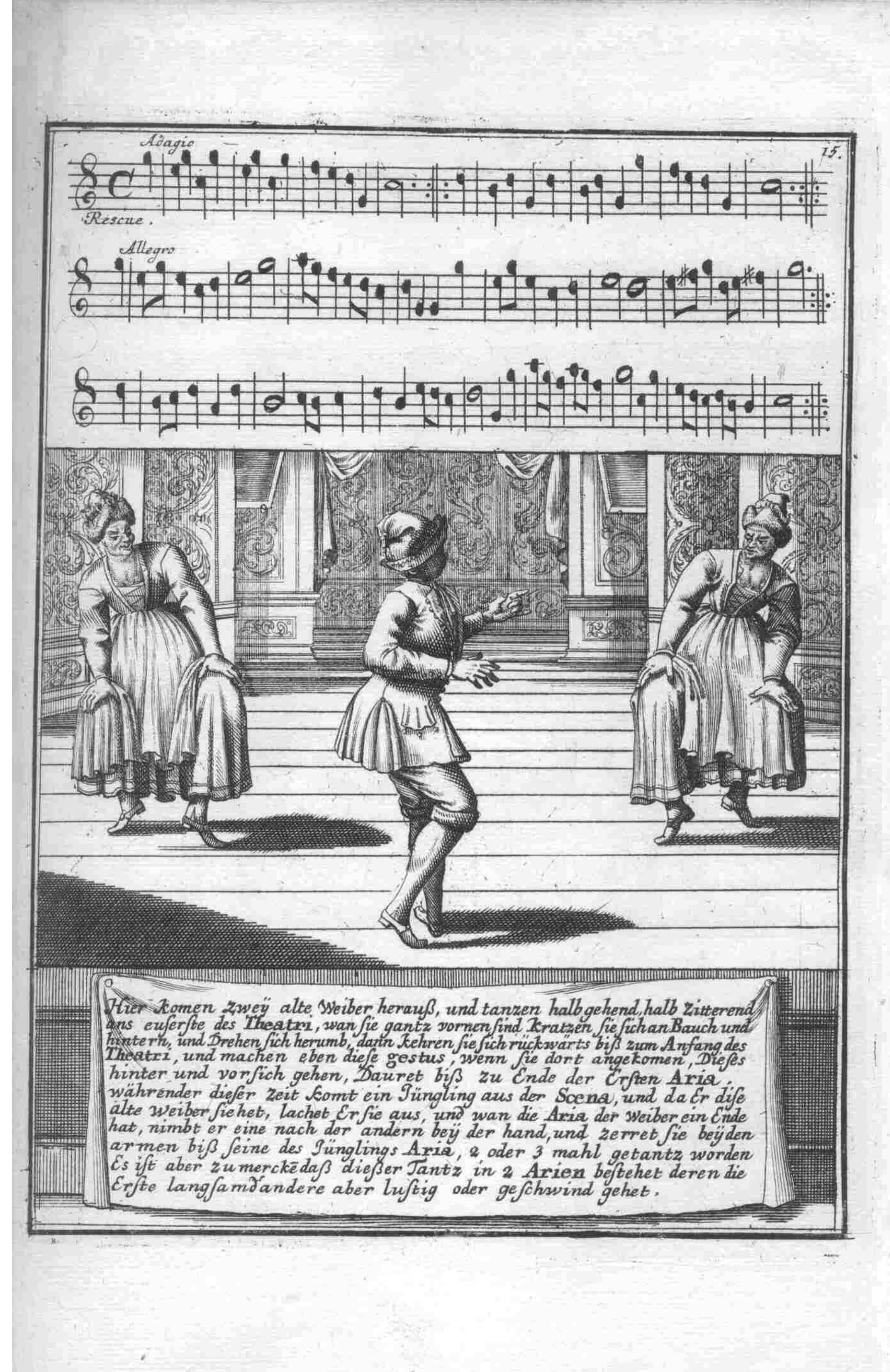
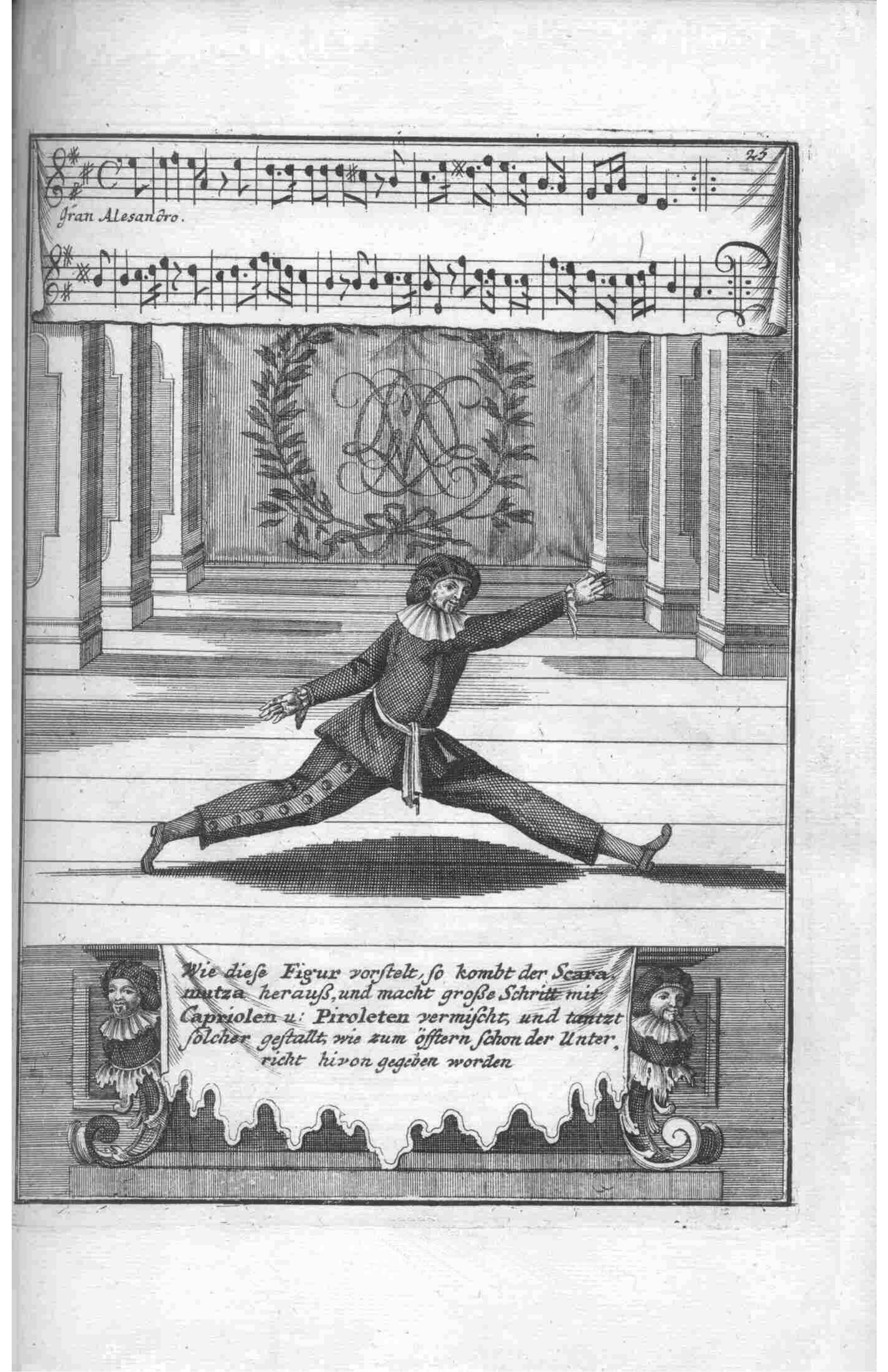
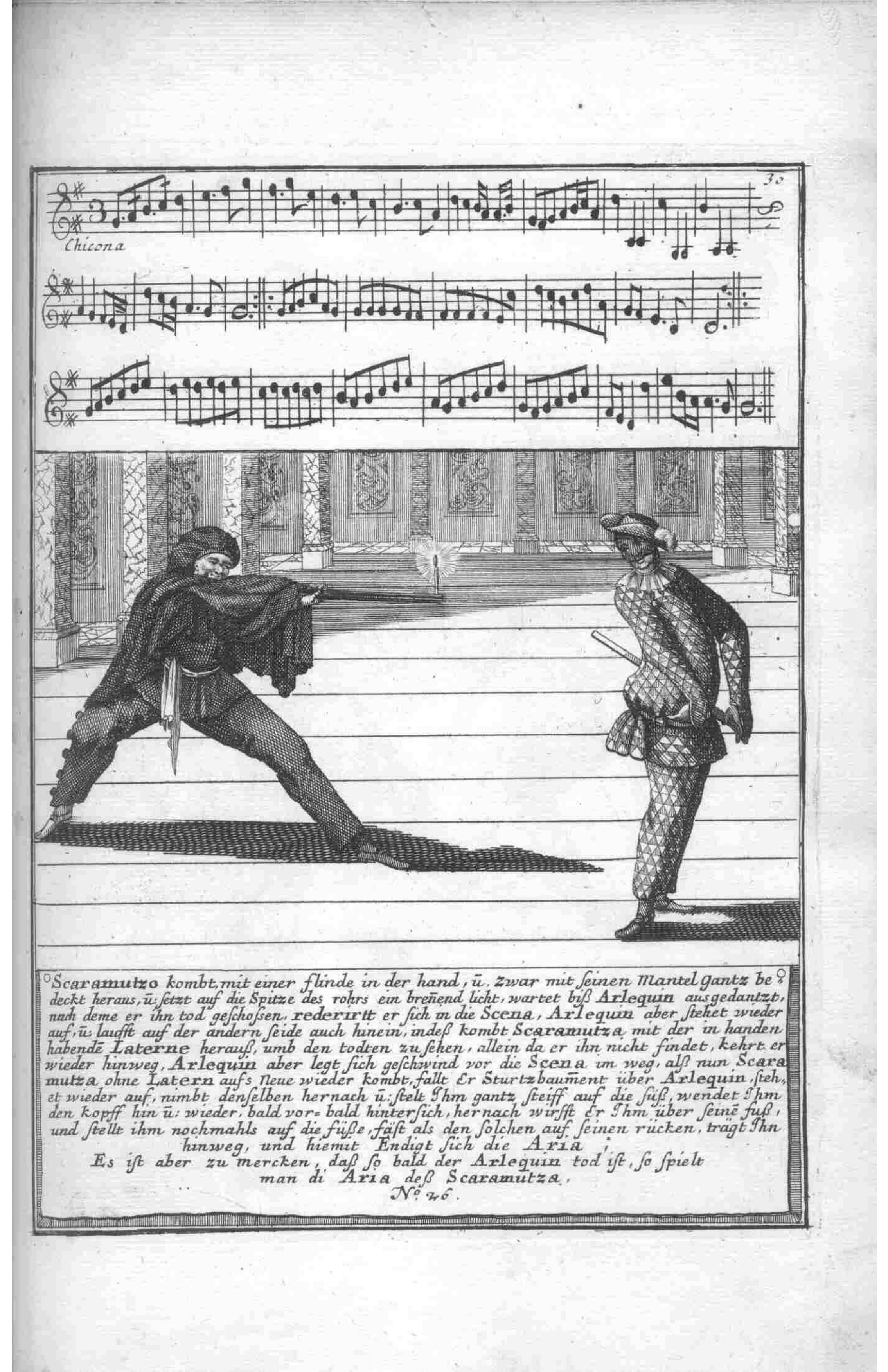
This image is one of the most detailed visual records of how theatrical dance was actually performed and taught in the early 18th century—what the bodies did, how they related in space, what characters they embodied, and how movement was notated and transmitted. Lambranzi's work is foundational to understanding the transition from Renaissance spectacle to Baroque theatrical practice, and the survival of both image and notation together allows us to reconstruct specific choreography across three centuries.
What you are looking at
Two figures in rich theatrical costume face each other on a wooden stage with draped curtains in the background. The figure on the left wears a dark, closely fitted garment with patterned hose and a cap; the figure on the right is dressed in an ornate costume of small diamond or scale-like patterns covering the entire body, with an elaborate feathered headdress. Both are caught mid-movement in what appears to be a combat or duel stance, with bent knees and dynamic weight distribution. The wooden floorboards stretch into perspective beneath them. At the top of the page, three staves of musical notation labeled "Chicona" provide the choreographic score for this theatrical moment. Below the stage scene, a cartouche in German script describes the piece, flanked by small emblematic objects—a lantern on one side and what appears to be a lamp or torch on the other.
The dancing
Both dancers are deep in the movement, weight shifted and legs bent in a dynamic, confrontational frame. The figure on the left reaches forward with arms extended in an aggressive or defensive posture, while the right-hand figure is braced and turned slightly away, suggesting evasion or countermovement. The footwork is grounded rather than elevated—this is a terrestrial combat, not an aerial display. The closed, tense relationship between the two bodies, with significant space maintained between them, is the choreographic point: they are locked in opposition.
The dance depicted
This is a theatrical combat dance or "duel" from the early 18th-century Italian school of theatrical dance. The piece is titled 'Chicona' in the musical notation and appears in Lambranzi's manual as one of character dances designed for performance on the stage rather than in ballroom society. The costumes—particularly the scaled or checkered pattern on the right figure—suggest a dramatic persona, possibly representing exotic or comic characters. This is not social dance but choreographed pantomime-dance, designed to tell a story of conflict through stylized movement and gesture.
How it was made
This is a copper-plate engraving, a technique that allowed for precise reproduction and wide circulation of instructional material. The crisp, clear lines permit both the musical notation and the anatomical detail of the dancers' poses to be legible even in multiple printings. The engraving technique also produces a uniform tonal texture in the background curtains and stage, using fine parallel lines (hatching), which was the standard method for creating shadow and depth in black-and-white printmaking before lithography. This medium was ideal for instruction manuals: each plate could be printed hundreds of times and bound into volumes.
About this work
This is Plate 28 from Gregorio Lambranzi's *Nuova e curiosa scuola de' balli theatrali* (New and Curious School of Theatrical Dances), published in Nuremberg in 1716. It documents a theatrical combat dance called 'Chicona,' pairing a musical score with a detailed engraving of two performers in character costume executing the movement. Lambranzi's manual is one of the most important surviving records of early 18th-century theatrical dance practice, bridging the Italian tradition and German court culture. It presents dances that were performed on stage as entertainment, with character types and dramatic scenarios, rather than dances for social participation.
How to look at it
Attend to the weight and tension in both bodies—this is not a display of virtuosity but a representation of conflict through posture and spatial relationship. The engraver has frozen a moment of maximum dramatic tension, with both figures balanced between offense and defense. Notice too how the notation at the top corresponds to this image: each musical phrase had a choreographic equivalent, and the title 'Chicona' likely refers to a specific character type or dramatic scenario. The ornate costume on the right figure suggests this was a 'character' role, a theatrical type rather than a representation of a 'normal' person—a common convention of theatrical dance in this period.
The artist
Gregorio Lambranzi was an Italian dancing master and choreographer active in the late 17th and early 18th centuries. He worked in Nuremberg and other German courts, where he compiled his *Nuova e curiosa scuola de' balli theatrali* with engravings likely by Johann Georg Puschner. The manual, published in German and Italian editions, represents Lambranzi's effort to codify and preserve the theatrical dance practice of his era in a form that could be studied and replicated by other masters. The work synthesizes Italian choreographic tradition with the theatrical conventions of the German-speaking world.
The period
The early 18th century saw theatrical dance beginning to establish itself as a distinct discipline separate from court dance and mime. The Baroque stage was dominated by commedia dell'arte-influenced character types, and dance was increasingly integrated into dramatic narratives performed in opera houses and court theaters. Lambranzi's publication coincided with the rise of professional theatrical dancing and the emergence of dancing masters who specialized in choreography for stage spectacle. At the same time, musical notation and choreographic recording were becoming more systematic: this was the era in which dance was beginning to be documented in ways that modern practitioners could study.
Where it lives
This plate is from the 1716 edition of Lambranzi's *Nuova e curiosa scuola de' balli theatrali*, one of the most comprehensive surviving dance manuals of the early 18th century. The complete work contained over 100 plates, each pairing a musical score with an engraved scene of dancers in performance. Copies are held in major libraries including the Library of Congress.
Dance in this work
Questions about this work
What is a 'chicona' and why is this dance called that?
The term likely refers to a specific character type in theatrical performance of the era—possibly related to Italian commedia dell'arte traditions. Without further documentation, the exact meaning is uncertain, but it appears to be a named dance associated with a particular dramatic scenario or persona. Lambranzi's manual titles often identify both the dance genre and the character it represented.
How would a dancer use this image and notation?
A dancing master would study both the musical notation and the engraved pose together: the notation gave the rhythm and phrasing, while the image showed the key positions and the spatial relationship between dancers. The image represents a single 'tableau' or moment of high importance in the choreography—not the entire dance, but the moment that crystallizes the dramatic or technical point. A master would understand from convention how to connect such moments into a complete phrase.
Why engrave dance at all, rather than use words?
Because the body in space is impossible to describe fully in words. An engraving allows another master to see posture, weight distribution, arm position, and spatial relationship all at once. Combined with musical notation, an engraving created a portable record that a professional choreographer could use to reconstruct and teach the dance to others—essential for the transmission of choreography across geography and generations.
What was theatrical dance in the early 18th century?
It was character-based, narrative-driven dance performed on stage, often as part of opera or spoken drama. It emphasized mime, dramatic gesture, and the representation of types (the seducer, the fool, the servant, the exotic outsider) rather than abstract movement. It was separate from both court social dance and ballet as we know it, occupying a middle ground between acting and dancing.
More Notation/Choreography artwork