49 works in this view — arrow keys or swipe to move between them.
Dance in Art
Acrobatic — Plate 33
Gregorio Lambranzi
- Medium:
- Copper-plate engraving
- Dance:
- Notation/Choreography
- Era:
- 1700s (Enlightenment/Minuet Era)
- Collection:
- Nuova e curiosa scuola de' balli theatrali (1716)
- Source:
- Library of Congress
- Rights:
- Public domain — free to use, share and adapt.
- Recorded as:
- Public Domain
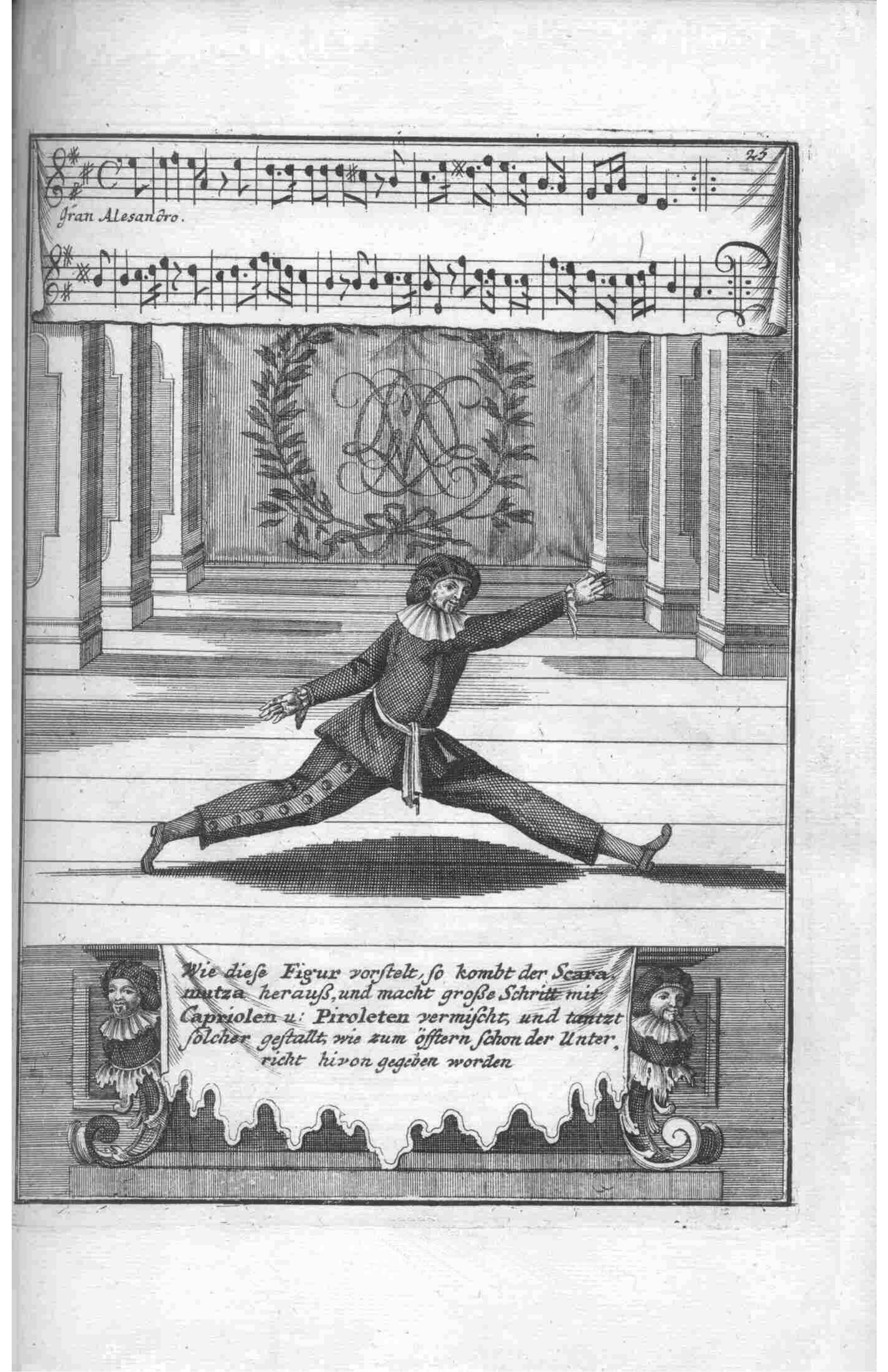
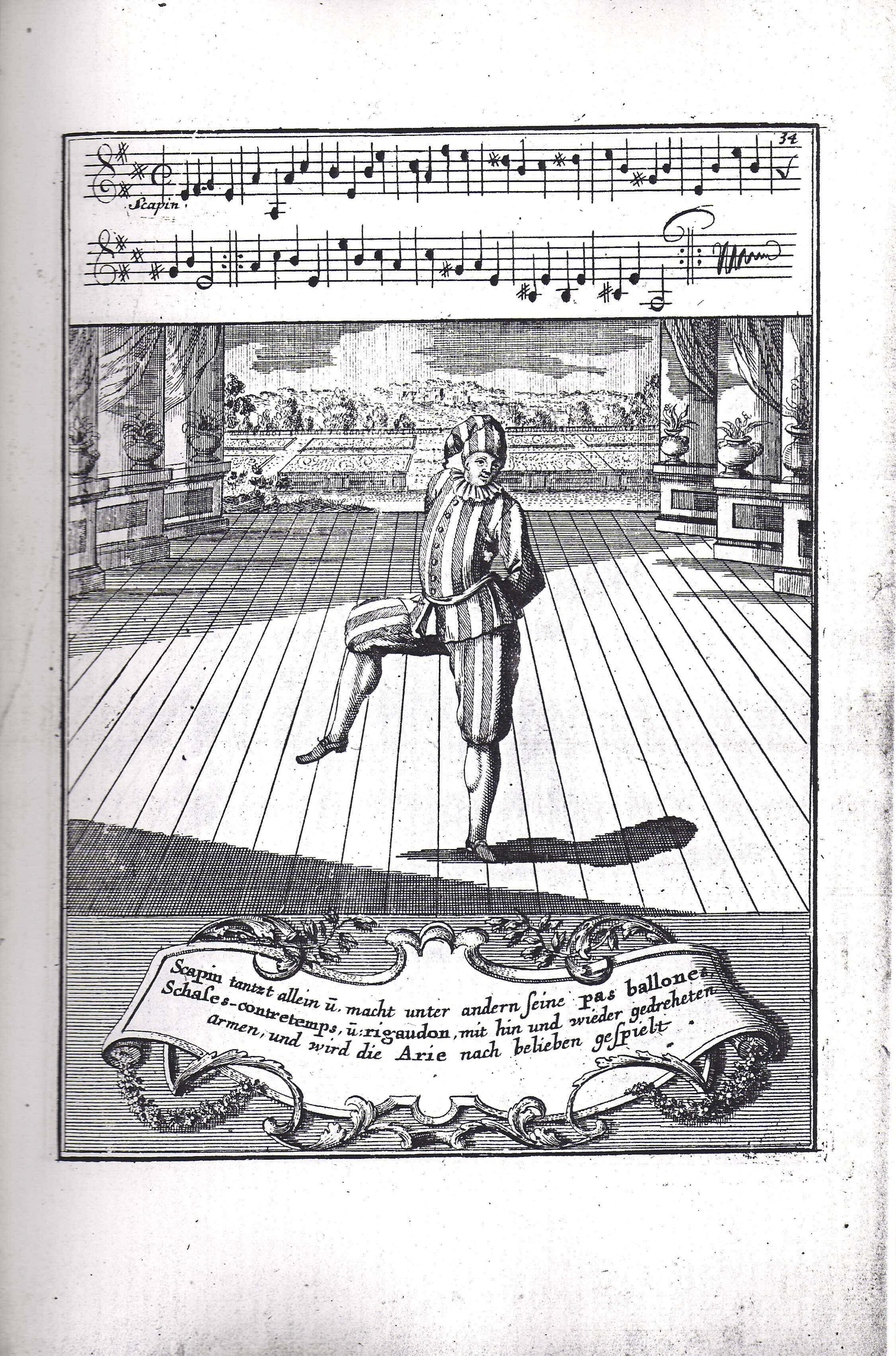
Lambranzi's prints are almost unique in providing simultaneous evidence of music, costume, and the exact position and extension of the body in early 18th-century theatrical dance—a moment when ballet technique was still forming. For dancers and historians, the image is legible in ways that written description alone could never be: you can see how high the leg extends, how the weight is distributed, what the supporting leg and torso are doing, and what kind of virtuosity the audience of the period expected. This is one of the earliest systematic attempts to document dance technique visually.
What you are looking at
A solo male dancer in theatrical costume stands on a wooden stage within a classical loggia, framed by draped curtains and columns. The stage opens onto a landscape vista. The dancer wears an elaborate, highly decorated tunic or doublet with horizontal stripes and ornamental bands, paired with fitted hose and shoes. His costume includes a distinctive ruffled collar and what appears to be a plumed or tall hat. He is caught mid-movement with his left leg raised in an extended position—a developpé or caper—while his right leg remains planted and his torso turns, creating a dynamic torsion through the body. His arms are positioned to balance and frame the movement. The entire scene is rendered in copper-plate engraving with fine parallel lines creating tone and shadow, characteristic of early 18th-century printmaking. The composition emphasizes theatrical spectacle: the formal architectural framing, the rich costume detail, and the moment of virtuosic extension.
The dancing
A single male performer in the center of the stage, legs in an extended turnout with the weight on the supporting leg and the working leg lifted high in a straight line—a fundamental technique of theatrical dance training. The upper body shows slight counter-rotation, the torso held upright and composed. The arms are positioned to frame the movement without apparent strain, suggesting trained control. The dancer's posture and the precision of the leg extension indicate formal training in the balletic idiom of the period.
The dance depicted
This plate illustrates a moment from the theatrical dance vocabulary of early 18th-century Italy and Central Europe. The extended leg position (developpé or similar) was a foundational element of the emerging ballet technique codified in this period, though it is also consistent with acrobatic or virtuosic display within theatrical dance more broadly. The costume is that of a character or comic dancer in the commedia dell'arte tradition or theatrical spectacle, not a court dancer in formal dress. The image demonstrates the ballistic, high-extension vocabulary that was becoming central to theatrical dance technique in this era, distinct from the measured steps of court dance.
How it was made
This is a copper-plate engraving, a medium that allowed precise linear detail and fine gradation of tone through cross-hatching. The technique was ideal for reproducing choreographic instruction: the plate could be printed many times and distributed in bound volumes to dance masters across Europe. The density of linear work—visible in the costume, the architectural setting, and the figure's anatomy—creates three-dimensional presence and allows the viewer to study the exact line of the body and the quality of extension. This medium was central to the circulation of dance knowledge in the 18th century.
About this work
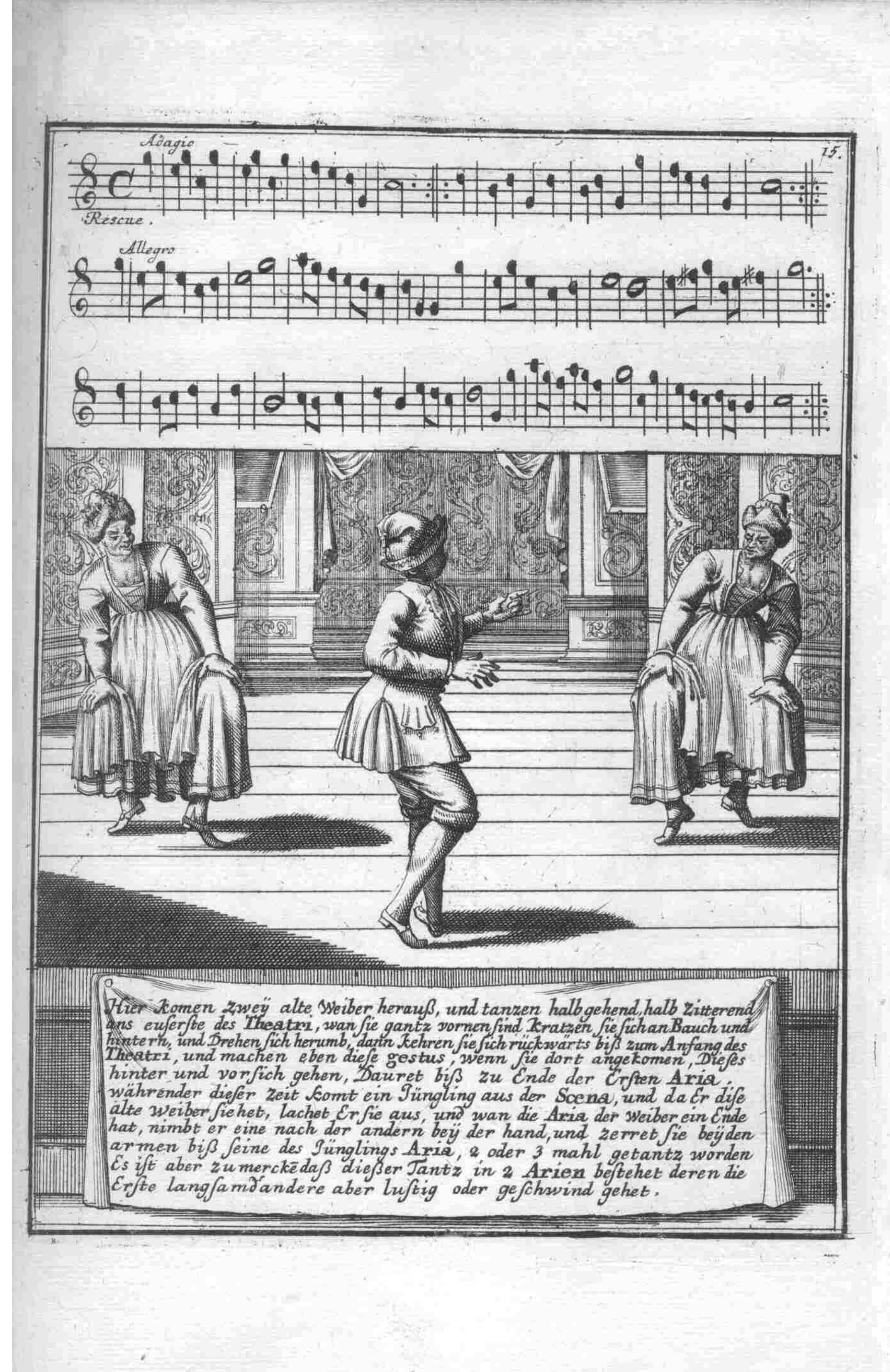
This plate is one of 60 engravings in Gregorio Lambranzi's *Nuova e curiosa scuola de' balli theatrali* (*New and Curious School of Theatrical Dances*), published in Nuremberg in 1716. Each plate pairs a piece of notated music with a costumed dancer shown in a signature pose or moment, accompanied by a German verse or instructional caption. Together, the volume functions as both a record of theatrical dance vocabulary and an instruction manual for dance masters. Lambranzi's work is among the most important surviving visual documents of early 18th-century dance technique and theatrical practice, capturing the transition from court dance toward the balletic idiom that would dominate European theater. The plates are precise enough that dancers and choreographers can, in many cases, reconstruct the steps and quality of movement from the image and the notation together.
How to look at it
Attend to the exact angle and height of the raised leg, the turnout of both legs, and the carriage of the torso—these tell you what the artist understood about the dance technique of the period. The costume is not incidental: the ruffled collar, striped tunic, and plumed hat situate this dancer in a specific theatrical tradition, distinct from court dance. Notice the two staves of musical notation at the top: Lambranzi has given you the music that accompanied this step, making it possible to understand the rhythm and phrasing. The landscape vista visible through the stage opening is also typical of early 18th-century theatrical design. The engraving style—the linear precision, the deep blacks, the fine hatching—is characteristic of the German printmaking tradition and speaks to the intended audience of dance masters and theater professionals who needed detail they could study and learn from.
The artist
Gregorio Lambranzi was an Italian dancing master and choreographer active in Nuremberg in the early 18th century. Little is known of his life beyond his published works, but *Nuova e curiosa scuola de' balli theatrali* (1716), with engravings after his designs by Johann Christoph Weigel, represents his major contribution to dance history. A second volume followed in 1728. Lambranzi's work bridges the world of commedia dell'arte, theatrical dance, and the emerging formal ballet technique. His plates are valued equally by historians of dance, costume, and stage design.
The period
The early 18th century was a transformative moment for European theatrical dance. The court ballet of Louis XIV's reign (17th century) had established a codified vocabulary of steps and positions, but dance was beginning to move beyond the court toward the public stage. Theatrical spectacle—including dance, acrobatics, and commedia dell'arte elements—was enormously popular in German-speaking territories and Italy. The notation systems of Beauchamp-Feuillet, which could record balletic movement, had recently been published and disseminated; Lambranzi's pairing of notation with illustration was part of a broader effort to preserve and teach dance technique in print. Costume and scenography were becoming increasingly elaborate, and the period saw growing interest in documenting performance practice for future reference and teaching.
Where it lives
This engraving is from *Nuova e curiosa scuola de' balli theatrali*, a bound volume of 60 plates published in Nuremberg in 1716. Copies are held in major libraries and dance archives across Europe and North America. The volume is available in facsimile and has been intensively studied by dance historians as one of the most valuable visual records of early 18th-century theatrical dance technique.
Dance in this work
Questions about this work
What is the dancer actually doing?
He is performing a developpé or similar high extension of the leg—a ballistic, controlled lift of the working leg from a bent position to a fully straight, lifted position while the supporting leg remains planted. This was a virtuosic technical element in early theatrical dance, requiring significant strength and training. The positioning shows turnout of both legs and a composed upper body, hallmarks of the emerging ballet technique.
Who was Gregorio Lambranzi?
An Italian dancing master and choreographer working in Nuremberg in the early 18th century. His *Nuova e curiosa scuola de' balli theatrali* (1716) is one of the most important surviving documents of early 18th-century theatrical dance, combining engraved illustrations with musical notation and choreographic description. A second volume was published in 1728.
Why do these plates have music at the top?
Lambranzi's method was to pair each dance position or step with the music that accompanied it. This allowed the volume to function as both a visual and musical instruction manual: a dance master could read the notation, consult the engraved image, and reconstruct the movement. It is one of the earliest attempts to document dance systematically in print.
How does this compare to modern ballet?
The vocabulary is ancestral to modern ballet—the turnout, the extended leg, the position of the arms—but the technique and aesthetic differ significantly. Lambranzi's dancers were theatrical performers trained in a mixed vocabulary that included elements of acrobatics, commedia dell'arte, and courtly steps. The formalization and refinement of ballet technique continued through the 18th and 19th centuries.
More Notation/Choreography artwork