49 works in this view — arrow keys or swipe to move between them.
Dance in Art
Combat/Duel — Plate 34
Gregorio Lambranzi
- Medium:
- Copper-plate engraving
- Dance:
- Notation/Choreography
- Era:
- 1700s (Enlightenment/Minuet Era)
- Collection:
- Nuova e curiosa scuola de' balli theatrali (1716)
- Source:
- Library of Congress
- Rights:
- Public domain — free to use, share and adapt.
- Recorded as:
- Public Domain
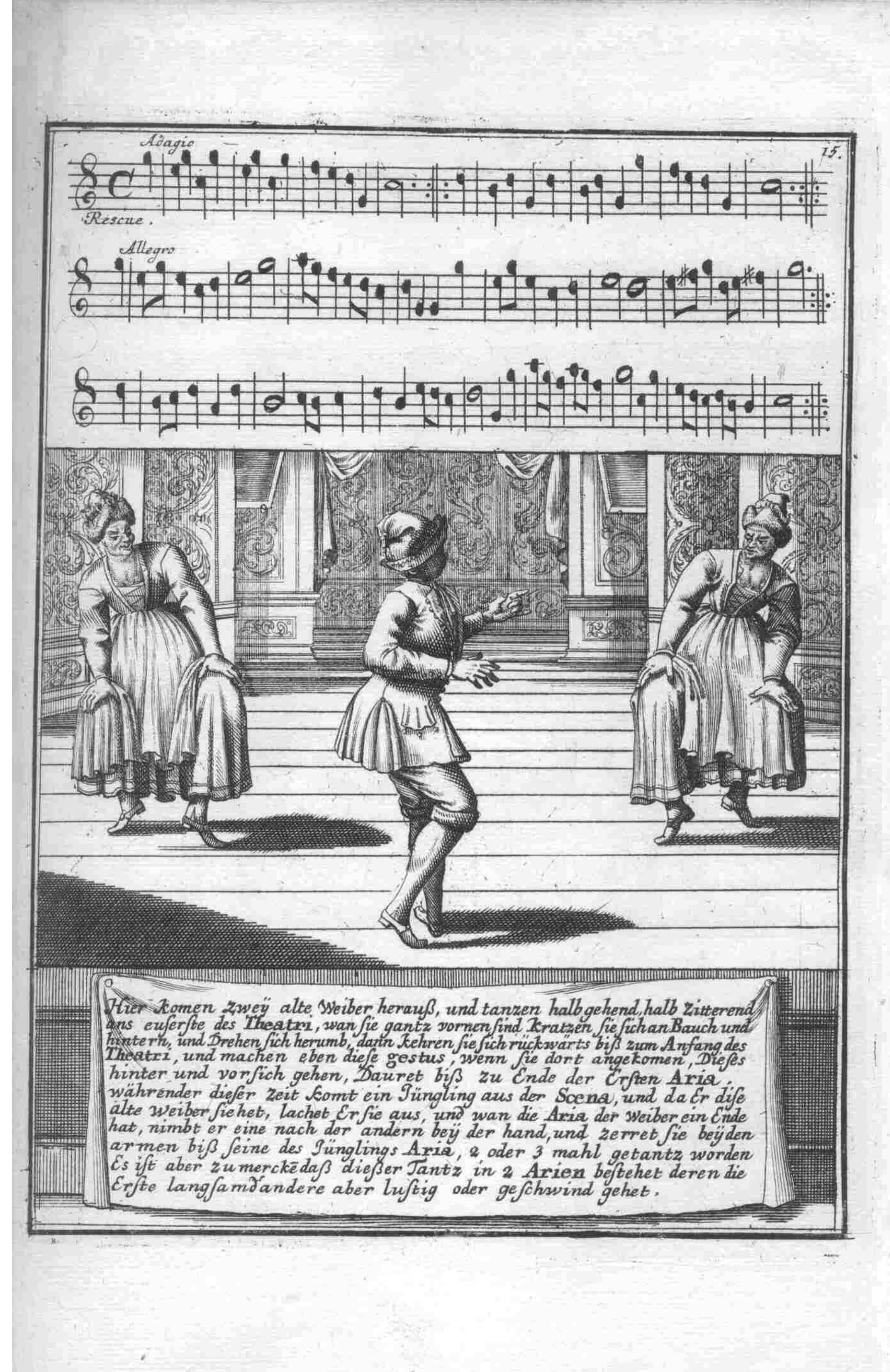
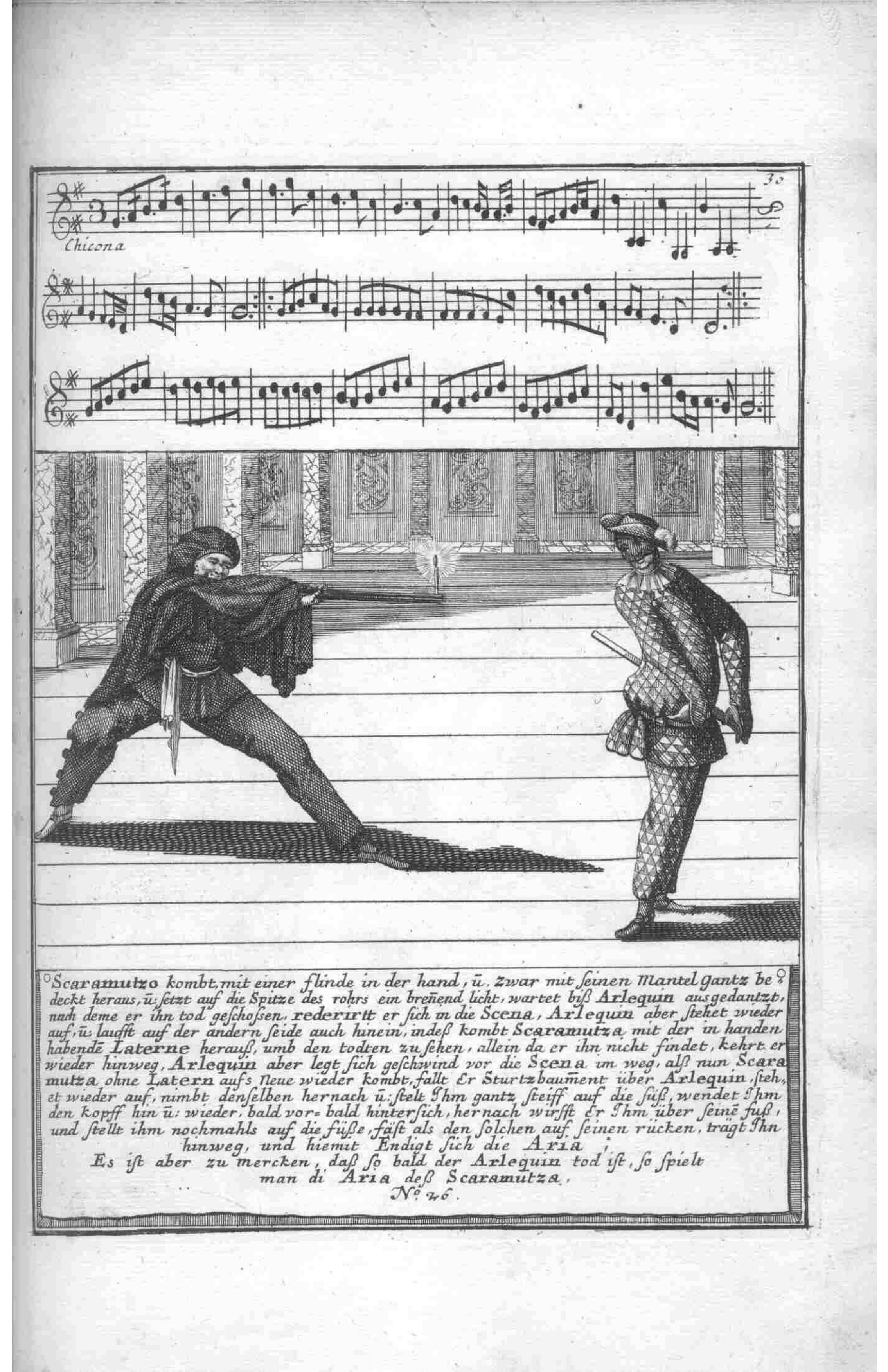
Lambranzi's manual is one of the earliest systematic visual records of how baroque dance was actually choreographed and performed, and this plate demonstrates that theatrical dance in this period included dramatic action, not merely refined courtly steps. The precision of the engraving—the stage architecture, the musical notation, the specific body position—reveals that combat and narrative gesture were as formalized and teachable as any minuet, challenging the idea that baroque dance was purely decorative.
What you are looking at
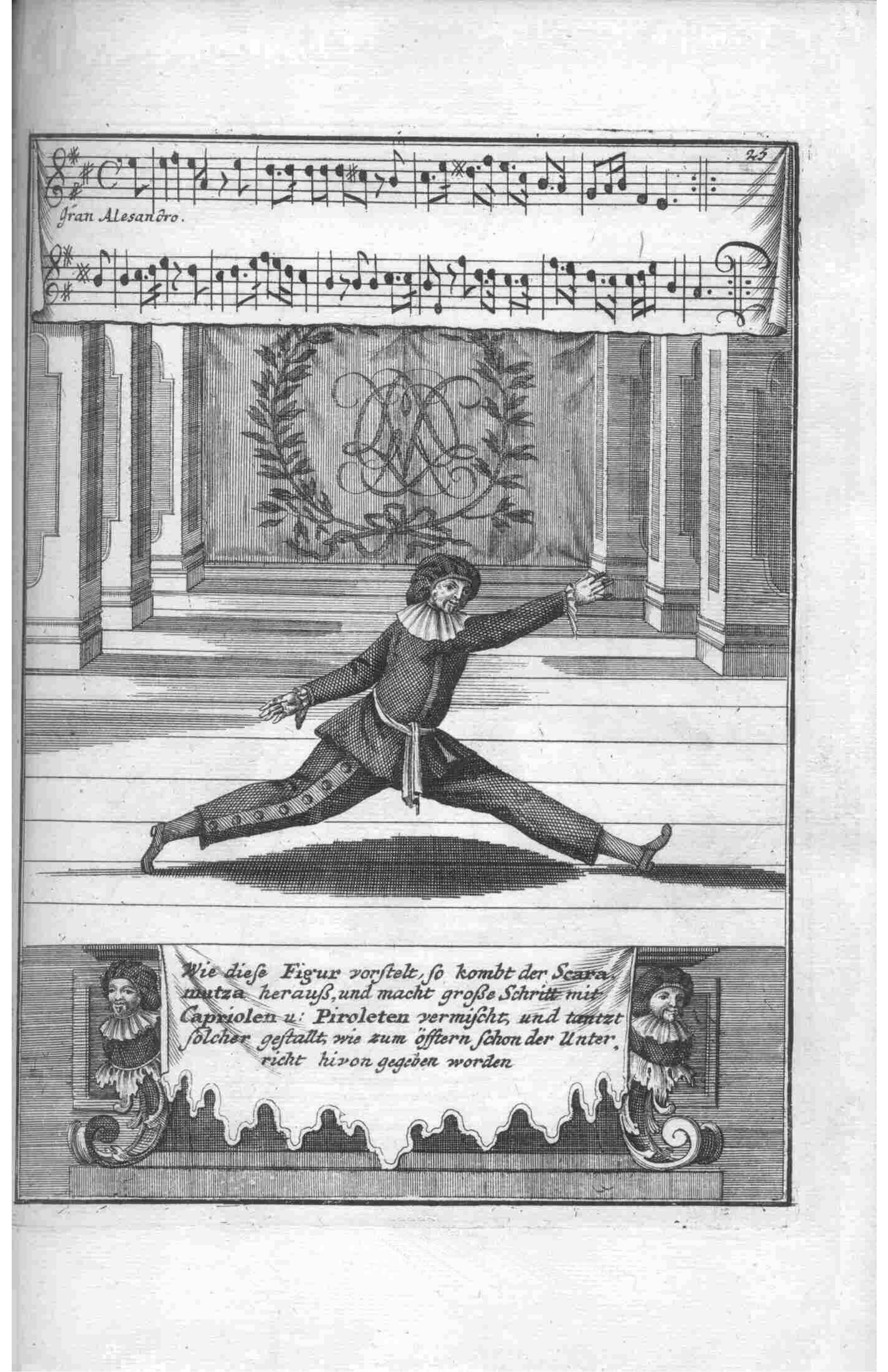
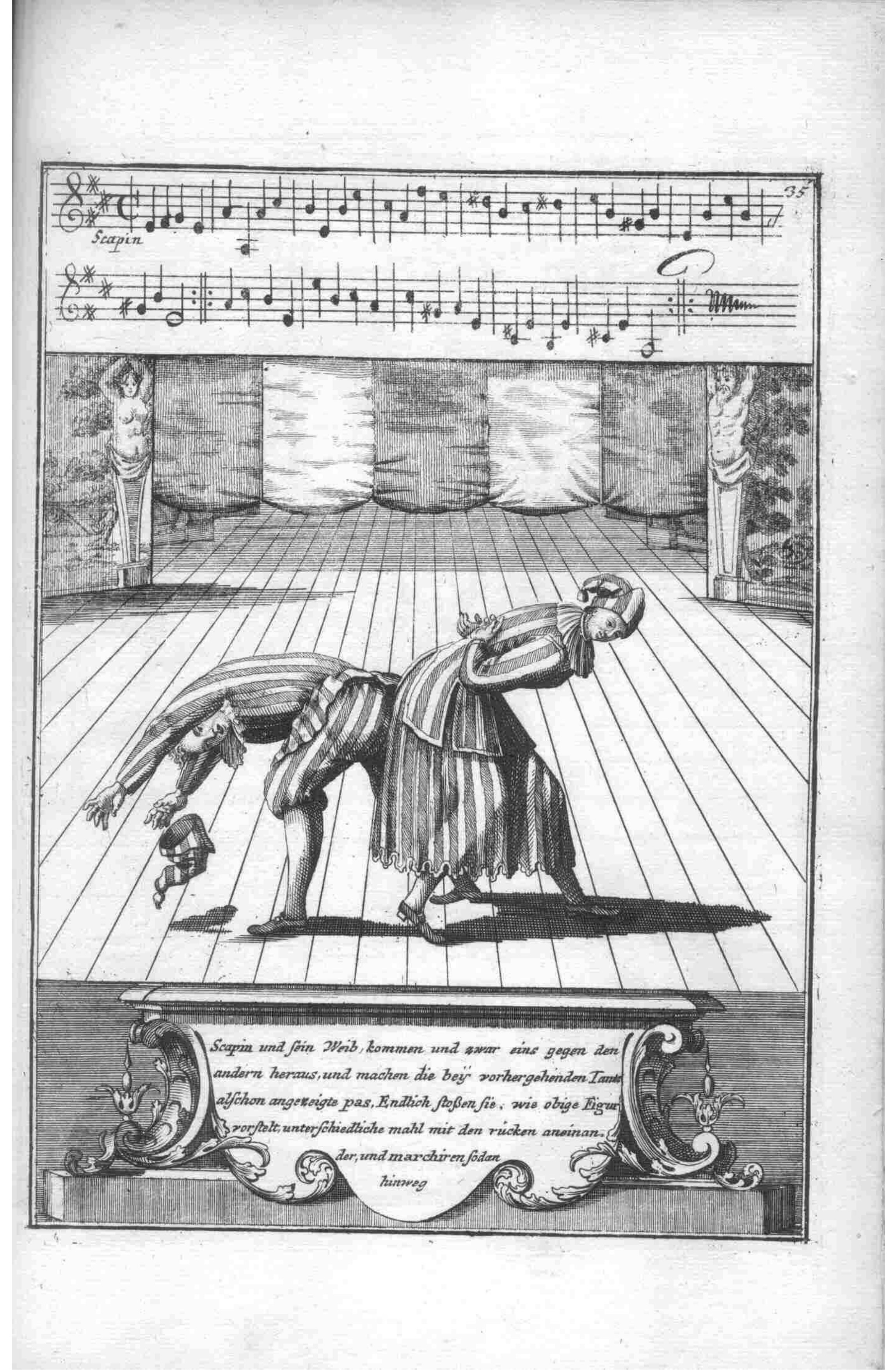
A costumed male dancer occupies the center of a wooden-floored stage framed by draped curtains and flanked by classical columns topped with statuary. He is captured mid-combat, body twisted in a dramatic lunge, with his right arm extended forcefully downward and his torso bent sharply backward, conveying the moment of engaging an invisible opponent or executing a theatrical blow. His costume is striped in dark and light tones with deep folds and pleats falling from his torso; the silhouette is exaggerated and theatrical, typical of 17th-century court dress adapted for stage performance. The setting is rendered in careful linear perspective, with the floorboards receding toward the back wall, establishing a shallow but defined stage space. Musical notation appears at the top of the page in two staves, indicating this moment is set to a specific choreographed piece.
The dancing
A single male figure dominates the composition. His weight is shifted dramatically to one side, with the torso arched and twisted to achieve maximum physical extension and visual impact. The right arm thrusts downward with force while the left appears raised or extended for balance; the legs are positioned in a wide, asymmetrical stance that conveys both attack and instability. The posture is balletic in its attention to line and extension, yet explicitly martial—this is not a courtly processional or minuet position but a moment of aggressive, dynamic action.
The dance depicted
This appears to be a theatrical combat or duel figure from early 18th-century court dance spectacle, likely a short episode within a longer choreographed entertainment rather than a social dance form. The image shows a staged hand-to-hand combat or fighting gesture executed with the precision and exaggeration of court theater. Such combat sequences were common in ballet d'action and theatrical dance narratives of the period, where dramatic pantomime and stylized swordplay or wrestling were incorporated into formal dance. The notation at the top confirms this was a formally composed and taught movement, not improvisation.
How it was made
This is a copper-plate engraving executed with fine lines to create tonal gradation through hatching and cross-hatching, evident in the shading of the costume, the architectural elements, and the stage floor. Engraving allowed precise reproduction and circulation of choreographic and theatrical information in printed manuals and books, making this work a teaching document as much as an artwork. The technique's capacity for fine detail enabled the artist to convey not just the pose but the texture of fabric, the depth of the stage, and the specificity of the moment. As part of a bound manual, it would have reached a literate, aristocratic, or professional audience interested in theatrical dance practice.
About this work
This is plate 34 from Gregorio Lambranzi's *Nuova e curiosa scuola de' balli theatrali* (Nuremberg, 1716), one of the most influential European dance manuals of the early 18th century. The plate pairs musical notation with an engraved image of a theatrical combat pose executed on a stage set, documenting the choreographic vocabulary and dramatic vocabulary of baroque court dance theater. The work is both a piece of visual art and a technical teaching document, preserving in precise detail a specific moment of movement language that would otherwise be lost to history. It belongs in a gallery of dance in art because it shows the exact intersection where formal dance vocabulary, theatrical spectacle, and visual documentation converge, capturing not just what dances looked like but how they were preserved and transmitted.
How to look at it
Observe the dramatic twist and extension of the torso—this is the moment Lambranzi wants the dancer to achieve and hold, a peak of the movement rather than a transition. Notice how the costume and perspective work together: the draped fabric exaggerates the body's geometric lines, while the receding stage floor anchors the figure in theatrical space rather than abstract void. The musical notation at the top reminds us that this frozen moment exists in time and rhythm; this is not a static pose but a beat or phrase within a larger sequence. The energy is centrifugal—the dancer appears to be hurling force outward in multiple directions simultaneously.
The artist
Gregorio Lambranzi was a dancing master and choreographer active in Nuremberg in the early 18th century. His *Nuova e curiosa scuola de' balli theatrali* (New and Curious School of Theatrical Dances), published in 1716, is regarded as one of the most comprehensive and visually detailed dance manuals of the period. The work combines Lambranzi's knowledge of both social and theatrical dance forms with careful notation and engraved illustrations, making it a primary source for understanding baroque performance practice. The manual was republished multiple times and influenced dance pedagogy across Europe.
The period
In the early 18th century, baroque court dance was at a turning point. Social dances like the minuet dominated aristocratic life, but theatrical dance—ballet d'action and dance spectacle—was becoming an increasingly sophisticated art form with its own vocabulary and dramatic ambitions. Combat, mime, and narrative pantomime were being integrated into dance as choreographers sought to tell stories and convey emotion through movement. The period saw the rise of professional dancing masters and the codification of technique; manuals like Lambranzi's were part of an effort to systematize and spread knowledge of both courtly and theatrical dance forms. Engraved instruction manuals were the primary technology for disseminating choreographic knowledge before film or notation systems became standardized.
Where it lives
This plate is from the 1716 Nuremberg edition of Lambranzi's *Nuova e curiosa scuola de' balli theatrali*, a printed dance manual. The work was a commercial publication, suggesting it was intended for a paying readership of dance students, professional performers, and the educated aristocracy interested in theater.
Dance in this work
Questions about this work
Who would have used this manual?
Lambranzi's manual served dancing masters, professional performers, and wealthy amateurs who studied dance as part of courtly education. It bridged social dance and theatrical practice, so it appealed to both ballroom dancers and those interested in theatrical spectacle. The manual was sophisticated and expensive enough to be a luxury item for the educated elite.
What does the musical notation tell us?
The notation at the top of each plate indicates that every movement was set to specific music, confirming that baroque choreography was as precise and composed as any musical score. Dancers learned both the movement and its musical accompaniment together; they were not improvising to generic rhythms but executing a fully notated piece.
Is this a real person or a generic demonstration?
The figure is a generic demonstration of a choreographic principle or movement phrase. Lambranzi may have drawn from live dancers or his own experience, but the aim was to capture the *movement itself*, not to document a specific performer or performance. The carefully controlled pose and theatrical setting emphasize the teachability and repeatability of the form.
What makes this different from a painting?
Engraving allowed Lambranzi to produce multiple identical copies that could be bound into books and distributed widely. Unlike a unique painting, a printed manual was designed to reach and instruct many dancers. The engraving's precision also made it easier to capture fine details of line and anatomy that would be essential to a dancing master studying the work.
More Notation/Choreography artwork