49 works in this view — arrow keys or swipe to move between them.
Dance in Art
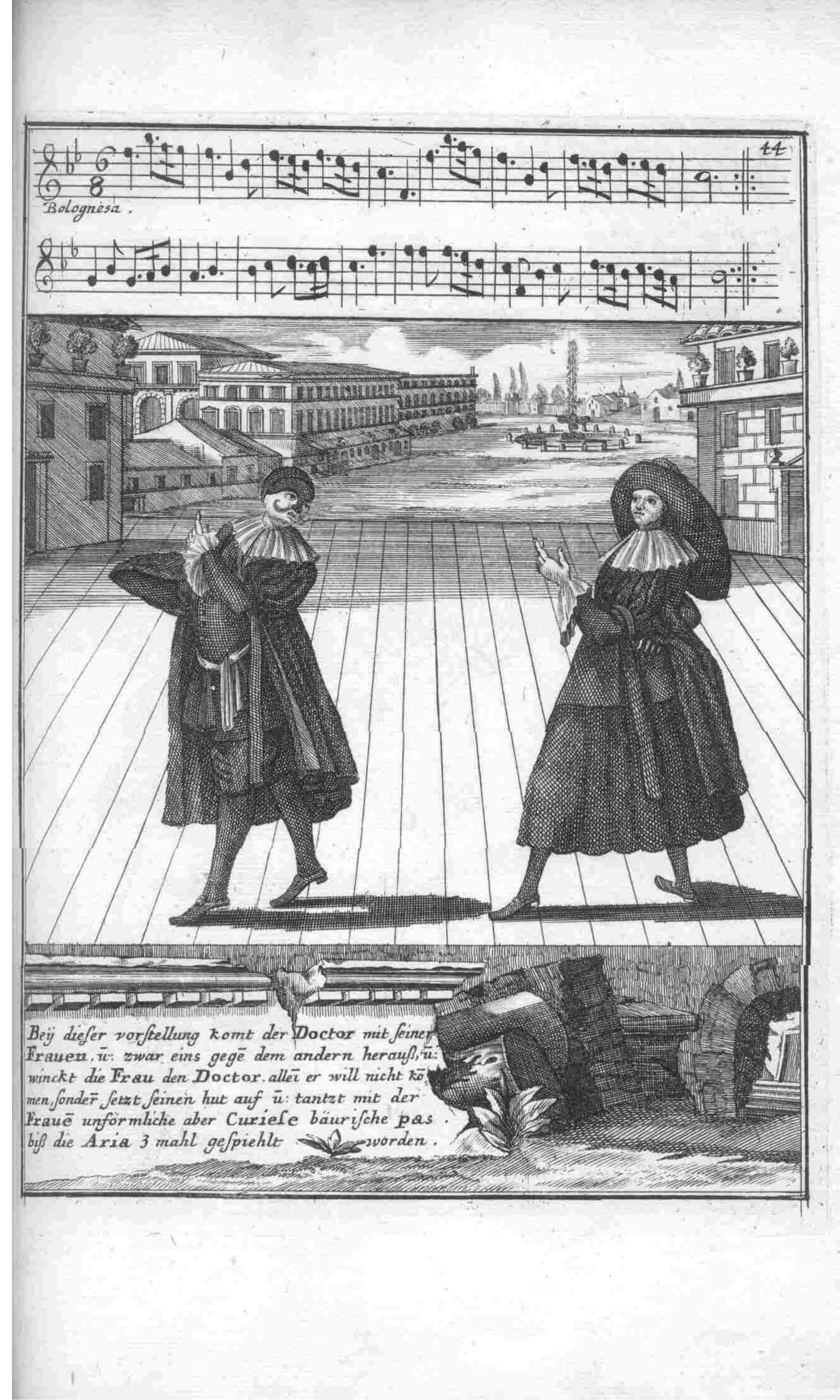
Courtly Couple — Plate 43
Gregorio Lambranzi
- Medium:
- Copper-plate engraving
- Dance:
- Notation/Choreography
- Era:
- 1700s (Enlightenment/Minuet Era)
- Collection:
- Nuova e curiosa scuola de' balli theatrali (1716)
- Source:
- Library of Congress
- Rights:
- Public domain — free to use, share and adapt.
- Recorded as:
- Public Domain
Lambranzi's plates are among the few surviving engraved documents that show us the full-body posture, dress, and partnering conventions of baroque theatrical dance; most contemporary dance notation records only footwork or arm direction, not the visual impression of the performed body. For scholars of dance history, costume history, and court life, these images are irreplaceable primary evidence of how dancers actually looked and held themselves on stage.
What you are looking at
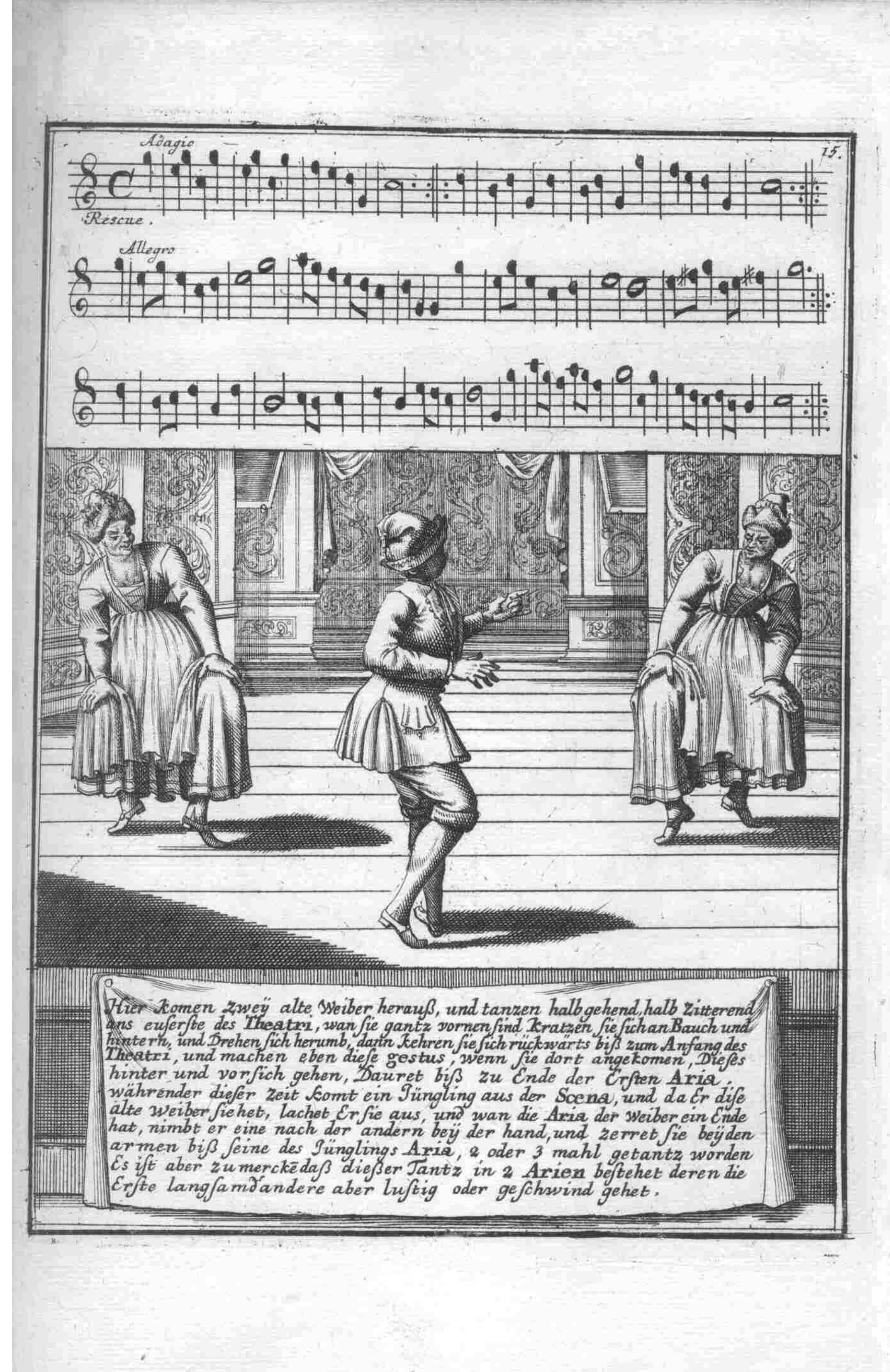
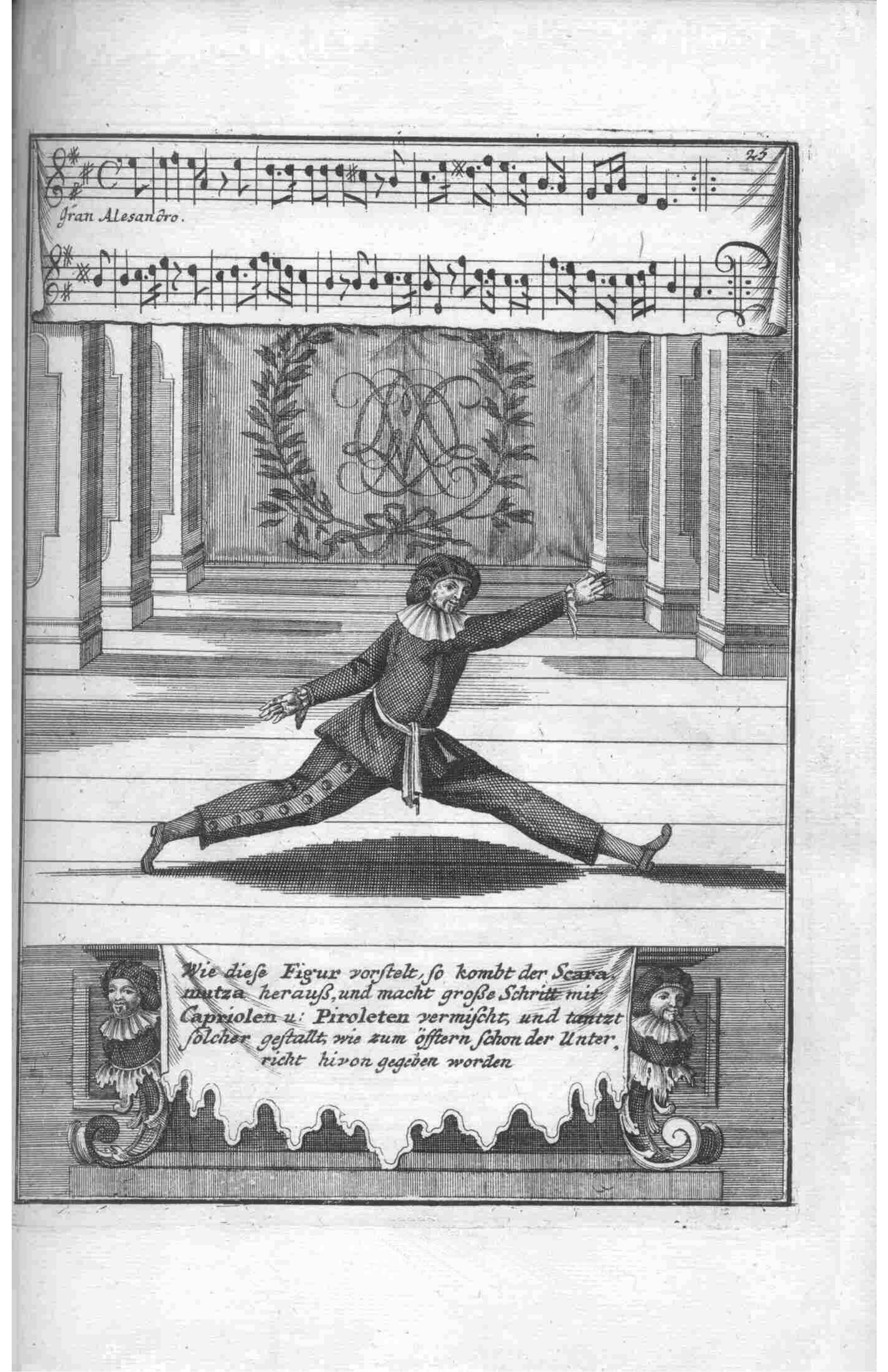
Two figures in formal early-18th-century dress face each other on a wooden stage, mirroring one another's poses. The woman on the left wears a dark patterned dress with a high ruffled collar and headdress; the man on the right, similarly attired, stands in a corresponding position. Both have their bodies angled slightly, one arm extended or gestured expressively. Behind them stretches a theatrical backdrop depicting a grand Renaissance palazzo with a central courtyard, colonnades, and a formal plaza where small figures gather—a perspective view typical of court theater design. The immediate stage floor is rendered in clear linear planks receding toward the backdrop. Music notation at the top of the plate identifies the piece, with a German caption below offering narrative context for the scene. The engraving's precise line-work and careful attention to architectural detail establish this as a didactic plate from a dance manual rather than a spontaneous performance document.
The dancing
Both figures stand in a formal upright posture with their weight evenly distributed. Their arms are raised and gestures are symmetrical and mirrored—each performer echoes the other's position, creating a bilateral composition. The positioning suggests a moment of social interaction or courtly salutation rather than active traveling steps; the bodies are frontal or near-frontal to the viewer, with heads held high and the elaborate dress—stiff collars and heavy fabrics—prominent. Neither figure appears to be mid-step or caught in a traveling movement; instead, they occupy a posed, almost sculptural stillness that emphasizes deportment and presentation.
The dance depicted
This plate illustrates a courtly dance, most likely a minuet or a formal processional/bransle-style suite typical of German-speaking court theaters in the early 1700s. The bilateral mirroring and symmetrical pose are characteristic of baroque court dance pedagogy, in which partners or matched couples demonstrated the 'positions' or 'attitudes' that constituted proper deportment. The formal dress, stage setting, and the inclusion of music notation all confirm this is a theatrical dance meant for aristocratic or court performance. The specific narrative or title is embedded in the German verse below the engraving, which the notation references; the dance likely had a dramatic or allegorical content beyond simple figures.
How it was made
This is a copper-plate engraving, a technique requiring the incision of fine lines into a copper surface to hold ink and transfer the image to paper. The precision visible in the architectural background, the fine parallel hatching that models the costumes' texture, and the clarity of the notation all demonstrate the engraver's skill and the medium's capacity for detail and legibility. Engraving was the standard method for reproducible dance instruction in this period, allowing multiple impressions to circulate among courts and households. The technique's relative durability and the care taken here indicate this plate was made for a substantial, carefully produced publication intended for a educated audience.
About this work
This is one of the 114 numbered plates from Gregorio Lambranzi's *Nuova e curiosa scuola de' balli theatrali* (Nuremberg, 1716), an illustrated choreographic manual that documented theatrical dance practice in the German-speaking world of the early Enlightenment. Each plate pairs a notated music excerpt with engraved figures demonstrating a specific dance scene or suite, making the publication one of the era's most important visual records of how baroque court dances were actually performed and taught. Lambranzi's work bridges the notation systems of earlier dance manuals (like Feuillet's *Chorégraphie*, 1700) and the theatrical conventions of his time, offering dance historians direct evidence of posture, partnering, costume, and stage design in early-18th-century German theater.
How to look at it
Attend to the mirrored posture and the stillness of the bodies—this is not an action photograph but a frozen 'attitude' or position meant to teach proper carriage and alignment. The heavy, stiff fabrics of the dress (especially the high ruffles) are not incidental; they constrain and define the body's range and shape the visual line the dancer presents. The architectural backdrop is not mere decoration but part of the performance: the formal palazzo asserts the courtly context and grandeur expected of the dance. The notation at the top is not illustrative but integral—it specifies the precise music and time, allowing a reader with knowledge of notation to reconstruct the movement sequence.
The artist
Gregorio Lambranzi (c. 1675–after 1730) was an Italian dancer, choreographer, and librettist active in the German courts, especially Nuremberg. He was master of ceremonies and chief choreographer at the court of the Margrave of Ansbach and compiled his manual as a comprehensive record of both ballroom and theatrical dance practice. The *Nuova e curiosa scuola* was his major work and remained influential throughout the 18th century; it was reprinted and translated, and is one of the few dance manuals of the baroque era to combine notation, engraved figures, costume detail, and dramatic context.
The period
In the early 1700s, baroque court dance was at a peak of formalization and theatrical elaboration. The minuet had become the dominant court dance across Europe, while theatrical dance in German courts often drew on French models (Lully, Beauchamp) and Italian innovations. Notation systems—particularly Feuillet's system, published in Paris in 1700—had recently made it possible to record and transmit choreography in print. Lambranzi's manual arrived during this moment of codification and was part of a wave of published dance instruction (by Kellom Tomlinson, Pierre Rameau, and others) that helped standardize baroque dance practice across courts. The theatrical setting and allegorical content of his scenes also reflect the influence of opera and court ballet on ballroom and ceremonial dance.
Where it lives
This plate comes from *Nuova e curiosa scuola de' balli theatrali*, a two-volume illustrated dance manual published in Nuremberg in 1716. The work is part of the Library of Congress collection. Plates from this edition are widely held in major research libraries and digital collections; this particular impression's provenance within LODance is recorded separately.
Dance in this work
Questions about this work
What is the music notation at the top?
The notated lines show the melody and rhythm of the dance suite this plate illustrates. A trained dancer of the period, reading both Feuillet notation (recorded in the scene) and standard music notation, would be able to perform the choreography to the correct music. The notation confirms this is a specific, documented composition, not a generic example.
Why are the two figures identical and mirrored?
In baroque court dance, symmetry was an ideal. Matching partners or dancers demonstrated 'positions' in unison or alternation, showing proper form and deportment. This bilateral composition was both pedagogically useful (the learner could imitate the image) and aesthetically pleasing, reflecting courtly values of order and symmetry.
What does the German text at the bottom say?
The caption is a narrative verse describing the dramatic or allegorical scenario the dance enacts. In this plate, the verse context would explain the characters and situation; the notation and engraved figures then show how that scene was danced. Many of Lambranzi's dances had amorous or dramatic themes.
How was this engraving used?
The manual was expensive and aimed at dance masters, court choreographers, and wealthy amateurs. An owner could study the plates, consult the notation, and attempt to learn or teach the dances; the images also served as a reference for costume, makeup, and stage design when performing theatrical dances at court.
More Notation/Choreography artwork