49 works in this view — arrow keys or swipe to move between them.
Dance in Art
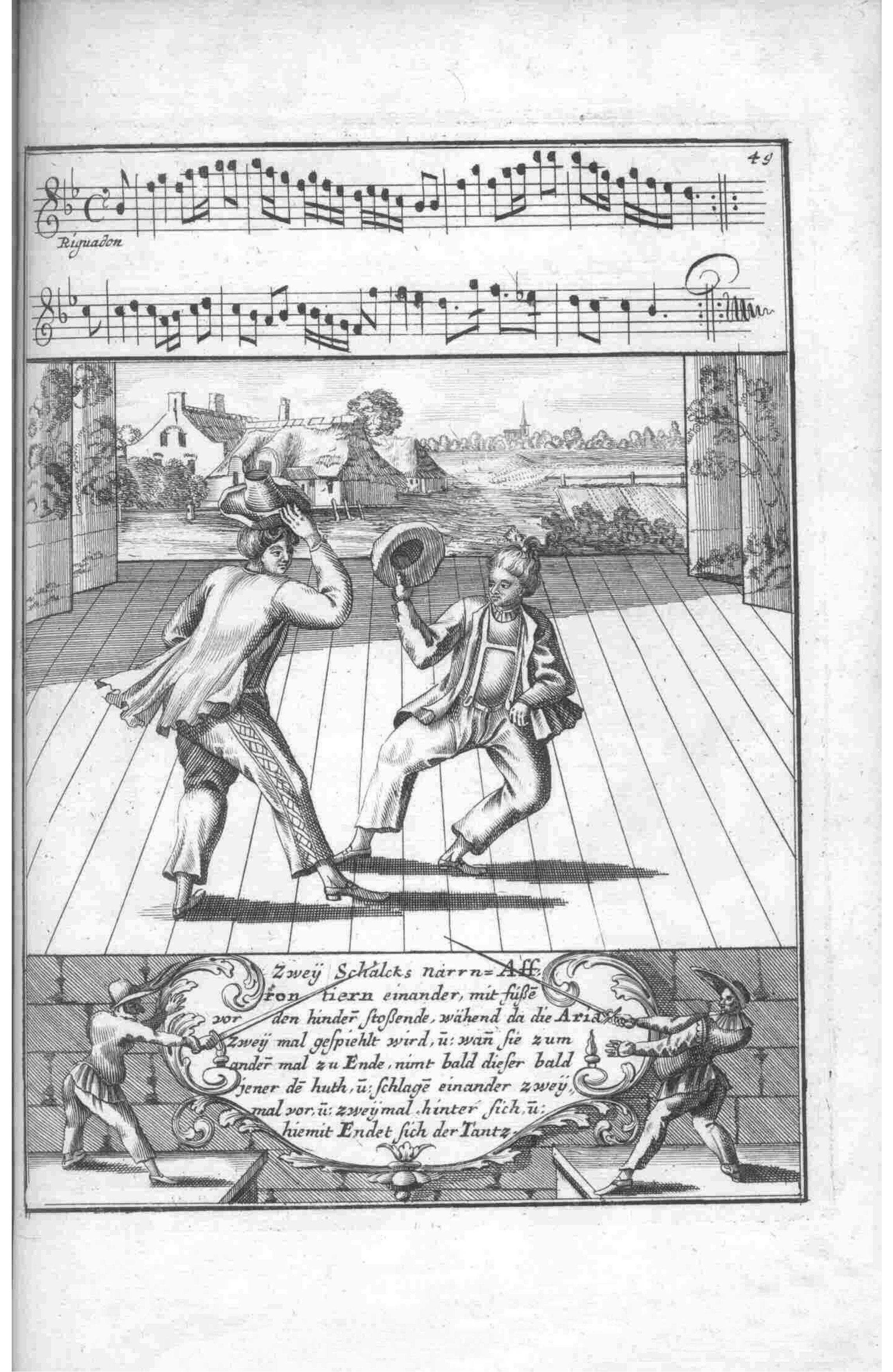
Combat/Duel — Plate 48
Gregorio Lambranzi
- Medium:
- Copper-plate engraving
- Dance:
- Notation/Choreography
- Era:
- 1700s (Enlightenment/Minuet Era)
- Collection:
- Nuova e curiosa scuola de' balli theatrali (1716)
- Source:
- Library of Congress
- Rights:
- Public domain — free to use, share and adapt.
- Recorded as:
- Public Domain
Lambranzi's manual is one of the few surviving visual and musical records of how professional stage dances were actually choreographed and performed in the early 18th century. The pairing of notation with image shows how choreographic knowledge was transmitted before video, and this particular plate reveals that combat—a central element of theatre from Shakespeare to opera—was conceived as formalized dance rather than realistic action. For dance historians and performers, this is a primary source for understanding the physicality and spatial organization of pre-classical theatrical movement.
What you are looking at
Two figures enact a stylized combat or duel on a wooden stage, framed by heavy curtains and opening onto a distant landscape. The figure on the left, dressed in a long coat with one arm raised high holding what appears to be a stick or sword, leans backward in an exaggerated defensive posture. The figure on the right, in similar period dress, stands lower and more forward, also armed and in an attacking stance. Both wear the formal dress of early 18th-century theatre—long coats, breeches, and period hats. The stage floor is rendered in perspective with bold parallel lines; beyond the curtains, a pastoral vista with buildings and water recedes into the distance. The engraving style is clean and linear, with fine cross-hatching for shadow and volume. Above the scene, two systems of musical notation labeled "Ripuazione" show the melody that accompanied this choreography.
The dancing
Two male figures face each other across the stage in clear opposition. The left figure's weight is back on his rear leg, his torso twisted, his raised arm extended upward and away from his body in a high defensive or parrying position. The right figure lunges forward on a bent front leg, his arm extended toward his opponent in an attacking gesture. Both maintain an upright carriage despite the action—a formal, controlled quality even in combat. The spacing between them is measured and deliberate rather than chaotic, suggesting choreographed rather than realistic fighting.
The dance depicted
This is a scene from theatrical dance combat of the early 18th century, most likely from the Commedia dell'arte or operatic tradition, where duels and sword fights were integrated into dramatic action. The engraving comes from Lambranzi's *Nuova e curiosa scuola de' balli theatrali*, a manual that documented dances for the professional stage. The choreography shown here emphasizes posture, arm extension, and spatial relationship over actual violence; the high arm position of the attacking figure and the exaggerated backward lean of the defending figure are theatrical conventions designed for visibility and aesthetic effect. This represents the formalized, dance-like quality of stage combat before modern fight choreography.
How it was made
Copper-plate engraving, a technique that allows for fine linear detail and wide reproduction. Each plate pairs musical notation with a single choreographic moment rendered from a three-quarter view that clearly shows the performers' positions and the stage space. The engraving technique ensured that Lambranzi's manual could be widely distributed and read by theatre practitioners across Europe, making it a key document of early 18th-century dance pedagogy. The precision of the medium matches the manual's aim: to preserve and transmit specific choreographic sequences through image and notation together.
About this work
This is Plate 48 from Gregorio Lambranzi's 1716 *Nuova e curiosa scuola de' balli theatrali*, one of the most important choreographic manuals of the early 18th century. The plate documents a theatrical duel choreographed to a specific melody, presented through both musical notation and an engraved stage scene. Lambranzi's work recorded dances for professional performers, drawing on the traditions of Italian theatre and the emerging vocabulary of formal stage movement. This combat sequence exemplifies how the Baroque stage integrated dance principles into dramatic action—movement that is highly stylized, geometrically organized, and synchronized to music rather than mimetic of real fighting.
How to look at it
Notice the moment the artist chose: not the clash itself, but the instant of opposition—one figure attacking, one defending, both in exaggerated postures that prioritize visibility and formal beauty over realism. The raised arm of the left figure creates a vertical line; the lunging leg of the right creates a diagonal. These geometric relationships are what make the combat legible from a theatre audience's distance. The musical notation at the top reminds us that this movement was timed and phrased to a specific melody, not free-form action. The formal stage setting and curtains frame this as theatre, not street fighting—a performance of combat, not combat itself.
The artist
Gregorio Lambranzi was an Italian dancer and choreographer active in the early 18th century. His *Nuova e curiosa scuola de' balli theatrali* (New and Curious School of Theatrical Dances), published in Nuremberg in 1716 with illustrations by Christoph Weigel, documented approximately 110 choreographed scenes for the professional stage. Lambranzi drew on the traditions of Italian Commedia dell'arte and emerging formal dance technique. The manual was one of the first systematic attempts to preserve stage choreography through the combination of image and notation, making it a foundational document for understanding early 18th-century theatre dance.
The period
The early 18th century was a moment of codification in European dance. The minuet was crystallizing as the dominant social dance, and formal technique was being systematized—Pierre Beauchamp's five positions of the feet had been established in France in the previous century. On the theatrical stage, dances were becoming increasingly integrated into dramatic narratives, particularly in opera and Commedia dell'arte. Lambranzi's manual appeared at a moment when theatre dance was gaining status as a teachable, transmissible art form worthy of preservation. Combat choreography was a prestigious skill; duels and fights were central to dramatic action, and staging them as stylized movement rather than chaotic violence required both training and aesthetic judgment.
Where it lives
This engraving is one plate from Lambranzi's *Nuova e curiosa scuola de' balli theatrali* (Nuremberg, 1716), held by the Library of Congress. The work was published as a printed manual, making it a commercial product intended for a wide audience of theatre practitioners and perhaps educated amateurs interested in dance and theatrical practice.
Dance in this work
Questions about this work
Is this an actual duel or a choreographed dance?
It is choreographed. Lambranzi's manual documents theatrical dances, and this combat is styled as formalized, geometric movement synchronized to music. The exaggerated postures, clear spatial relationship, and accompanying musical notation all indicate this is a staged, rehearsed sequence designed for theatrical effect rather than realistic fighting. The high arm positions and extended lines are aesthetic choices, not practical sword technique.
What style of dance is this?
This is theatrical dance from the early 18th century, likely influenced by Italian Commedia dell'arte and operatic traditions. It combines elements of balletic technique (upright carriage, extended lines, formal positions) with dramatic action. It is not yet ballet in the 19th-century sense, but professional stage dance of the Baroque era.
Why is there music notation at the top?
Choreography in the 18th century was inseparable from music. The notation shows the melody that accompanied this sequence, indicating that the dancers' movements were timed and phrased to the music. This was essential information for any performer trying to learn and reproduce the choreography.
Who was Lambranzi and why does his manual matter?
Lambranzi was an early 18th-century Italian dancer and choreographer. His 1716 manual is one of the only surviving visual records of how professional stage dances were choreographed and performed before the development of modern notation systems. It provides primary source evidence for the movement vocabulary, spatial organization, and aesthetic principles of early 18th-century theatre dance.
More Notation/Choreography artwork