49 works in this view — arrow keys or swipe to move between them.
Dance in Art
Acrobatic — Plate 49
Gregorio Lambranzi
- Medium:
- Copper-plate engraving
- Dance:
- Notation/Choreography
- Era:
- 1700s (Enlightenment/Minuet Era)
- Collection:
- Nuova e curiosa scuola de' balli theatrali (1716)
- Source:
- Library of Congress
- Rights:
- Public domain — free to use, share and adapt.
- Recorded as:
- Public Domain
This image is one of the few surviving detailed visual records of acrobatic dance practice in the early 18th century, showing exactly what theatrical bodies were expected to do and how movement was notated for transmission. Lambranzi's *scuola* is the most complete surviving manual of this era's stage dance vocabulary and remains essential to understanding what dancers trained in and what audiences expected to see in theater.
What you are looking at
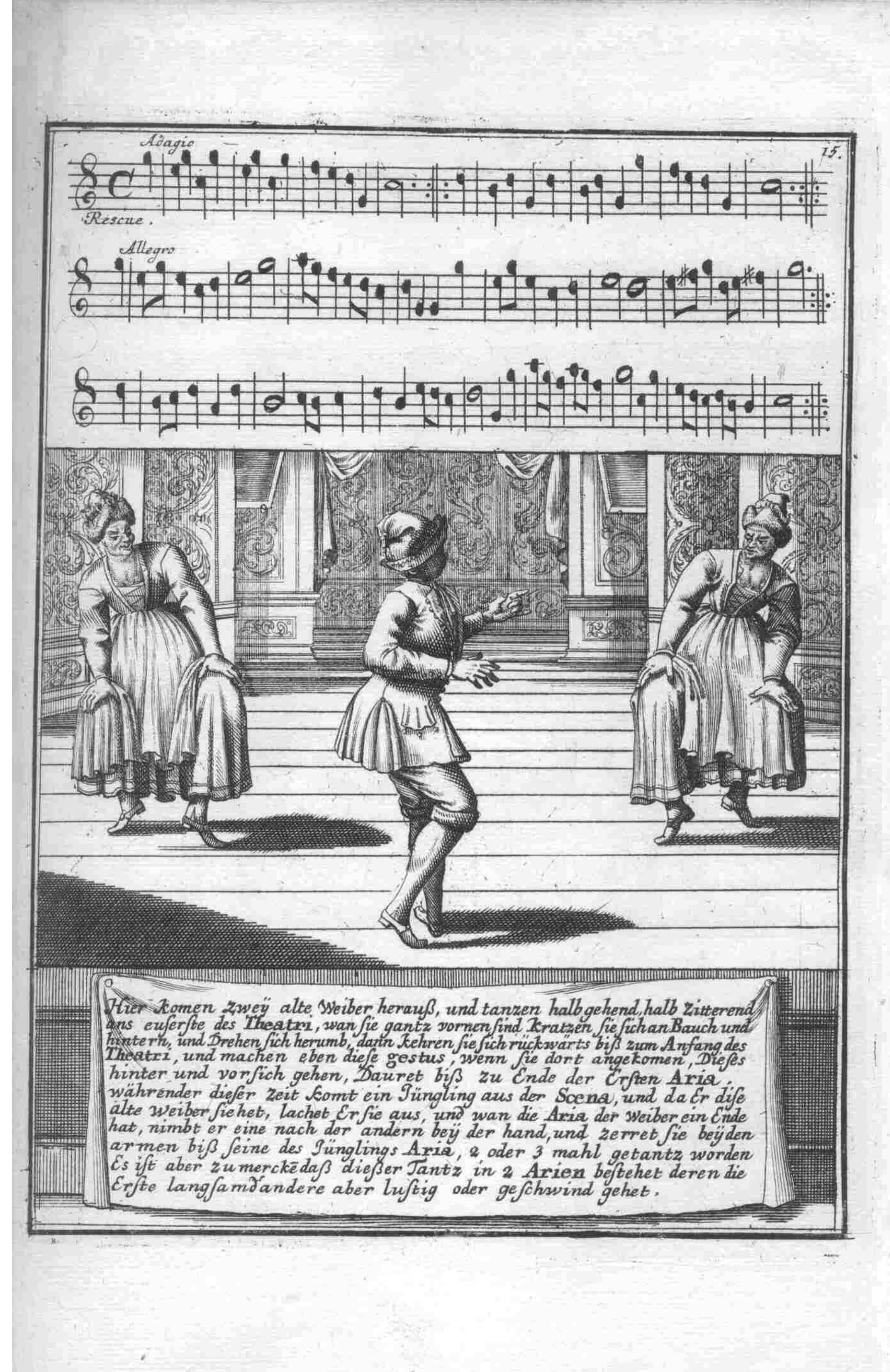
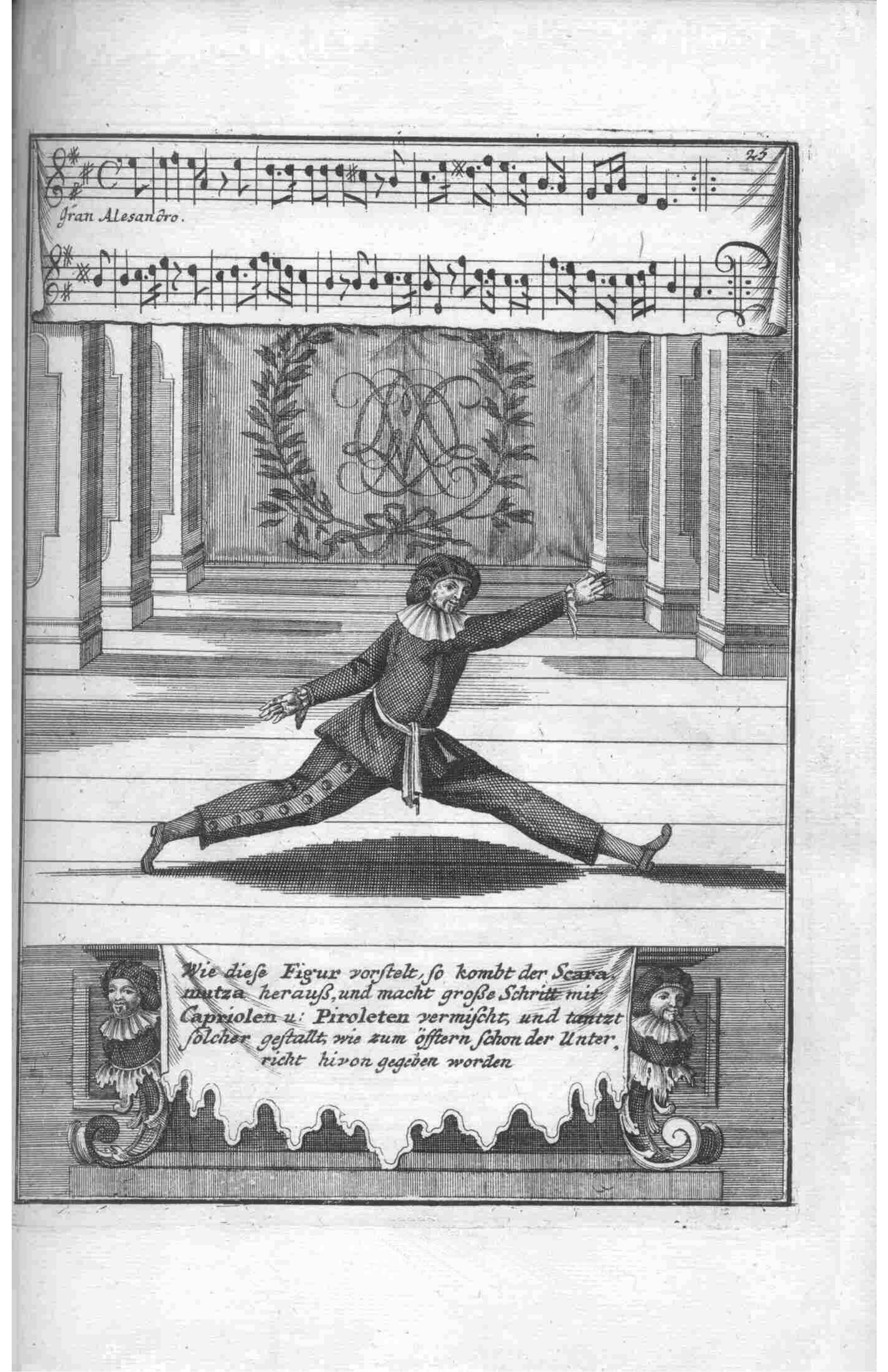
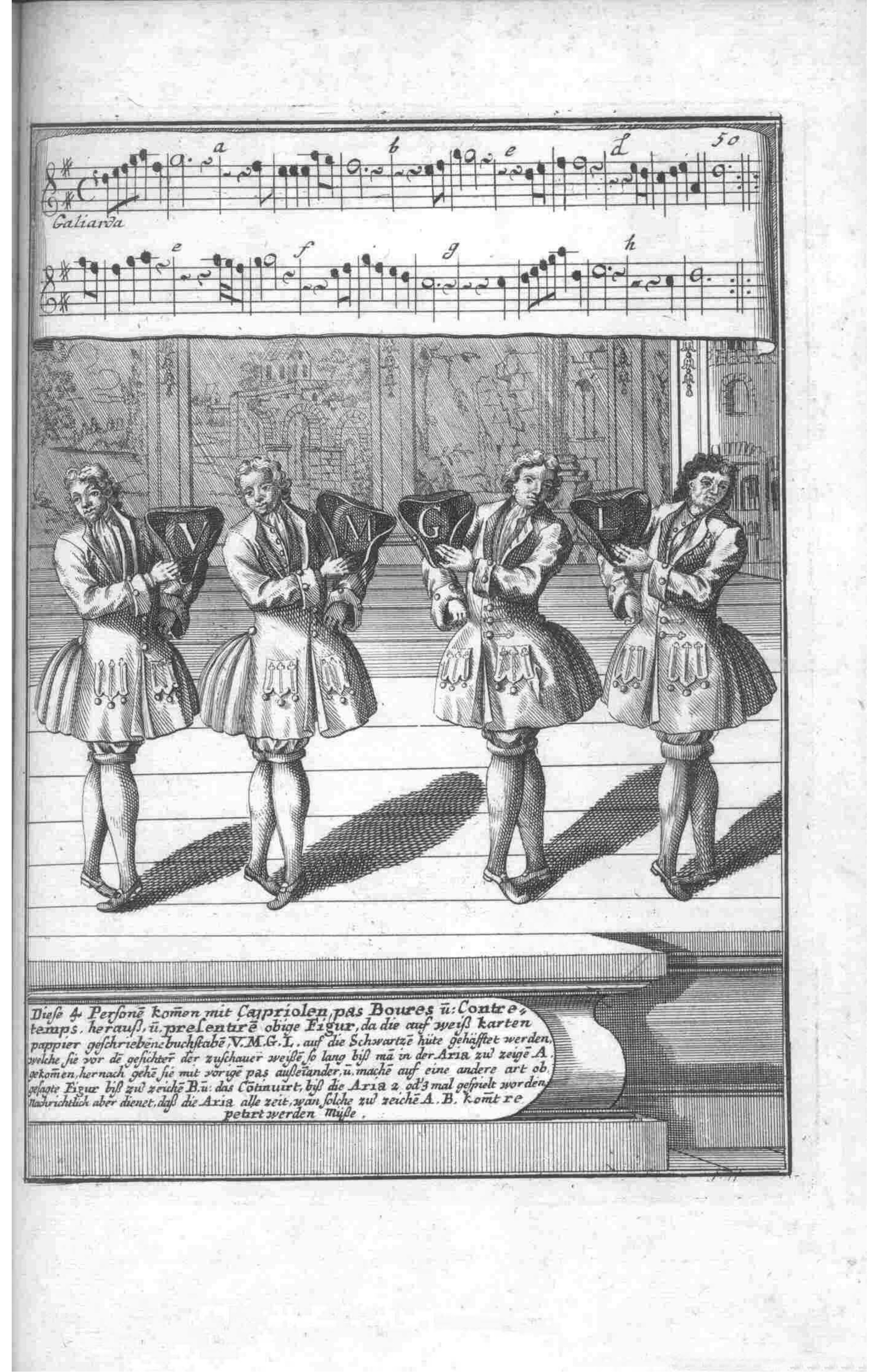
Four male dancers in theatrical costume stand in a line across a curtained stage, each in an identical pose of acrobatic tension. They wear short pleated skirts decorated with ornamental trim, fitted vests or jackets, and white stockings; their hair is curled in the fashion of the early 18th century. Each figure leans backward sharply from the waist, supporting himself on one leg while the other extends forward at an acute angle, arms bent and held away from the body in a position of controlled strain. The stage is shallow and formal, bounded by draped curtains on either side. The engraving is precise and finely detailed, with careful cross-hatching to render volume and shadow in the figures' limbs and torsos. The composition emphasizes symmetry and the geometric clarity of the acrobatic line—the repeated posture transforms individual virtuosity into a unified, almost architectural group figure.
The dancing
Each dancer stands in a deep backward lean, the torso arched and the weight concentrated on a single supporting leg. The free leg thrusts forward horizontally, knee straight, while both arms are raised and bent, creating a frame that balances the backward extension of the body. The pose demands considerable core strength and flexibility; the dancers are evidently trained acrobats capable of holding this extreme hyperextended position. The uniformity of the four figures—identical costume, identical pose, identical spacing—suggests this is a synchronized group number rather than four independent soloists.
The dance depicted
This is a theatrical acrobatic or contortion piece, part of the vocabulary of early 18th-century stage dance. The plate belongs to Lambranzi's *Nuova e curiosa scuola de' balli theatrali*, the most comprehensive manual of theatrical dancing and acrobatics of its era. Lambranzi documents not only courtly minuets and formal dances but also the virtuosic physical feats—tumbling, contortion, lifting, and extreme flexibility—that formed part of theatrical spectacle and were taught alongside conventional dance. This particular figure would have appeared in a theatrical context, likely in a comedy or spectacular intermezzo, executed by trained male performers.
How it was made
Copper-plate engraving, a technique that allowed for fine linear detail and precise reproduction. The engraving's clarity and small scale made it suitable for binding into a manual or treatise, circulating among dance masters, choreographers, and theater practitioners across Europe. The combination of notated music at the top and the engraved figure below follows the format of the entire *scuola*: each plate pairs a musical phrase with its corresponding movement, creating a kind of choreographic score. The technique's precision also allowed Lambranzi to render the subtle weight distribution and musculature required for the pose.
About this work
This is a plate from Gregorio Lambranzi's *Nuova e curiosa scuola de' balli theatrali* (Nuremberg, 1716), one of the foundational documents of early modern theatrical dance. The work documents an acrobatic group figure—four dancers in a synchronized hyperextended pose—and pairs it with musical notation at the top of the plate. The *scuola* is remarkable for treating acrobatics, tumbling, and extreme flexibility as legitimate parts of the theatrical dance vocabulary, worthy of systematic notation and instruction. This plate demonstrates the physical virtuosity expected of male theatrical dancers in the period and the integration of acrobatic feats into formal stage spectacle.
How to look at it
Attend to the precision of the pose: the angle of the backward lean, the exact height of the extended leg, the positioning of the arms, the distribution of weight onto a single supporting leg. The artist has captured a moment of controlled tension, not a moment of transition. The symmetry and repetition across four figures suggest that this is meant to be read as a choreographic unit—a formation or ensemble figure—rather than four separate dancers. The musical notation at the top indicates that this movement was synchronized to a specific musical phrase, making this a marriage of movement and music that would be transmitted from choreographer to dancer through the manual.
The artist
Gregorio Lambranzi (fl. 1716) was an Italian or German dancer and choreographer active in the early 18th century. He is known almost exclusively through the *Nuova e curiosa scuola de' balli theatrali*, published in Nuremberg in 1716 in both Italian and German editions. The work contains approximately 50 engraved plates, each showing a dancer or group of dancers in a specific figure or movement, paired with musical notation. Lambranzi's systematic approach to documenting theatrical dance—treating acrobatics, tumbling, and extreme flexibility alongside courtly dances and character dances—makes the *scuola* a unique and invaluable record of early 18th-century stage practice. Little is known of his life beyond the manual itself.
The period
The early 18th century was a period of transition in theatrical dance. The court ballets of the 17th century were giving way to more specialized theatrical spectacle, in which male and female dancers performed in operas, comedies, and intermezzi. Acrobatic and tumbling feats had long been part of theater, but Lambranzi's manual is the first to systematically document them alongside other dance vocabularies. The period saw increasing professionalization of dance, formalization of technique, and growing distinction between courtly social dance and theatrical spectacle. Male dancers in particular were valued for physical virtuosity and strength—the ability to tumble, lift, and perform extreme flexibility feats was a mark of professional status. The *scuola* also reflects the broader European circulation of dance knowledge through printed manuals and engravings, a practice that had begun with Arbeau's *Orchésographie* in 1589 and would accelerate through the 18th century.
Where it lives
This plate is from the *Nuova e curiosa scuola de' balli theatrali* (Nuremberg, 1716), a two-volume illustrated manual of theatrical dance published simultaneously in Italian and German editions. The work consists of engraved plates paired with brief descriptions and musical notation, intended as an instructional text for dance masters and performers.
Dance in this work
Questions about this work
What is an acrobatic pose like this doing in a dance manual?
In the early 18th century, theatrical dance was much broader than what we now call dance. Male theatrical performers were expected to be skilled acrobats, tumblers, and contortionists; these feats were spectacular crowd-pleasers and demonstrations of virtuosity. Lambranzi's manual treats them as legitimate parts of the choreographer's vocabulary, to be notated and taught alongside minuets and character dances. This work was typically performed in comedy, farce, or spectacular intermezzi rather than in serious opera, but it was a regular part of professional theater.
How do we know this was actually performed?
Lambranzi's manual is the only surviving systematic notation of its kind from this era, so we cannot directly compare his descriptions to other sources. However, acrobatic feats and tumbling are widely documented in theater histories, contracts, and descriptions of 17th- and 18th-century spectacle. The fact that Lambranzi devotes roughly half his manual to acrobatics and tumbling suggests these were common and valued skills. The level of detail in his drawings—the precise angles, the attention to balance and weight—suggests he was recording actual practice rather than inventing fantasy.
Why are all four dancers doing exactly the same thing?
The synchronized group figure was a staple of theatrical spectacle. Repetition and symmetry created visual impact and demonstrated the control and precision of the dancers. It also served a practical function in theater: a formation that could be repeated allowed the choreographer to fill stage space and create impressive visual effects with trained performers. This kind of geometric, repetitive grouping would have been used in corps de ballet work in opera as well as in independent acrobatic numbers.
Is this the same as modern acro dance?
Not quite. Modern acro dance emphasizes partner lifts, tumbling sequences, and continuous movement. This pose is a held, static figure—a feat of strength and flexibility frozen in time. It is closer to what we might now call contortion or extreme flexibility performance, though in a theatrical context. The purpose is similar: to astonish the audience with what a trained body can do.
More Notation/Choreography artwork