49 works in this view — arrow keys or swipe to move between them.
Dance in Art
Solo Dancer — Plate 57
Gregorio Lambranzi
- Medium:
- Copper-plate engraving
- Dance:
- Notation/Choreography
- Era:
- 1700s (Enlightenment/Minuet Era)
- Collection:
- Nuova e curiosa scuola de' balli theatrali (1716)
- Source:
- Library of Congress
- Rights:
- Public domain — free to use, share and adapt.
- Recorded as:
- Public Domain
Lambranzi's *scuola* is one of the few printed visual records of how professional dancers actually moved and posed in the early 18th-century theater, before the rise of ballet as a codified art form. The image shows that theatrical dance of this period combined courtly nobility with dramatic gesture and character—and that male dancers routinely performed solos with props and allegorical meaning, a practice later eclipsed by the focus on female ballet dancers.
What you are looking at
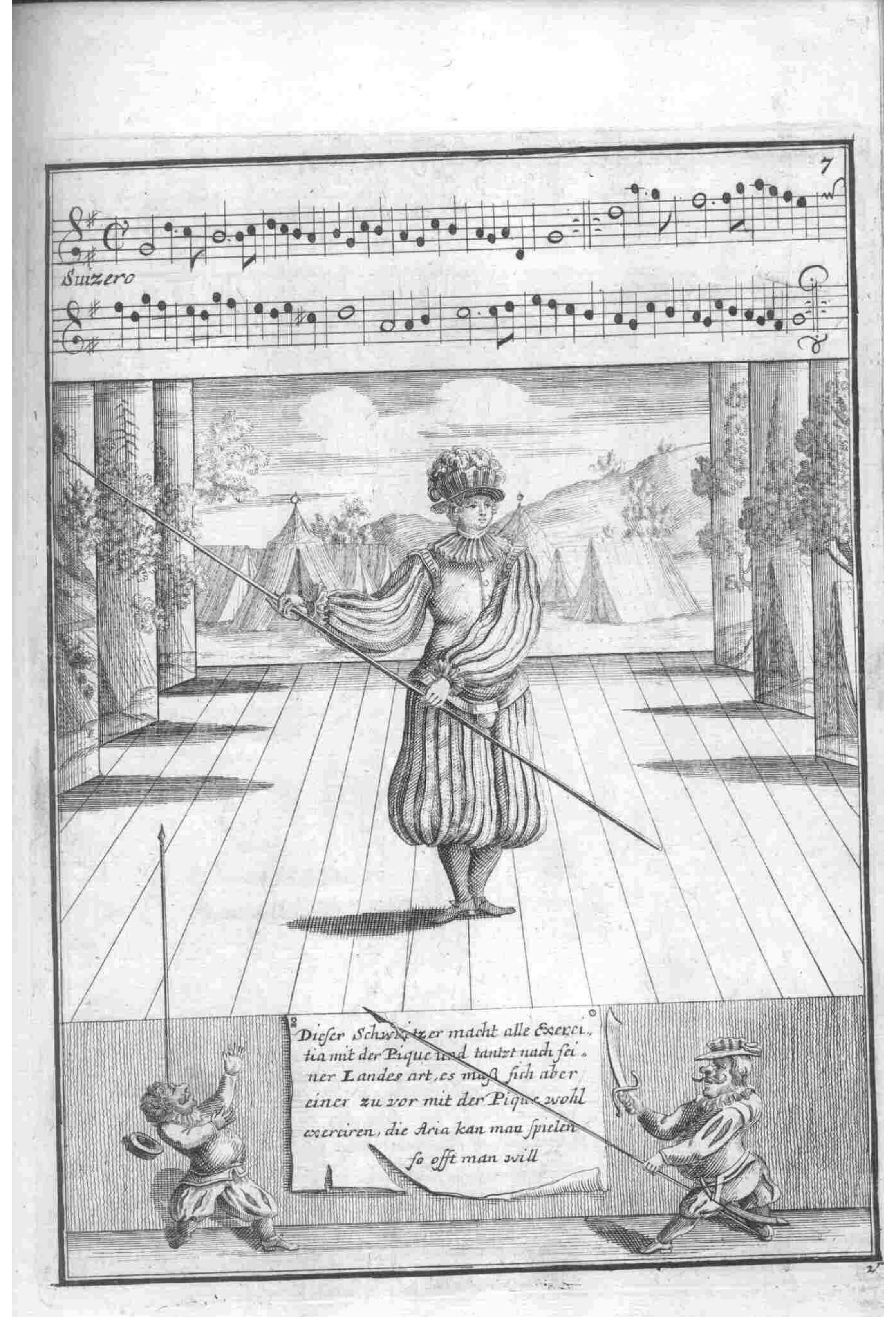
A solo male dancer stands center stage on a wooden floor beneath an ornate proscenium arch, framed by tall curtains that open onto a distant landscape with military tents. The figure wears early 18th-century theatrical costume: a heavily puffed and pleated tunic in the manner of court dress, with elaborate drapery, a high feathered headdress, and ornamental collar. His right arm extends diagonally upward holding a long pike or lance; his left arm gestures expressively outward. The pose suggests vigorous action—the body is in three-quarter view with weight shifted, suggesting forward momentum or a lunging movement. The stage is formally lit and geometrically rendered, emphasizing theatrical illusionism. Below the stage, two putti (cherub figures) flank a cartouche containing German verse printed in italics, a typical design element of early dance manuals. Above the scene sits notated musical staff with two melodic lines marked *Suzzero*, indicating the music accompanying this choreography.
The dancing
The dancer's frame is open and expansive, with the torso upright and the weight on the balls of the feet in a stance suggesting readiness and control. The raised pike arm follows a diagonal line from hip to above the head, creating vertical emphasis; the opposite arm sweeps forward at shoulder height with an open palm, suggesting noble bearing and courtly deportment. The legs are not fully visible but the posture implies the dancer is on or near the toes, a hallmark of elevated Baroque technique. The single figure and the weapon—unusual in court dance—suggest this is a theatrical or allegorical solo rather than a social danza.
The dance depicted
This is almost certainly a theatrical solo from the early 18th-century *ballo* or *balletto teatrale* tradition—a form of court-derived theatrical dance performed by professional or court dancers on the stage rather than in the ballroom. The presence of the pike and the military camp in the background suggest this is likely part of an allegorical or martial-themed dance-drama, possibly celebrating a victory or noble virtue. The expressive arm gestures and the formal stage setting indicate this is a demonstration of noble bearing (*nobiltà*) and controlled virtuosity rather than a social partner dance. The notated music and the precise pose freeze a moment of dynamic action, characteristic of how Lambranzi's manual documented theatrical choreography for repertorial study and transmission.
How it was made
This is a copper-plate engraving, a medium that allowed fine linear detail and wide circulation in printed form. The engraver has used parallel line-work (*hatching*) to suggest volume, shadow, and texture—visible in the rendering of the tunic's pleats, the feathered headdress, and the stage curtains. Engraving was the standard reproductive technique for dance manuals in this period, permitting precise notation of pose and gesture that could be studied from multiple copies. The technique's clarity and its capacity for figurative detail made it ideal for instructional images: a dancer could learn a position from the engraved plate as from a live master.
About this work
This is plate 57 from Gregorio Lambranzi's *Nuova e curiosa scuola de' balli theatrali* (Nuremberg, 1716), one of the most influential published records of early 18th-century theatrical dance. Each plate in this manual pairs a notated musical phrase with an engraved figure in costume, frozen in a characteristic posture, to document both the music and the choreographed action. This solo depicts a theatrical dancer in noble court dress, holding a pike and striking a dynamic pose suggestive of a martial or allegorical role. The work stands at the intersection of dance, music notation, and theatrical spectacle—a moment when choreography began to be systematized and recorded for transmission beyond the court. Lambranzi's manual was widely copied and remained in use as a teaching and reference tool throughout the 18th century.
How to look at it
Attend to the dancer's posture and the direction of the limbs: the diagonal line of the pike, the open gesture of the arm, the implied elevation of the body all suggest a moment of dynamic action arrested in the frame. Notice how the engraver has rendered the elaborate costume in fine detail—the pleating, the texture, the feathered headdress—which tells us this is a court or noble figure, not a commoner. Look at the music staff above: the relationship between the notated melody and the figure's pose is what Lambranzi intended—the engraving captures the moment when that music and this gesture coincide. The stage setting, with its perspective and theatrical curtains, announces this as a *theater* dance, not a ballroom practice.
The artist
Gregorio Lambranzi was an Austrian ballet master and choreographer active in the early 18th century. His *Nuova e curiosa scuola de' balli theatrali*, published in Nuremberg in 1716, was the first major European printed manual to combine musical notation with engraved figures demonstrating actual dance choreography. The work drew on Lambranzi's own practice as a theater choreographer and served both as a record of his method and as a teaching tool for dance masters across Europe. The manual remained influential and was reprinted and adapted throughout the 18th century, establishing a model for how choreography could be documented and transmitted in print.
The period
The early 18th century saw the transition from dance as a courtly social practice to dance as a theatrical and increasingly professionalized art. Court dances like the minuet, gavotte, and courante were still performed in formal settings, but professional dancers and choreographers were creating elaborate spectacles for the stage—often incorporating character, narrative, and mime. The military costume and pike in this solo reflect the period's taste for allegorical and historical subject matter in ballet and theatrical dance. Lambranzi's manual emerged at a moment when choreographers were beginning to document and codify their art, presaging the systems of dance notation (like Feuillet notation) that would dominate the century. The combination of musical staff and figure allowed the manual to capture the synchronization of music and movement that was central to the period's aesthetic.
Where it lives
This plate is from Lambranzi's *Nuova e curiosa scuola de' balli theatrali* (Nuremberg, 1716), a printed dance manual in which each plate pairs a musical score with a choreographed figure. The work was widely circulated and copied; editions and partial copies survive in libraries and collections across Europe and North America. The record indicates this copy is held at the Library of Congress.
Dance in this work
Questions about this work
What is the dancer holding and why?
The figure holds a pike or spear, a prop typical of military, allegorical, or character dances in early 18th-century theater. The background landscape shows a military encampment, suggesting this solo is part of a narrative celebrating war, victory, or noble virtue. Props like pikes, swords, and shields appear regularly in Lambranzi's manual as part of dramatic or allegorical choreography.
Who was Gregorio Lambranzi?
Lambranzi was an Austrian ballet master and choreographer whose *Nuova e curiosa scuola de' balli theatrali* (1716) was the first major European printed manual combining notated music with engraved figures demonstrating actual dances. It became one of the most influential dance manuals of the 18th century and remained in use as a teaching tool for decades. The work is a primary document for understanding how professional dancers moved and were trained in the early 1700s.
What does 'Suzzero' mean?
Suzzero is Italian for 'carefree' or 'lighthearted,' and it appears as a marking above the musical staff. It is the title or character designation for this particular dance, suggesting the mood or dramatic context of the choreography—similar to how a composer might mark a piece 'Allegro' or 'Andante.'
Is this ballet?
Not in the modern sense. This is theatrical dance from the early 18th century, performed by a professional or court dancer in a theatrical setting. It precedes the codification of ballet technique and vocabulary that emerged later in the century. Lambranzi's dances are closest to what historians call *balli teatrali* or *balletti*—theatrical dances that drew on courtly technique but incorporated character, gesture, and props for dramatic effect.
More Notation/Choreography artwork