49 works in this view — arrow keys or swipe to move between them.
Dance in Art
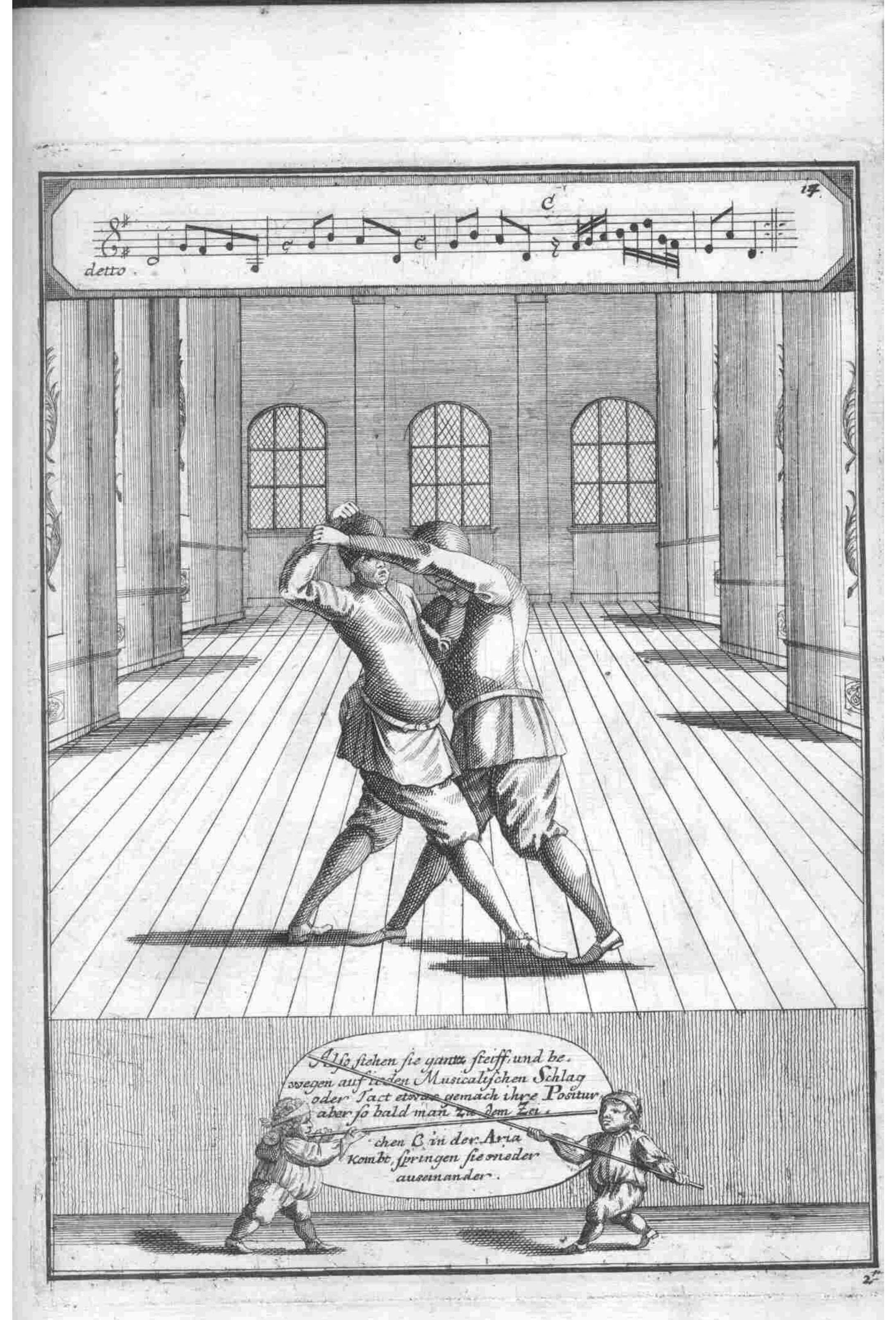
Combat/Duel — Plate 64
Gregorio Lambranzi
- Medium:
- Copper-plate engraving
- Dance:
- Notation/Choreography
- Era:
- 1700s (Enlightenment/Minuet Era)
- Collection:
- Nuova e curiosa scuola de' balli theatrali (1716)
- Source:
- Library of Congress
- Rights:
- Public domain — free to use, share and adapt.
- Recorded as:
- Public Domain
Lambranzi's manual is one of the only surviving visual and notational records of how professional dancers actually moved in the early 18th century, and one of the first to systematically link music notation directly to body movement. This plate in particular shows that theatrical dance of the period encompassed far more than the refined courtly dances we often imagine—it included acrobatic, dramatic, and comedic action that required careful choreographic structure and musical coordination.
What you are looking at
Two men in mid-combat occupy the center of a sparse, formal stage bounded by classical columns and high arched windows. The figure on the left, dressed in a long coat and breeches, has thrown his head back and raised both arms defensively or in a gesture of alarm, while his opponent grasps or strikes at him from the right. Both wear period costume suggesting the early 18th century. The wooden floorboards recede in perspective toward the rear wall, emphasizing the theatrical depth of the space. At the top of the engraving, musical notation in a single staff line runs horizontally—a composed piece in C labeled "detto" (meaning "the same," suggesting this is one of a series). Below the stage action, two cherub figures flank a cartouche containing German text that provides the dance description or title. The entire composition is framed by a bordered rectangle typical of contemporary theatrical manuals.
The dancing
Both men stand in an upright, somewhat exaggerated theatrical posture characteristic of staged combat rather than actual fighting. The left figure's weight appears thrown backward, his arms raised high—one bent at the elbow—in a reactive or defensive gesture. The right figure leans forward with arm extended, suggesting a lunge or striking motion. Neither figure is in a closed ballroom hold; instead, their bodies are separated and their interaction is combative and directional. The poses suggest a choreographed sequence of attack and defense rather than naturalistic movement.
The dance depicted
This is a theatrical duel or combat choreography as performed in early 18th-century German court dance theater. The piece is one of 104 plates in Lambranzi's manual, each pairing a notated music phrase with a costumed stage action. The combat shown here is not actual swordplay but rather a stylized, gestural representation of fighting suitable for theatrical performance—the exaggerated arm positions and backward recoil of the left figure indicate a formalized, dance-like interpretation of conflict. Such pieces were performed by professional dancers and noble amateurs as part of court spectacles, school demonstrations, and theatrical interludes, often as comic or dramatic interjections within ballet sequences.
How it was made
This is a copper-plate engraving, a technique that allowed fine detail, clear reproduction, and wide distribution of instructional material. Lambranzi's manual was printed in Nuremberg in 1716 and circulated throughout the German-speaking courts and among dance teachers. The engraving technique permitted precise depiction of both the musical notation and the human figure in space, making it valuable as both a performance guide and a record of choreographic invention. The pairing of music and image on a single plate—a pioneering feature—established a model for later dance manuals and made the work influential far beyond its immediate audience.
About this work
This plate documents one of the 104 choreographed theatrical dances published by Gregorio Lambranzi in his *Nuova e curiosa scuola de' balli theatrali* (New and Curious School of Theatrical Dances), the most comprehensive choreographic manual of the early 18th century. Unlike the courtly minuets and galliards of the previous century, Lambranzi's collection celebrates spectacular, athletic, and often comic dances performed by professional dancers on stage—including combats, falls, character dances, and dramatic gestures. This particular plate shows a choreographed duel: a stylized, gestural combat scene in which two figures enact an exaggerated dramatic conflict through body position and mime rather than actual swordplay. The work is crucial evidence of what European theatrical dance looked like in the age of Louis XIV's influence and the early development of ballet as a distinct art form.
How to look at it
Notice the exaggerated backward recoil of the left figure—head thrown back, both arms raised—which is not a natural response to attack but a theatrical gesture emphasizing shock or vulnerability. The composition freezes a moment of maximum dramatic contrast: one figure lunges forward while the other recoils in alarm. The formal stage setting and formal costume direct attention to the deliberate, choreographed nature of the movement. This is not documentary realism but a stylized, gestural language in which the body communicates an emotional or narrative idea through enlarged, clear poses. The musical notation above confirms that this gesture occurred at a specific point in a measured musical phrase, linking body and music as a unified theatrical utterance.
The artist
Gregorio Lambranzi was an Italian dance master and choreographer active in the late 17th and early 18th centuries, associated with courts in both Italy and southern Germany. Little is certain about his life, but his publication demonstrates that he was a systematic thinker about dance notation and pedagogy. The *Nuova e curiosa scuola* is his only known substantial surviving work and may represent accumulated practice from a career of creating dances for court entertainments and theatrical productions. The German-language cartouches and Nuremberg publication suggest he worked in or for German court circles late in his career.
The period
Lambranzi's manual appeared in 1716, at a moment when theatrical dance in Europe was separating from courtly social dance. The reign of Louis XIV (d. 1715) had established ballet as a court spectacle and entertainment form, and professional dancers were increasingly trained and visible as performers. At the same time, social dances like the minuet were becoming standardized and codified through notation systems (including Feuillet's system, which influenced Lambranzi). This plate documents dances from the theatrical, performative end of that spectrum—combat, gesture, and dramatic action executed on stage by trained bodies, not social dances performed by courtiers. The musical notation at the top reflects the increasing integration of dance and music in theatrical productions and the emerging notion that choreography could be recorded and transmitted as a permanent text.
Where it lives
This is one of 104 copper-plate engravings bound in *Nuova e curiosa scuola de' balli theatrali*, published in Nuremberg by Johann Jacob Wolrab in 1716. The work exists in German and Italian editions and was widely held in court and university libraries, particularly in German-speaking regions. The copy described here is held by the Library of Congress.
Dance in this work
Questions about this work
Is this an actual duel or a staged dance performance?
This is a choreographed stage performance, not actual combat. The exaggerated arm positions, theatrical posture, and inclusion in a dance manual make clear that the figures are executing a stylized, formalized gesture-dance that represents conflict rather than depicts it realistically. The backward recoil and raised arms are theatrical conventions designed to communicate dramatic action to an audience, not practical fighting technique.
What is the music notation at the top?
The single line of notation shows the musical phrase composed to accompany this choreographed action. Each of Lambranzi's 104 plates pairs a short, original musical composition with a stage dance, indicating that the two were meant to be performed together. The notation allows a musician and dancer to coordinate their timing, making the manual a guide to both music and movement.
Who would have performed this dance?
These dances were performed by professional dancers in court theatrical productions, school demonstrations, and public entertainments. Lambranzi's manual was used by dance masters to teach both professional dancers and noble amateurs how to execute these spectacular and comic actions. The level of formalization and the theatrical setting suggest training and rehearsal, not social dancing by amateurs.
Why is this manual important to dance history?
Lambranzi's *Scuola* is one of the first comprehensive, illustrated choreographic records to systematically pair notated music with drawn human figures in specific stage positions. It documents theatrical dances of the early 18th century—a gap in the historical record—and shows that professional dance encompassed dramatic, acrobatic, and comic action as well as the courtly dances more commonly preserved in notation systems like Feuillet's.
More Notation/Choreography artwork