49 works in this view — arrow keys or swipe to move between them.
Dance in Art
Combat/Duel — Plate 69
Gregorio Lambranzi
- Medium:
- Copper-plate engraving
- Dance:
- Notation/Choreography
- Era:
- 1700s (Enlightenment/Minuet Era)
- Collection:
- Nuova e curiosa scuola de' balli theatrali (1716)
- Source:
- Library of Congress
- Rights:
- Public domain — free to use, share and adapt.
- Recorded as:
- Public Domain
This plate preserves a moment in dance history when theatrical choreography was being systematized and written down for the first time. It shows us how trained stage performers of the early 18th century understood and executed interaction, mime, and spatial control—knowledge that is otherwise lost. For anyone studying the history of ballet, opera, or theatrical gesture, Lambranzi's engravings are primary sources: they are what the dance actually looked like.
What you are looking at
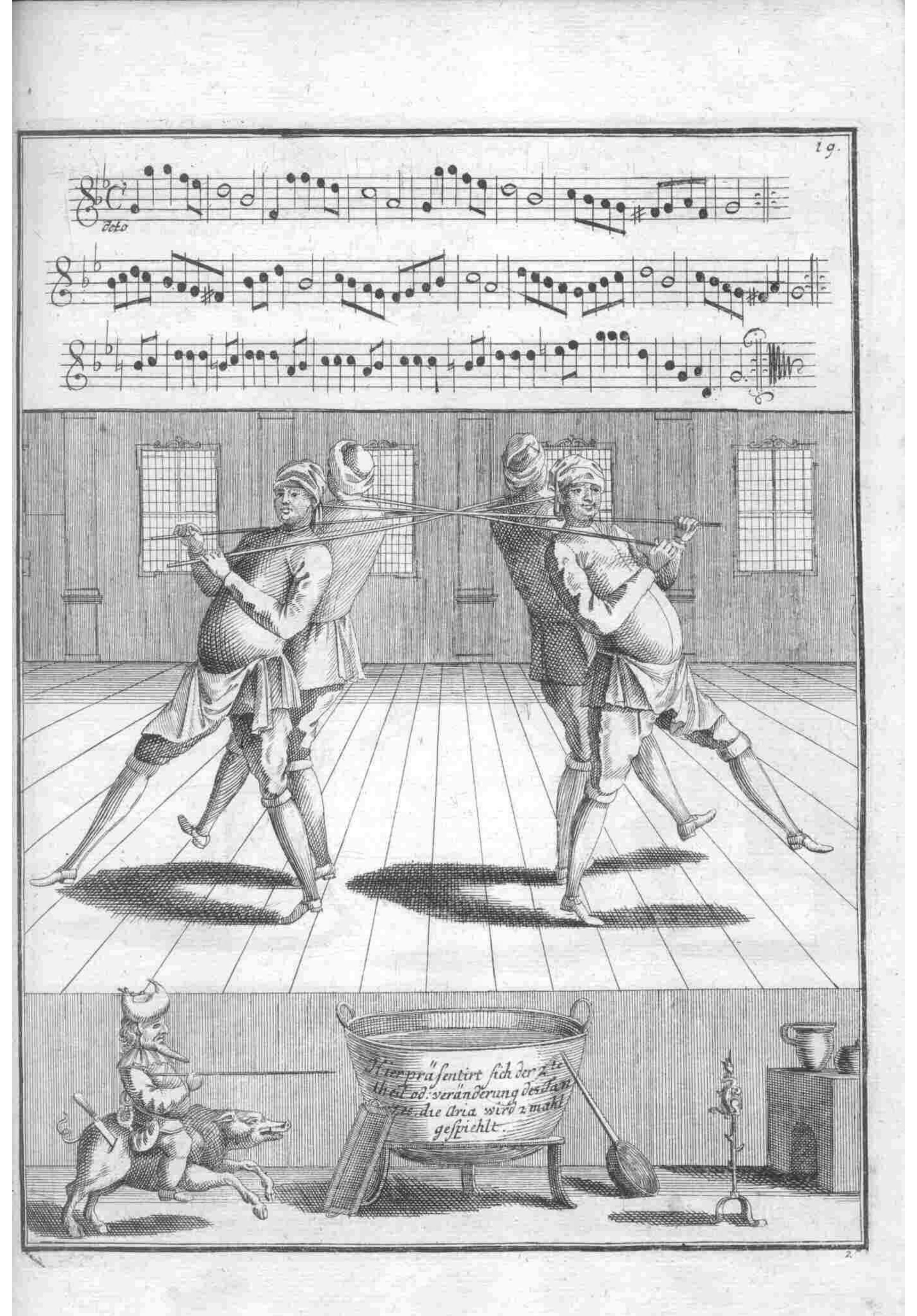
Two identically dressed figures face each other across a wooden floor in a curtained theatrical space, their bodies in symmetrical combat stance. Each wears a turban, fitted tunic, and hose in the fashion of early 18th-century theatrical costume. They grip a length of fabric or ribbon stretched taut between them, their torsos pitched forward at identical angles, knees bent, weight on the balls of their feet. The composition is perfectly balanced—every limb, every fold of drapery, mirrors its opposite. Above the stage a musical staff notates the piece. Below, in a separate scene, a cauldron sits with attendant props, suggesting this is one plate in a sequence of theatrical choreography demonstrations.
The dancing
Both figures adopt an identical lunge position, knees deeply flexed, torsos inclined forward from the hip, arms extended to grip what appears to be a scarf or cord at chest height. The weight distribution and pitch of the body suggest controlled tension and balance rather than violent action. The legs are straight and turned out from the hips, the feet positioned to support the forward lean. This is not realistic combat but a symmetrical, highly formalized interaction—each dancer a mirror of the other.
The dance depicted
This is not a dance in the vernacular sense but a *scenic action* from the theatrical vocabulary of early 18th-century opera and ballet. Lambranzi's manual documents the choreography and mime that accompanied music in staged productions. The 'combat' depicted here—the symmetrical grappling with fabric—belongs to a tradition of stylized stage combat and pantomime that preceded modern dance but shaped theatrical movement for centuries. These were taught steps, learned from notation, performed by trained actors and singers, usually as part of a larger dramatic scene. The paired figures suggest a formal, didactic demonstration: *this* is how two opponents interact with a prop, how the body holds tension, how symmetry creates theatrical meaning.
How it was made
A copper-plate engraving from Lambranzi's *Nuova e curiosa scuola de' balli theatrali* (Nuremberg, 1716), one of the period's most influential and widely circulated manuals of theatrical dance and gesture. Engraving allowed precise line work and the pairing of notation with illustration—text at the top, figure below—that made it possible to transmit choreography across Europe. The technique's precision and reproducibility gave the manual authority: these were the correct positions, the canonical forms. The book was printed and reprinted, reaching dancers and composers across the German-speaking and Italian regions for decades.
About this work
This is one plate in a systematic visual archive of theatrical choreography from the early 18th century. It belongs to a moment when the codification of dance was accelerating—when teachers, composers, and impresarios began to write down and illustrate movement so that it could be learned, repeated, and transmitted. Lambranzi's work sits at the intersection of opera, ballet, pantomime, and pedagogy. The symmetry and formality of the image—the mirror-image bodies, the musical notation, the careful perspective of the stage—all signal that this is canonical knowledge, not casual observation. For dancers and historians, it documents a stage vocabulary that has largely disappeared: the gestural grammar of pre-Romantic theatrical movement.
How to look at it
Notice the perfect symmetry: every position, every angle, is repeated across a vertical axis. This is not how bodies naturally interact; it is how they were taught to interact on stage. The artist has frozen the moment of maximum tension—the hold, the balance, the controlled strength required to maintain the pose. Look at the knees: deeply bent, supporting the entire weight of the body from a low center of gravity. Look at the arms: extended but not relaxed, holding tension through the shoulders. This is not a snapshot of combat but a diagram of a specific position to be learned and performed. The musical notation above confirms this: every movement has a corresponding musical phrase, part of a choreographed sequence, not improvisation.
The artist
Gregorio Lambranzi (c. 1680–after 1725) was a dancing master, choreographer, and theorist based in Nuremberg. His *Nuova e curiosa scuola de' balli theatrali* (New and Curious School of Theatrical Dances), first published in 1716 with a German edition following in 1725, was among the first systematic attempts to document theatrical choreography in print. The work includes over 100 engraved plates, each pairing a notated musical phrase with an illustration of a costumed figure or figures in a specific pose or sequence. Lambranzi drew on Italian and French theatrical traditions but adapted them for a German audience and the specific demands of the Nuremberg stage. His manual was both a teaching tool and a record of performance practice—a bridge between the improvisation and regional variation of earlier dance and the standardization that would accelerate through the 18th century.
The period
In the early 18th century, dance was in transition. The court dances of the Baroque—minuets, gavotts, courantes—were becoming formalized and increasingly codified. At the same time, theatrical dance (the choreography of opera, spoken drama, and ballet d'action) was developing its own vocabulary distinct from social dancing. Lambranzi's manual appeared at a moment when several forces converged: the rise of the professional dancer and choreographer, the development of musical notation precise enough to accompany choreographic description, the expansion of printing technology, and a new emphasis on writing down and standardizing movement. In visual art, the early 18th century was the age of the engraved manual—in fencing, riding, anatomy, and gesture—all attempting to freeze and transmit embodied knowledge through the page. Lambranzi's work belongs to this broader pedagogical and archival impulse.
Where it lives
This plate is from *Nuova e curiosa scuola de' balli theatrali*, printed in Nuremberg in 1716 and now held by the Library of Congress. The manual is a bound collection of over 100 engraved plates, each illustrating a different theatrical action, pose, or dance figure with accompanying musical notation. Individual plates were often separated and circulated independently, but this one is catalogued as Plate 69 of the complete work.
Dance in this work
Questions about this work
Is this a real fight or a dance?
Neither exactly—it is a *theatrical action*, a stylized mime of combat performed as part of an opera or dramatic production. It was choreographed, notated, and taught like a dance, but it depicts an interaction rather than what we would call a dance today. The symmetry and formal positioning make clear that this is a theatrical convention, not realistic combat. It belonged to a vocabulary of gesture and movement that actors and singers needed to learn.
Why is the image so symmetrical?
Symmetry was a fundamental principle of Baroque and early 18th-century theatrical aesthetics. It signaled order, control, and high style. In Lambranzi's manual, symmetrical positions serve a didactic purpose: they are easier to learn, remember, and transmit on the page. This particular pose—two figures mirroring each other—would have been recognized as a canonical theatrical interaction, like a handshake or a bow.
What is that thing they are holding?
Most likely a scarf, ribbon, or length of fabric—a common prop in theatrical mime and dance. Holding it creates a visual line connecting the two figures and gives their interaction a physical focus. It may represent wrestling, restraint, or simply a formal, balletic way of touching without direct contact—appropriate to the conventions of staged performance.
Why does the music appear at the top?
In Lambranzi's system, every movement corresponds to a musical phrase. The notation allows someone who can read music to follow the choreography: the music and the image together constitute a complete record of the action, the way it moved through time, and how long it lasted. This was one of the first attempts to integrate dance notation with musical score.
More Notation/Choreography artwork