49 works in this view — arrow keys or swipe to move between them.
Dance in Art
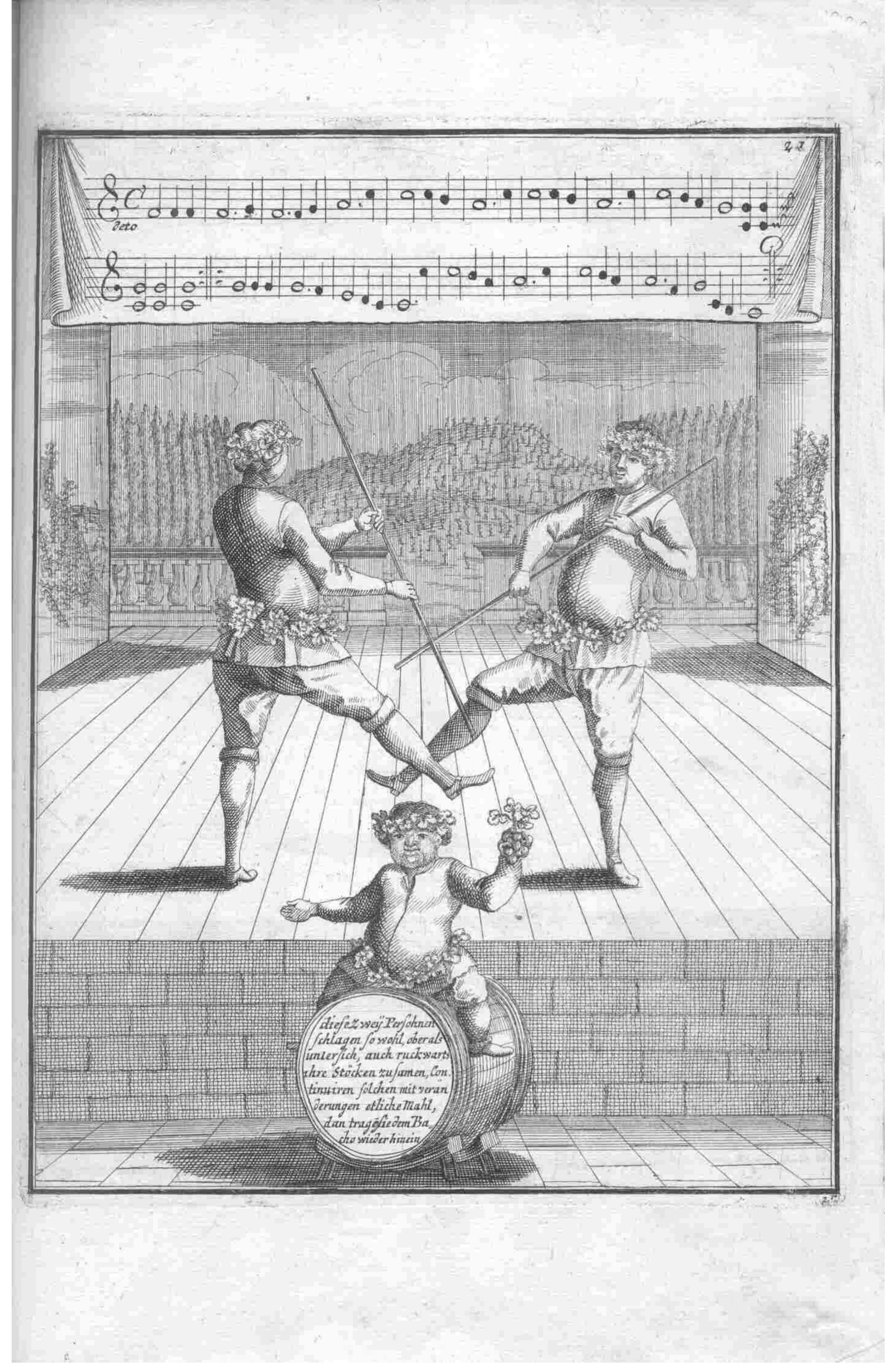
Comic Character — Plate 71
Gregorio Lambranzi
- Medium:
- Copper-plate engraving
- Dance:
- Notation/Choreography
- Era:
- 1700s (Enlightenment/Minuet Era)
- Collection:
- Nuova e curiosa scuola de' balli theatrali (1716)
- Source:
- Library of Congress
- Rights:
- Public domain — free to use, share and adapt.
- Recorded as:
- Public Domain
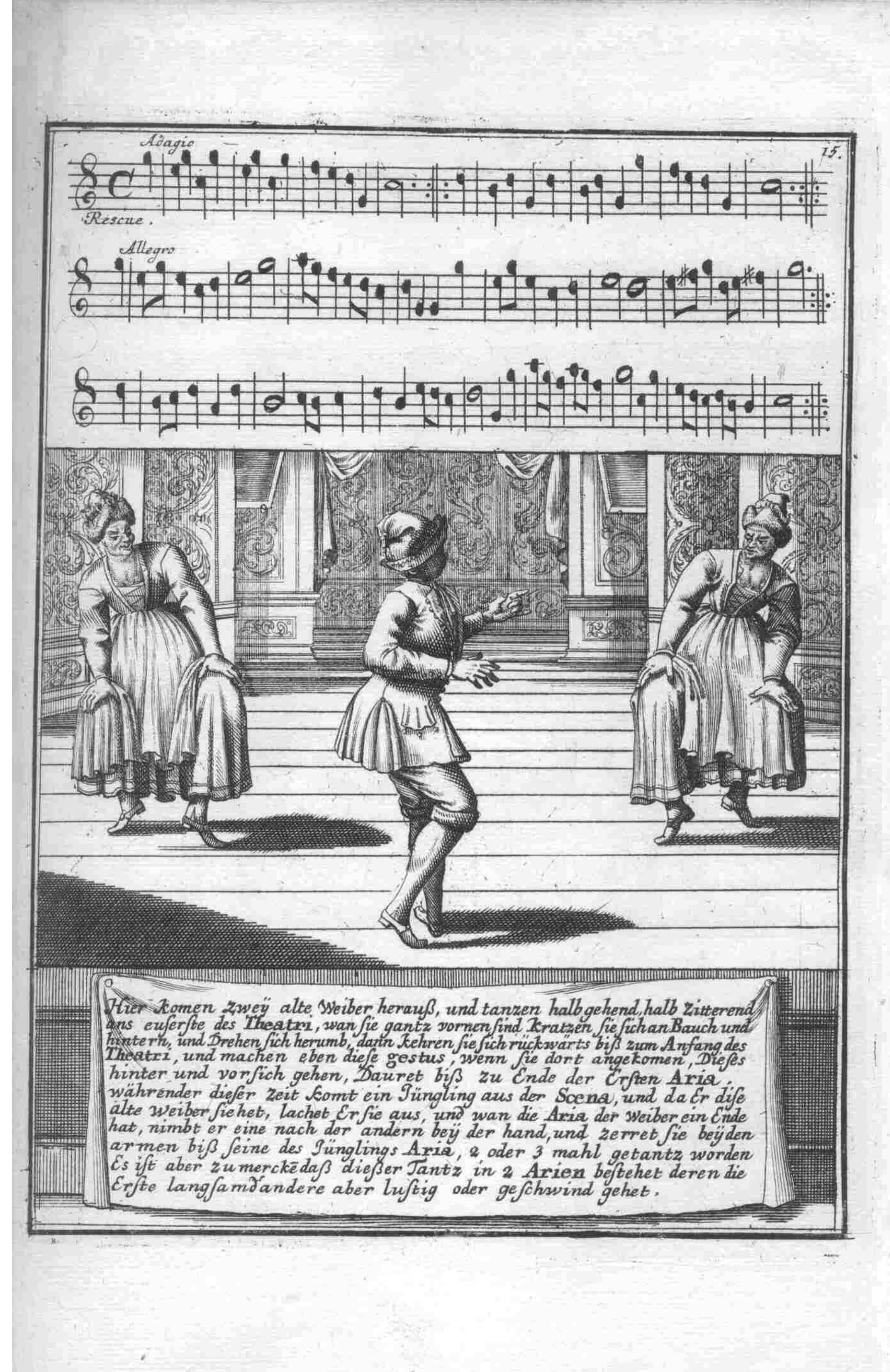
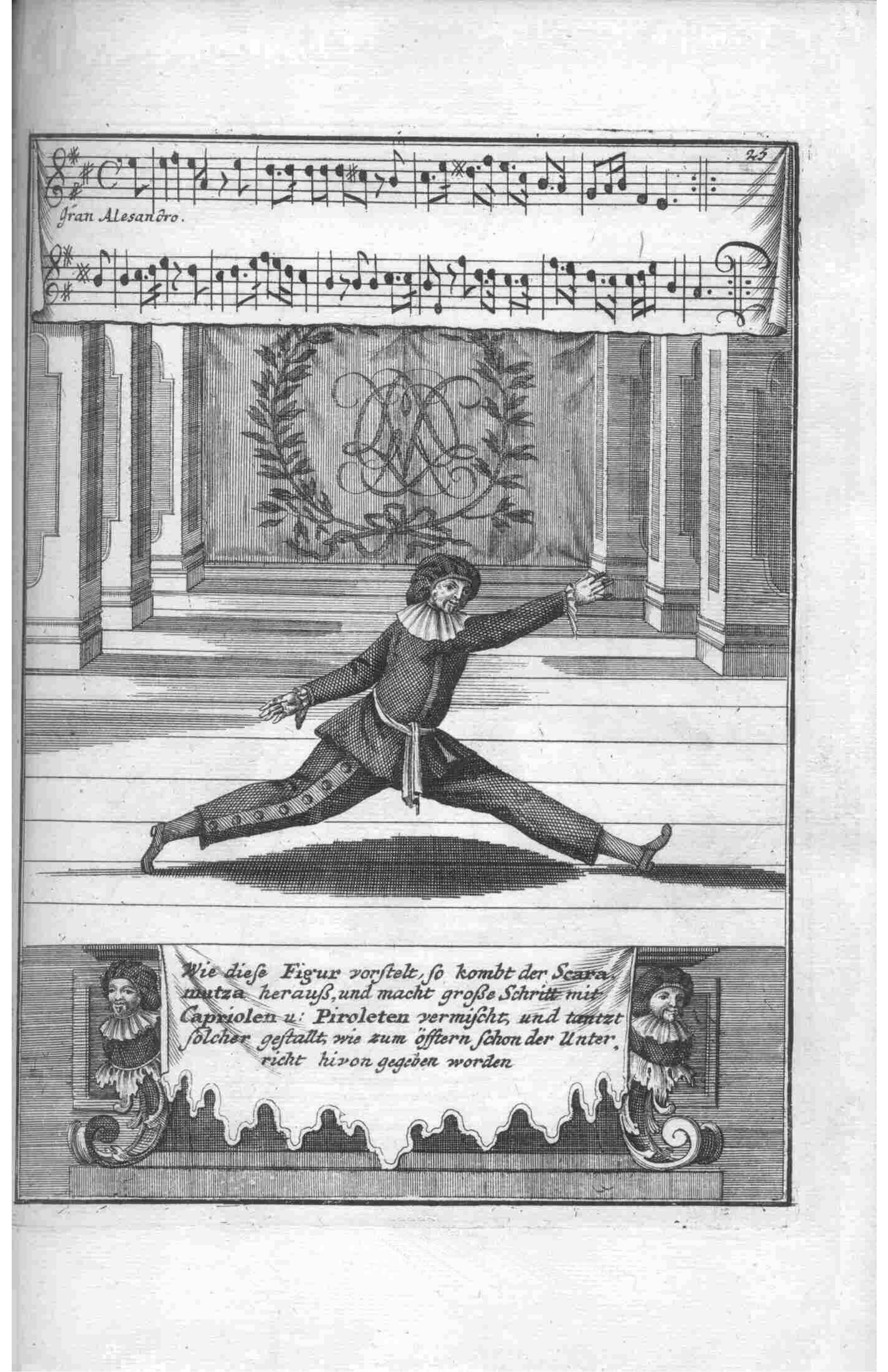
Lambranzi's manual is one of the very few sources that document theatrical dance steps and choreography before the advent of modern notation systems; the plates are among the earliest visual evidence of how comic and character dances were actually performed on stage. This plate specifically shows the integration of props, allegorical figures, and narrative gesture into choreography—a key aspect of Baroque theatre that has left few traces. For dance historians and theatre practitioners, Lambranzi is invaluable precisely because it records ephemeral performance in visual form.
What you are looking at
Two adult dancers in theatrical costume occupy a wooden stage framed by a painted backdrop of formal gardens and cypress trees. Both wear fitted bodysuits with draped fabric at the hips, floral wreaths on their heads, and are barefoot. The figure on the left holds a long staff or stick diagonally across the body; the figure on the right grasps what appears to be a rope or cord. Between and below them stands a small cherub or putto figure, also crowned with flowers, who holds the other end of the rope in one hand and grapes in the other. The setting is a classical interior with a checkerboard floor, suggesting a nobleman's hall or theatre. Above the scene, two staves of notated music appear, labeled 'Tao' at the left. Below the stage, a cartouche contains German verse in a period hand. The engraving is finely detailed with crosshatching to suggest volume and shadow.
The dancing
Both adult dancers are depicted in a moment of theatrical interaction, leaning toward each other with arms extended and bodies angled. The figure on the left holds the staff upright and slightly forward; the figure on the right has one arm raised, hand open. Neither is in a closed or partnered ballroom hold. The bodies are upright and poised rather than actively stepping or turning; the composition suggests a pause or a gesture within a choreographed sequence. The small putto between them appears to be an allegorical or comic prop-character integral to the choreography.
The dance depicted
This plate is titled 'Comic Character' and depicts theatrical dance of the early 18th century, most likely a comedic or pantomimic interlude as performed in European court theatres or early opera houses. The presence of the putto, floral crowns, and rope or garland suggest this is a scene of playful courtship or comic seduction. The musical notation above and the formal theatrical setting indicate this was a choreographed piece with an accompanying tune, consistent with the divertissements and intermezzos that punctuated spoken theatre and opera in the 1710s. The style of dress, pose, and interaction does not correspond to any of the formal courtly dances of the period (minuet, gavotte) but rather to comic or character dance, which occupied a distinct place in theatrical performance.
How it was made
This is a copper-plate engraving, a technique that required incising fine lines into a prepared metal surface and then inking and printing the plate. The result is the precise, linear quality visible here—every detail from the staff to the floor planks to the hair ringlets is defined by discrete marks. Engraving allowed for wide circulation of the image; this plate is one of 80 in Lambranzi's manual, which would have been issued to dance masters and theatre practitioners across Europe. The technique also permitted fine tonal gradation through varying density of parallel lines (crosshatching), creating the illusion of volume and depth even in black and white.
About this work
This is one of 80 engraved plates from Gregorio Lambranzi's *Nuova e curiosa scuola de' balli theatrali* (*New and Curious School of Theatrical Dances*), published in Nuremberg in 1716. Each plate pairs a short musical score with a single choreographed scene involving costumed performers, a setting, and an explanatory German verse. The manual is one of the most important documents of early 18th-century theatrical dance, capturing not the ballroom dances of the nobility but the character dances, comic turns, and scenic pieces that livened theatre and opera. This particular plate shows a comic scene involving two dancers and an allegorical putto figure, their interaction framed by theatrical costume, stage setting, and notation. The work sits at the intersection of dance history, theatre history, and the visual documentation of movement—a moment when choreography was beginning to be recorded systematically, and when visual engraving made that record portable and teachable.
How to look at it
Notice the moment chosen: not mid-step or mid-turn, but a moment of pause and gesture, in which the dancers' bodies and the placement of the props tell a narrative or comic point. The formal theatrical framing—the stage, the backdrop, the checked floor—emphasizes that this is scripted performance, not social dancing. The small putto at the center is not incidental decoration but part of the choreography; the rope connecting the figures suggests a structured pattern or game. The musical notation above offers a clue to the tempo and phrasing of the movement, though the steps themselves are not notated but rather communicated through the visual image. Viewers familiar with Baroque theatrical practice will recognize the vocabulary of allegory and comic character that structures the scene.
The artist
Gregorio Lambranzi was an Italian dancer and choreographer active in the late 17th and early 18th centuries. He is known almost exclusively through this single printed manual, which he apparently compiled and had engraved in Nuremberg. The *Nuova e curiosa scuola* represents his attempt to systematize and disseminate choreography for theatrical performance across Europe. Whether Lambranzi composed all the dances himself, compiled them from his own practice, or drew them from a broader tradition is not fully clear from the surviving record. The manual was influential and was reprinted; it remains the most direct window into his work and ideas.
The period
In the early 18th century, dance was divided into sharply different registers: courtly dances (minuet, courante, gavotte) performed by and for the nobility in ballrooms; and theatrical dances performed by professionals on stage, including character dances, comic pantomime, and elaborate multi-figure scenarios integrated into operas and plays. Lambranzi's manual documents the second category almost exclusively. At the same time, visual documentation of dance was becoming more common; the rise of the printed manual (paralleled in other arts) reflected both the increasing professionalization of dance and the belief that movement could and should be recorded and taught. The engraving technique made possible the wide circulation of such manuals across Europe.
Where it lives
This plate is from the 1716 Nuremberg edition of Lambranzi's *Nuova e curiosa scuola de' balli theatrali*, one of 80 plates in the manual. The work is held in the Library of Congress collection and is digitized as part of that institution's online historical materials.
Dance in this work
Questions about this work
Who were these dances for?
Lambranzi's dances were designed for professional theatre dancers and for dance masters teaching theatrical technique. Unlike court dances, which the nobility learned for their own social participation, these were spectacle—to be watched and admired. The manual was a practical teaching tool, circulated among practitioners across Europe.
What is the putto doing?
The putto (Cupid-like figure) is part of the choreography, not mere decoration. The rope connecting all three figures suggests a structured spatial pattern or game. Given the title 'Comic Character' and the floral crowns, this is likely a scene of comic courtship or seduction, with the putto embodying the theme of desire or love-play.
Can we tell what the music sounds like?
The notation at the top gives the melodic outline but not the instrumentation, tempo markings, or full harmonic context. The two staves suggest it was for two voices or instruments. Without access to the German verse below or additional period context, the full meaning of the pairing between music and movement is not immediately clear from the engraving alone.
Is this the same as a minuet or gavotte?
No. While both were performed in the early 18th century, minuets and gavottes were courtly social dances with prescribed steps and figures. Lambranzi's theatrical dances include character dances, pantomime, and comic interludes—a different genre performed by professionals on stage. The costume, setting, and use of props are also distinctly theatrical rather than ballroom.
More Notation/Choreography artwork