49 works in this view — arrow keys or swipe to move between them.
Dance in Art
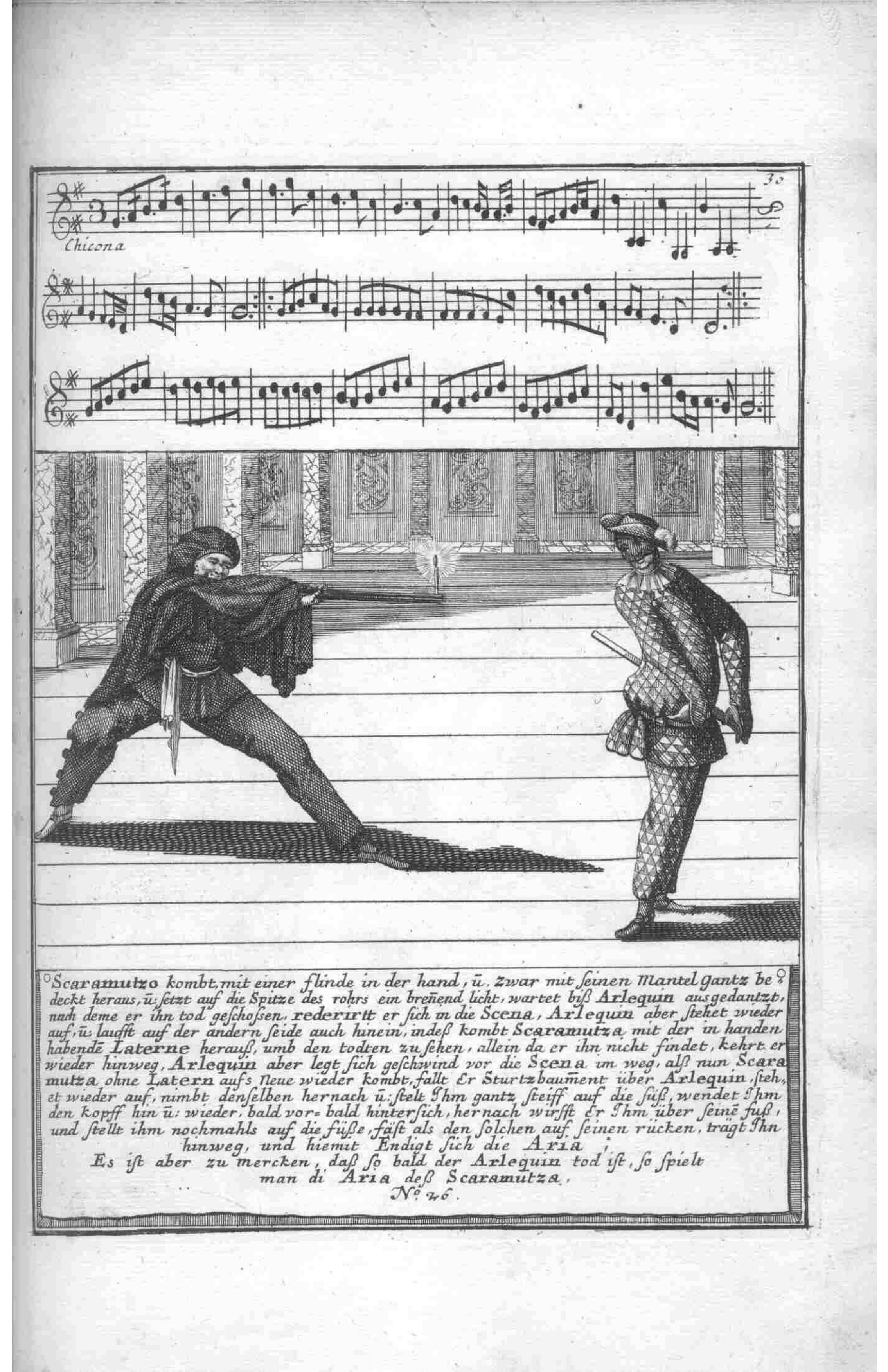
Combat/Duel — Plate 73
Gregorio Lambranzi
- Medium:
- Copper-plate engraving
- Dance:
- Notation/Choreography
- Era:
- 1700s (Enlightenment/Minuet Era)
- Collection:
- Nuova e curiosa scuola de' balli theatrali (1716)
- Source:
- Library of Congress
- Rights:
- Public domain — free to use, share and adapt.
- Recorded as:
- Public Domain
This plate preserves rare visual evidence of how theatrical combat was choreographed and danced in the baroque period—not as naturalistic fighting, but as a stylized, rhythmic form intimately tied to music and costume. For dancers and choreographers, it documents the relationship between baroque bodily deportment, dramatic character, and technical skill. For historians, it demonstrates how dance was treated as a teachable, reproducible art form worthy of the same careful documentation as music or text.
What you are looking at
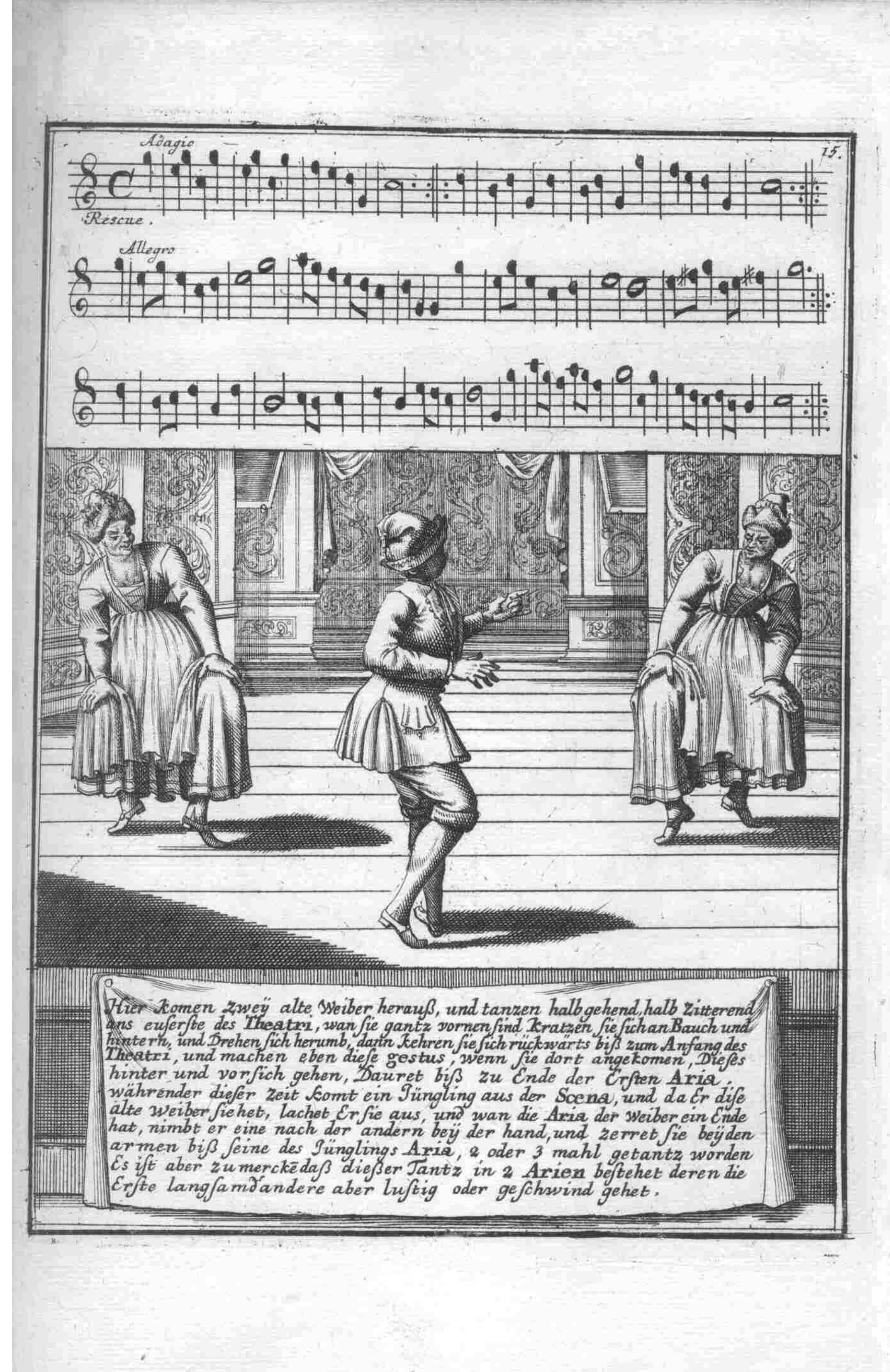
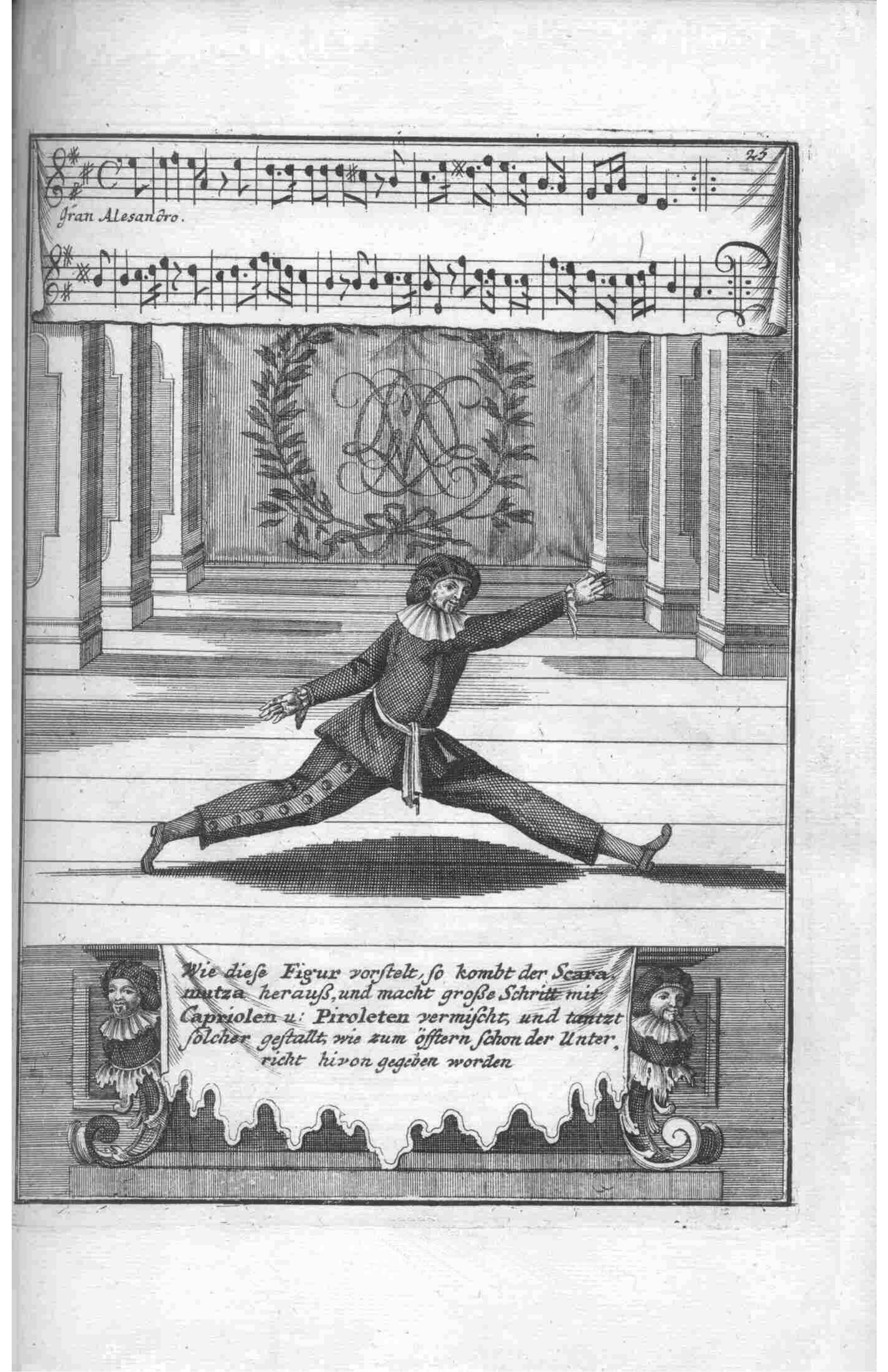
Two elaborately costumed figures stand on a wooden stage framed by a drawn curtain, engaged in a stylized combat or duel with sticks or staves. Both wear richly decorated theatrical dress typical of early 18th-century court entertainment: one figure on the left in a flowing cape or cloak with detailed patterning, the other on the right in equally ornate costume with ruffled details. The stage floor is rendered in clear perspective with evenly spaced planks receding into depth. Behind the curtain frame, a harbor or waterside scene is visible—boats, ships, and distant shoreline rendered in careful linear detail. The composition is framed by architectural elements suggesting a proscenium stage, with decorative pilasters on either side. At the top of the engraving, a single line of musical notation (marked *petto*) runs the width of the page, indicating this is from a notated choreographic manual. Below the image, a block of German verse in a decorative cartouche provides caption or instruction.
The dancing
Both figures stand in a confrontational pose with knees flexed and torsos upright, holding staffs or batons at angles suggesting active engagement. The figure on the left leans slightly forward in an aggressive stance, while the figure on the right maintains a more defensive posture. Both are balanced on the balls of their feet in what appears to be an active, athletic frame—the weight distributed for mobility rather than stillness. The arms are extended in a controlled manner typical of theatrical combat choreography, with clear lines of action and counter-action between the two bodies.
The dance depicted
This is a *ballroom theatrical combat or duel sequence*—a stylized pantomime-dance of the kind popular in early 18th-century German and Italian court theaters. The notation at the top confirms this is a choreographed piece, not a naturalistic fight. The German caption and presence in Lambranzi's manual indicate this was danced by professional theatrical performers as part of courtly entertainment, likely incorporating both rhythmic footwork and dramatic gesture. The staff work suggests influence from earlier commedia dell'arte and acrobatic traditions, though executed here with the refined posture and deliberate spacing of baroque theatrical dance. The presence of music notation ties it directly to a composed score.
How it was made
This is a copper-plate engraving, a labor-intensive medium requiring a specialist to cut the image into a prepared copper plate for printing. The fineness of the line work—visible in the cross-hatching that models the figures' clothing, the parallel lines defining the stage boards, and the delicate rendering of the harbor scene in the background—demonstrates technical mastery and suggests this was produced by a skilled professional engraver working from a drawn design. The technique allowed for precise reproduction of choreographic detail across multiple impressions, making this manual a portable, distributable record of specific dances. The inclusion of musical notation in the same plate indicates integrated design for both movement and music instruction.
About this work
This is Plate 73 from Gregorio Lambranzi's *Nuova e curiosa scuola de' balli theatrali* (Nuremberg, 1716), one of the most comprehensive surviving notated records of early 18th-century theatrical dance. The plate documents a choreographed duel or combat dance performed in full theatrical costume on a framed stage, paired with a composed musical line. The work is historically significant as a detailed visual-musical record of how baroque court dancers performed dramatic action: the figures' posture, the proportional use of the stage, the integration of narrative and rhythm. Lambranzi's manual is among the earliest to combine notation, music, and detailed engraved illustration as a method of recording and transmitting dance across geography and time, making it foundational to our knowledge of how dance functioned in baroque theater.
How to look at it
Attend first to the posture and weight distribution of both figures: this is not a naturalistic fight, but a carefully controlled, balletic engagement where balance and precise positioning matter as much as dramatic effect. Notice the stage frame and perspective—the artist has taken care to show us how the dancers occupy three-dimensional theatrical space, with the floor receding in clear perspective lines. The musical notation at the top is not decorative; it indicates that every moment of the figures' motion corresponds to a specific measured beat. The harbor scene in the background might seem incidental, but it establishes the theatrical fiction: this combat takes place in a specific narrative location, likely a port or coastal drama. Finally, observe how the two figures are posed in a moment of suspended action—not a climactic blow, but a structured moment of readiness and engagement, typical of how baroque artists froze choreographed dances to make them teachable.
The artist
Gregorio Lambranzi (c. 1675–after 1730) was a dancing master, choreographer, and theorist working primarily in Nuremberg and northern Europe. He is remembered almost entirely through his *Nuova e curiosa scuola de' balli theatrali*, published in 1716, which contains 52 plates of choreographed theatrical dances paired with musical notation and detailed German captions. The manual was translated and republished in French in 1728, indicating its influence across court cultures. Lambranzi's approach—combining precise visual illustration with musical notation and written instruction—was innovative for its time and established a model for dance documentation that influenced later 18th-century treatises. Beyond this publication, little is known of his biography or other works.
The period
The early 18th century was a moment of flourishing theatrical dance in German and Italian courts, following the decline of the French court ballet system under Louis XIV. Lambranzi's manual emerges in this context of vibrant, geographically dispersed courtly entertainment, where dances moved between courts through the circulation of printed manuals and the movement of dancing masters themselves. The baroque theatrical aesthetic—ornate costume, dramatic gesture, integration of music and narrative—was at its height. Simultaneously, the baroque style in visual art was reaching its most elaborate phase, reflected in the dense, detailed engraving technique used to document these dances. The inclusion of musical notation reflects the period's intense engagement with dance as a composed, notatable art form, parallel to developments in music theory and composition.
Where it lives
This plate is from the original 1716 Nuremberg edition of *Nuova e curiosa scuola de' balli theatrali*, held in the Library of Congress. The manual is a bound collection of 52 engraved plates, each paired with musical notation and German verse instruction, representing the most comprehensive illustrated dance manual of the early baroque period.
Dance in this work
Questions about this work
Is this a real fight or a choreographed dance?
This is a choreographed theatrical dance, not a real combat. The precise postures, the musical notation at the top, and the placement within Lambranzi's instructional manual all confirm that every movement was composed and notated. The figures' balanced, controlled stances and the refined theatrical costume indicate that this is a stylized dramatic performance—likely a duel sequence in a court ballet or theatrical spectacle—rather than martial action.
What does the notation at the top tell us?
The musical line indicates that this choreographed sequence was composed to fit a specific musical score. In baroque dance manuals, notation served to align movement with music, allowing dancers in different locations to learn and perform the same piece in synchronized time. This integration of dance and music was essential to how baroque theater worked and how court dances were transmitted between courts.
Who would have danced this?
This would have been danced by professional or well-trained courtly performers—either career theatrical dancers or noblemen and women trained in the elaborate dance vocabulary of the baroque court. The ornate costume and theatrical setting indicate this was a spectacle piece, not a social dance for general courtly participation. Such dances were performed at court festivals, theatrical entertainments, and special occasions.
Why is the harbor visible behind the stage?
The harbor scene establishes the narrative setting for the duel—this combat likely occurs within a larger theatrical story set in a port or coastal location. The backdrop would have been painted scenery on the stage, and Lambranzi's engraving preserves both the choreography and the theatrical context in which the dance took place.
More Notation/Choreography artwork