49 works in this view — arrow keys or swipe to move between them.
Dance in Art
Combat/Duel — Plate 74
Gregorio Lambranzi
- Medium:
- Copper-plate engraving
- Dance:
- Notation/Choreography
- Era:
- 1700s (Enlightenment/Minuet Era)
- Collection:
- Nuova e curiosa scuola de' balli theatrali (1716)
- Source:
- Library of Congress
- Rights:
- Public domain — free to use, share and adapt.
- Recorded as:
- Public Domain
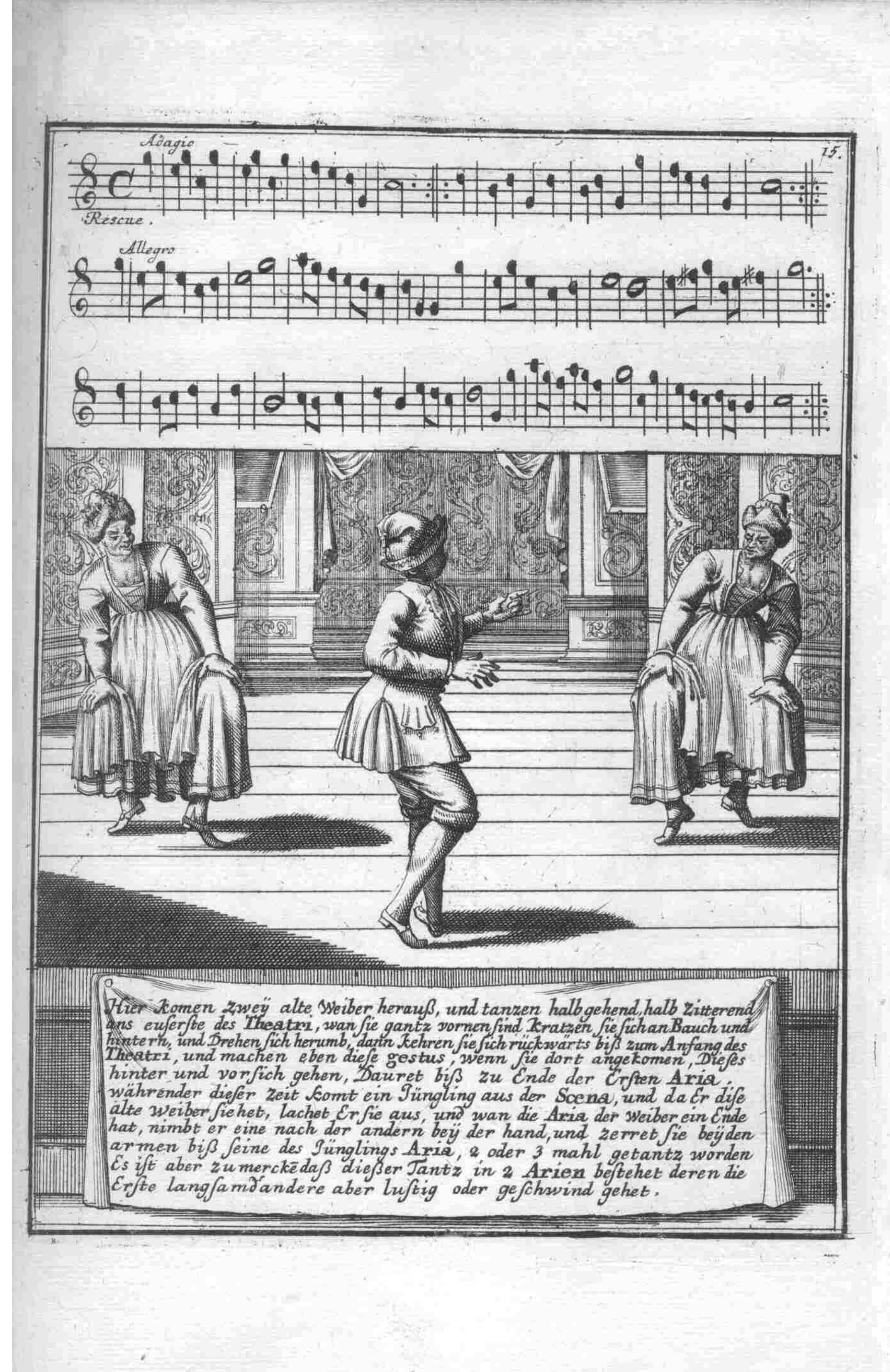
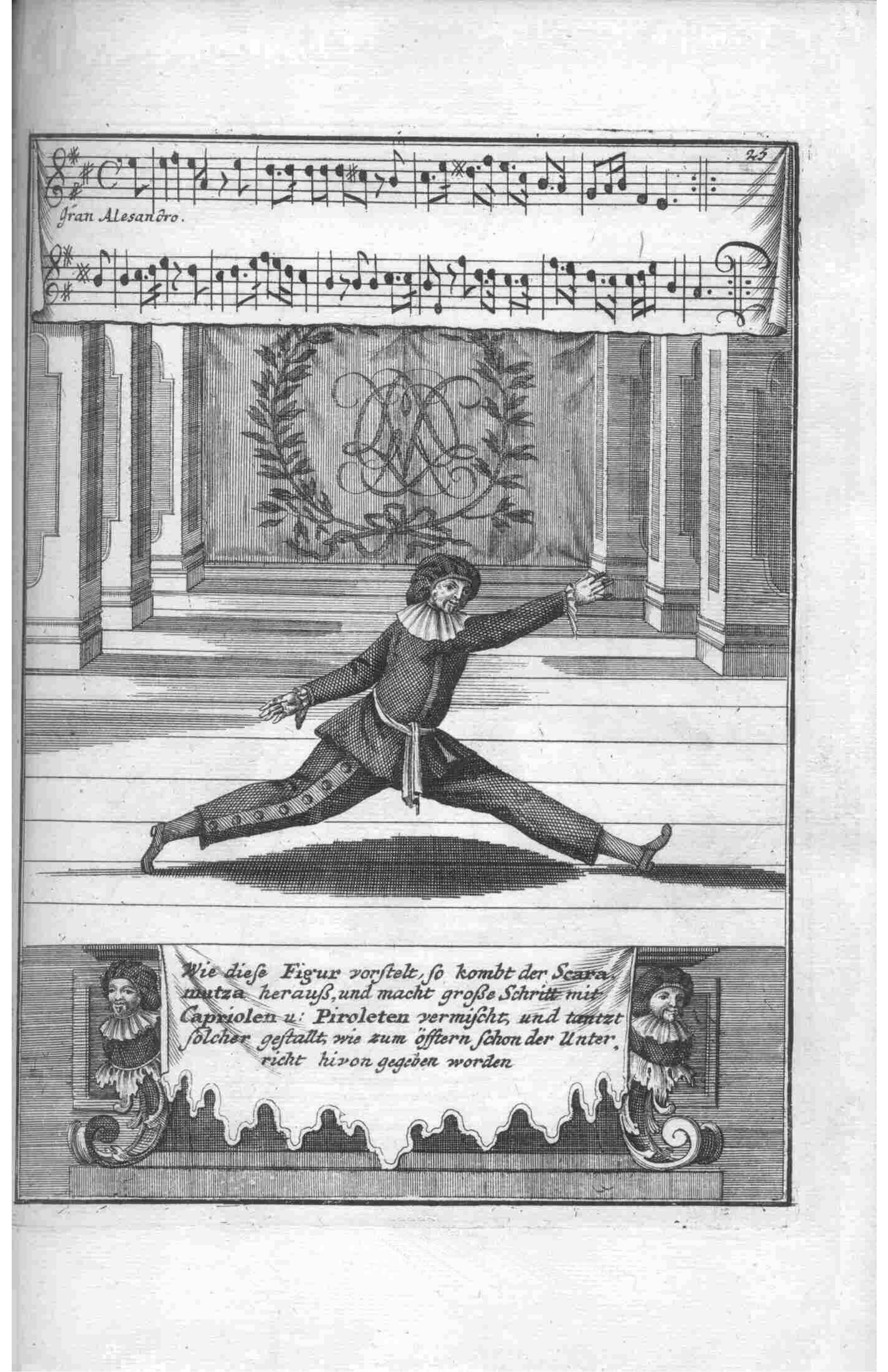
This is one of the earliest systematic attempts to record theatrical movement through image and notation together. It shows that 'dance' in the early 18th century meant far more than what we now call ballet—it included dramatic combat, pantomime, and gestural narrative, all governed by rules of proportion, balance, and stage technique. For historians of theatre and movement practice, Lambranzi's plates are primary evidence of how bodies were trained and choreographed.
What you are looking at
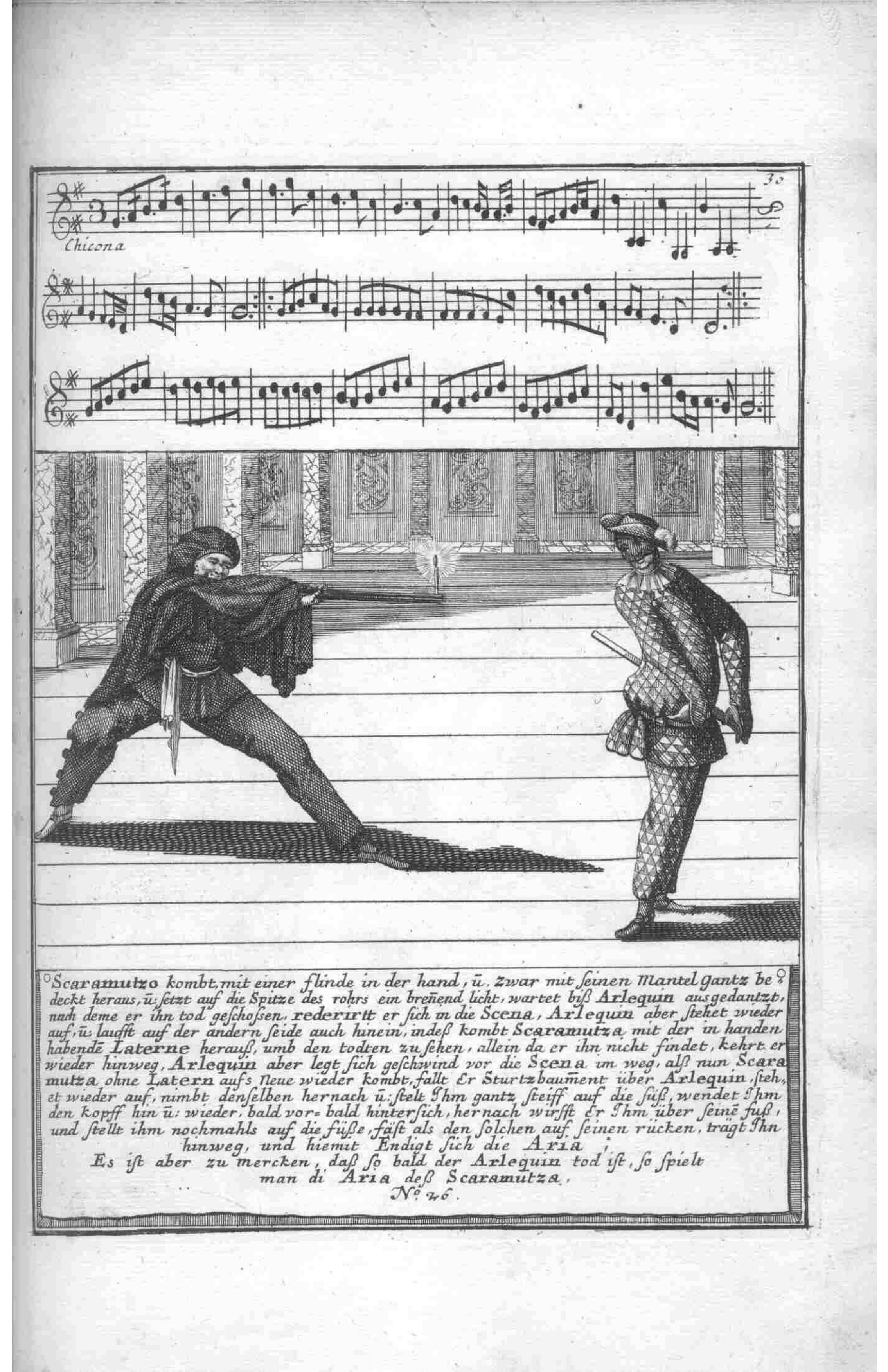
A theatrical stage scene depicts three figures in a dramatic combat or duel, set within a classical interior with fluted columns, draped curtains, and statuary visible in the background. The scene is rendered in copper-plate engraving with careful cross-hatching and linear perspective establishing depth. Two male figures in draped costumes brandish long poles or staffs—one at left lunging forward in attack, the other at center-right in a defensive crouch. A third male figure at right, also in classical drapery, appears to be gesturing or conducting the action. The floor is rendered with perspective lines receding toward the back wall. The composition freezes a moment of theatrical combat: weight is committed, bodies are extended, and the spatial relationship between the figures creates visual tension around the central pole-wielder.
The dancing
All three figures are male and costumed in simple classical draped garments. The figure at left is upright and lunging forward, staff raised and extended diagonally across the body, weight pressing into the attack. The central figure crouches low in a defensive posture, knees bent, body angled away from the oncoming staff, arms positioned for balance or evasion. The third figure stands to the right, his posture more upright and observational, one arm raised as if directing or narrating the contest. The gestural language is emphatic and committed—these are not tentative movements but dynamic, purposeful actions with clear weight transfer and spatial awareness.
The dance depicted
This is a theatrical combat pantomime or staged duel, likely from the comedic or dramatic interludes that accompanied operatic and balletic performances in early 18th-century European theatre. The engraving documents a choreographed fight sequence—a common feature of theatrical dance manuals of the period. The figures' use of props (staffs or swords), their exaggerated stances, and the carefully composed spatial relationships indicate this is a taught and repeatable sequence, not a naturalistic fight. The postures and angles suggest training in stage combat technique adapted for dance and pantomime. The third figure's observational gesture hints that this may be a teaching or demonstrative moment, showing how such a combat should be executed.
How it was made
This is a copper-plate engraving, a medium that allowed for fine linear detail and mass production of instructional images. The technique relies on parallel and cross-hatching lines to suggest volume, shadow, and spatial depth—the floor, drapery, and background are all rendered through the controlled accumulation of fine incised lines. Engraving was ideal for technical instruction because it could show clear outlines and anatomical clarity. This work comes from a printed manual (*Nuova e curiosa scuola de' balli theatrali*), meaning it was designed for circulation among theatrical professionals, dance masters, and educated performers who could read both notation and image. The combination of musical notation at the top and this detailed stage image below made such plates valuable teaching documents.
About this work
This is a plate from Gregorio Lambranzi's 1716 *Nuova e curiosa scuola de' balli theatrali*, one of the most influential European dance manuals of its era. It documents a choreographed stage combat—a standard feature of theatrical spectacle in the Baroque and early 18th-century period. The engraving pairs musical notation (visible at top) with a precisely rendered stage image, showing three male figures in classical dress performing a combat sequence with staffs or swords. This work matters because it preserves not ballet in the modern sense, but the broader theatrical dance vocabulary of the period: pantomime, gesture, and dramatic action were taught, notated, and performed as dance. Lambranzi's manual is one of the few surviving records that show us what theatrical movement looked like before the standardization of ballet technique.
How to look at it
Observe the weight and commitment in each figure's posture. The lunging attacker at left is extended forward, his center of gravity committed to the direction of the staff—this is not a tentative gesture but a full-bodied action. The crouching defender's bent knees and angled torso show how theatrical combat required the body to absorb and deflect force, even if the actual contact was stylized. Notice also the third figure's elevated arm and observational stance—this may indicate a teaching moment, where one master shows another how a combat should be executed. The precise spacing between the figures and the careful rendering of the floor's perspective lines remind us that this is choreography: every position is calculated for sightlines and geometric clarity, not naturalism.
The artist
Gregorio Lambranzi was an Italian choreographer and dance master active in the early 18th century, based in Nuremberg. His *Nuova e curiosa scuola de' balli theatrali* (1716) was published in two volumes with 120 engraved plates, each pairing a notated musical phrase with a precisely rendered figure or group performing a theatrical movement or dance. The work synthesized Italian and German theatrical traditions and was widely circulated across Europe, making it one of the most influential dance manuals of its period. Lambranzi's method—combining notation, music, and detailed visual representation—established a model for dance instruction that influenced pedagogical practice throughout the 18th century.
The period
In the early 18th century, 'dance' in theatrical contexts was a broader category than the ballet of later centuries. The Baroque and early Enlightenment stage integrated ballet proper with pantomime, dramatic action, and technical spectacle. Lambranzi's manual documents this mixed vocabulary at a moment when European courts and commercial theatres were standardizing the training of performers. Simultaneously, notation systems for dance (like those of Pierre Beauchamp and Raoul Auger Feuillet) were being refined and published, creating a new culture of reproducible, teachable movement. Lambranzi's work sits at the intersection of Italian comedy and gesture traditions, French courtly dance technique, and the emerging German theatrical practice. The publication of illustrated dance manuals in the early 18th century made theatrical movement knowledge portable and democratic—no longer confined to oral transmission within court or troupe, these sequences could be learned from a book.
Where it lives
This engraving is plate 74 from the 1716 Nuremberg edition of Gregorio Lambranzi's *Nuova e curiosa scuola de' balli theatrali* (*New and Curious School of Theatrical Dances*). The work was originally published in two volumes as an illustrated manual for dance masters and theatrical professionals. Lambranzi's manual survives in copies held in major libraries and collections across Europe and North America, making it one of the most accessible primary sources on early 18th-century theatrical dance practice.
Dance in this work
Questions about this work
Is this ballet?
Not in the modern sense. This is theatrical dance or stage combat—a broader category that includes pantomime, dramatic gesture, and choreographed action. In the early 18th century, professional stage dancers trained in multiple styles: ballet proper (codified positions and movements), but also dramatic and comic action, acrobatics, and fight choreography. Lambranzi's manual teaches all of these as part of a unified dance curriculum.
What is the music at the top?
That is musical notation showing the melody and rhythm that would accompany this choreographed sequence. Lambranzi paired each movement or 'figure' with specific music, making clear that dance and music were inseparable in theatrical practice. A performer would learn both the music and the movement as a single unit.
Who performed these dances?
Professional male and female dancers employed by European courts and commercial theatres. Lambranzi's manual was designed for dance masters and established performers, not amateurs. The work assumes the reader already understands basic theatrical dance technique and is seeking to expand their repertory of specific, teachable sequences.
How do we know this was actually performed?
Lambranzi's manual was printed and distributed widely, and references to it appear in 18th-century theatrical records and other dance manuals. The level of detail and the systematic organization of the plates suggest that these were not fanciful inventions but recordings of actual practice. However, no video record exists—the engraving and notation are our primary evidence of how the movement looked and sounded.
More Notation/Choreography artwork