49 works in this view — arrow keys or swipe to move between them.
Dance in Art
Group — Plate 83
Gregorio Lambranzi
- Medium:
- Copper-plate engraving
- Dance:
- Notation/Choreography
- Era:
- 1700s (Enlightenment/Minuet Era)
- Collection:
- Nuova e curiosa scuola de' balli theatrali (1716)
- Source:
- Library of Congress
- Rights:
- Public domain — free to use, share and adapt.
- Recorded as:
- Public Domain
This image is one of the rare surviving visual documents of early 18th-century theatrical dance practice. It records not only the music and steps but the costume, stage setting, and spatial arrangement of a professional court dance, giving us concrete evidence of how these dances looked in performance. Lambranzi's manual remains the most authoritative source for understanding the transition between Renaissance court dancing and the codified technique of Baroque ballet.
What you are looking at
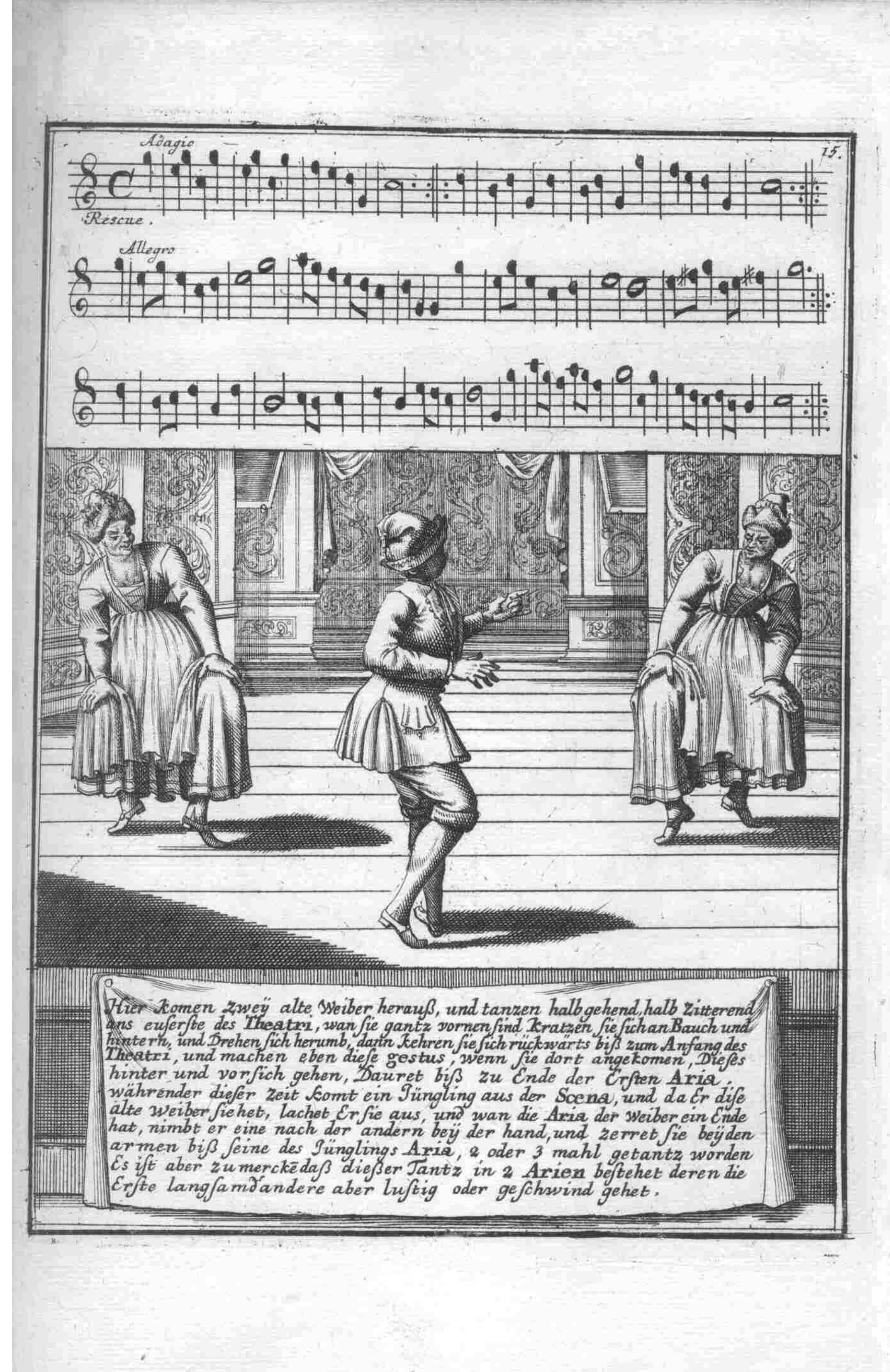
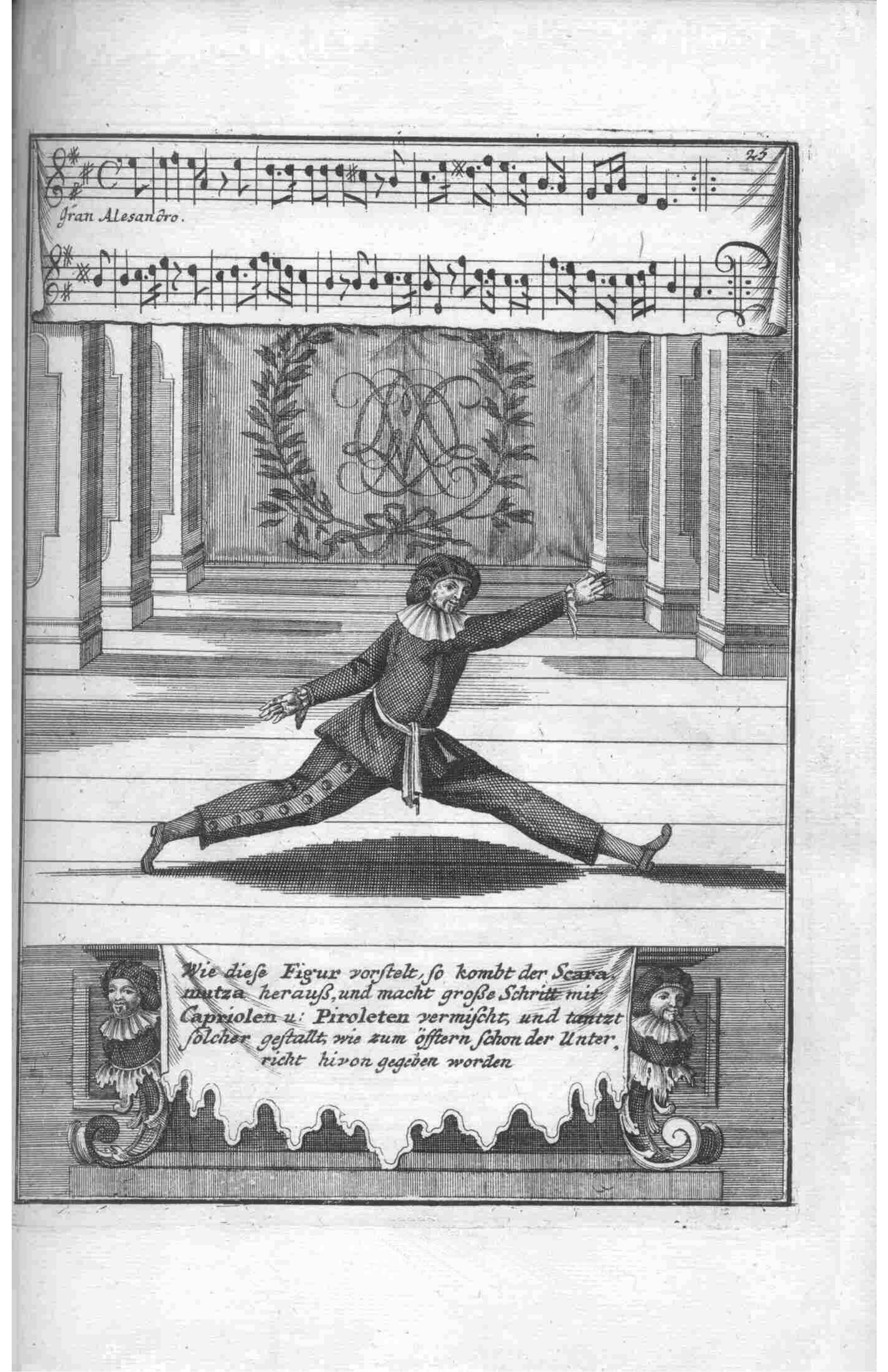
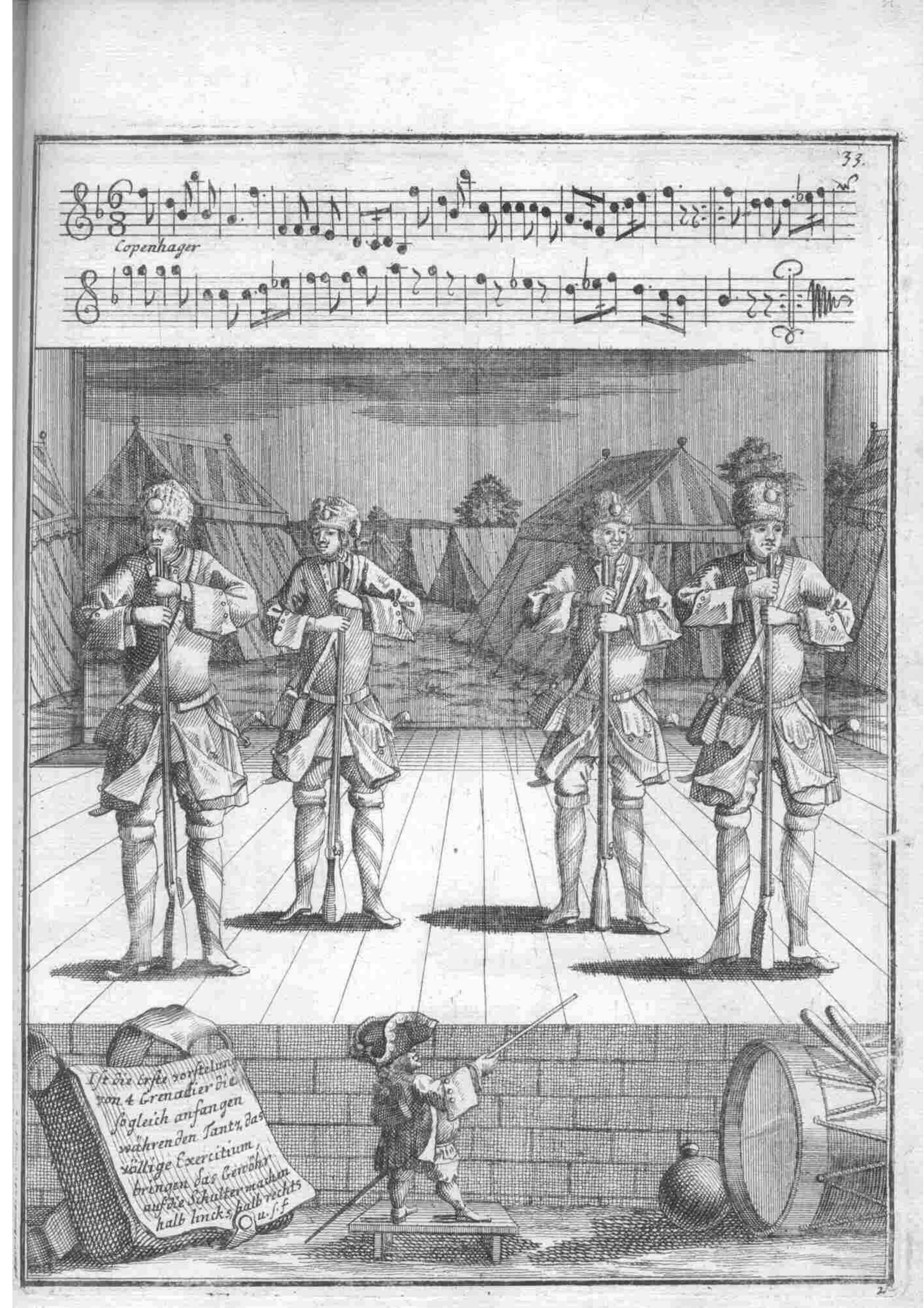
A theatrical stage scene with five figures in military or armored dress arranged in a line across a wooden floor. The figures wear coordinated costumes with fitted jackets, breeches, boots, and ornate headpieces or crowns, suggesting characters of rank or nobility. The background shows a painted backdrop with architectural elements and draped tents, typical of early 18th-century theatrical scenery. The foreground contains stage properties: a shield or armor plaque on the left bearing German text, a drum on the right, and what appears to be a large barrel or prop. The lighting is even and frontal, consistent with stage illumination. Above the scene, two staves of musical notation indicate the melody for this dance.
The dancing
All five figures stand upright in a formal, symmetrical arrangement along the stage depth. Each holds a long staff or pike vertically, suggesting a martial choreography. Their postures are rigid and controlled rather than flowing, with arms held at specific angles. The figures appear to be in a stationary pose rather than mid-movement, presenting the formal frame or opening position of the dance. Their positioning—three in the rear, two in the foreground—creates a clear spatial hierarchy typical of theatrical formation dances.
The dance depicted
This is a military or martial theatrical dance (*ballo theatrale*) from the early 18th century German court tradition. The costume, weaponry, and formal arrangement indicate a dance designed to display courtly prowess and martial dignity. The rigid postures and use of pikes suggest movements based on military drill and geometric formations rather than the fluid, rounded arm movements of courtly minuets or galliards. The notation at top indicates a composed, notated choreography rather than an improvised social dance. This type of martial divertissement would have been performed in court ballets or theatrical intermezzos, where such dances served as spectacle demonstrating the grace and discipline of trained performers.
How it was made
This is a copper-plate engraving from Gregorio Lambranzi's *Nuova e curiosa scuola de' balli theatrali*, a Nuremberg publication of 1716. Engraving allowed precise rendering of detail and fine parallel line-work for shading, visible in the careful hatching of the costumes, the stage floor, and the backdrop. The technique was ideal for reproduction and distribution to a wide readership of dance masters and courtly performers. The pairing of musical notation with a single staged figure or group—repeated across 52 plates in the collection—created a manual format: each plate showed both what to listen for and what a choreographed sequence should look like. The small scale and clarity made these pages suited to study and instruction.
About this work
This is Plate 83 from Gregorio Lambranzi's influential *Nuova e curiosa scuola de' balli theatrali* (1716), one of the most significant published dance manuals of the early Baroque. The plate documents a choreographed military dance (*ballo di guerra*) for five performers in full theatrical dress, with music notated above. Lambranzi's work is exceptional for pairing notated choreography with engravings showing actual costume, formation, and stage setting—making it one of the earliest visual records of how theatrical dances were actually performed and staged. The martial theme, formal arrangement, and ornate dress are characteristic of court spectacle dances that preceded and influenced later ballet.
How to look at it
Observe the rigid symmetry and formal spacing: this is not a moment of fluid motion but a held formation, likely either the opening or a climactic tableau of the dance. Note the weight distribution—all figures are upright and centered, suggesting a restrained, dignified style quite different from the turning, curving walks of a minuet. The vertical lines of the pikes and the figures' bodies echo and reinforce each other, emphasizing geometric order. The stage properties (armor, drum, barrel) are not mere decoration but part of the dance's theatrical vocabulary, suggesting that performers may have interacted with them. The carefully composed notation above confirms that this is a specific, authored choreography rather than a generic court dance.
The artist
Gregorio Lambranzi (c. 1655–after 1710) was a Nuremberg-based dancer and choreographer who created the *Nuova e curiosa scuola de' balli theatrali* as a comprehensive manual of theatrical dances for his contemporaries. The work was translated into French and circulated widely among European court dance masters. Lambranzi's achievement was to document choreography in action rather than as abstract steps, combining musical notation with engraved stage scenes showing actual dancers, costumes, and scenery. This hybrid format made his work practical for learning and teaching, and it has made it invaluable to modern dance historians seeking evidence of 17th and early 18th-century performance practice.
The period
In the early 18th century, theatrical dance at the German and Italian courts was undergoing codification. The *ballo theatrale*—a choreographed performance dance distinct from social dancing—was becoming formalized and increasingly incorporated into court spectacles and operatic productions. Martial dances like this one reflected the fascination of courtly culture with displays of military discipline and courtly prowess. Lambranzi's manual appeared at a moment when dance masters recognized the value of recording choreography in print; the traditional reliance on verbal transmission and apprenticeship was giving way to published notation and imagery. This shift paralleled broader Enlightenment efforts to systematize and preserve knowledge.
Where it lives
This plate comes from the *Nuova e curiosa scuola de' balli theatrali*, a 52-plate manual published in Nuremberg in 1716. Each plate pairs a musical stave with an engraved stage scene, creating a hybrid instruction manual and performance document. The work survives in multiple copies in European libraries and is held by the Library of Congress, among other institutions.
Dance in this work
Questions about this work
What is Lambranzi's manual, and who used it?
The *Nuova e curiosa scuola de' balli theatrali* is a choreographic manual documenting theatrical dances (ballos) performed in German and Italian courts. It was written for dance masters and courtiers who wanted to learn both new dances and the visual language of stage performance. The work was translated into French and circulated across European courts, making it one of the most influential dance publications of its era.
Why is a military dance on a stage?
Military dances were a popular form of court entertainment and courtly display. They demonstrated the refined discipline and martial prowess that were valued in aristocratic culture. These dances were performed as divertissements in court ballets and operatic intermezzos, where they served as spectacular and meaningful entertainment rather than utilitarian military training.
Can we learn the actual steps from this image?
The notation provides the melody, but the musical notation in Lambranzi's era does not indicate exact footwork or arm movements in modern detail. The engraving shows the formation, costume, and stage arrangement, which tells us about the dance's character and scale. Together, the image and notation give dance historians significant information about performance style, but reconstructing the full choreography requires expertise in historical notation systems.
How does this compare to ballet as we know it?
This martial dance predates the formalization of classical ballet technique by several decades. It represents the theatrical dance tradition from which ballet evolved. The upright posture, geometric formations, and codified choreography are proto-ballet, but the style is heavier and more military than the turned-out, ethereal aesthetic that would develop in the 19th century.
More Notation/Choreography artwork