49 works in this view — arrow keys or swipe to move between them.
Dance in Art
Negri — Dance Plate (plate 12)
Cesare Negri (il Trombone)
- Medium:
- Engraving
- Dance:
- Notation/Choreography
- Era:
- Pre-1700 (Renaissance/Baroque)
- Collection:
- Le Gratie d'Amore (1602)
- Source:
- Library of Congress
- Rights:
- Public domain — free to use, share and adapt.
- Recorded as:
- Public Domain
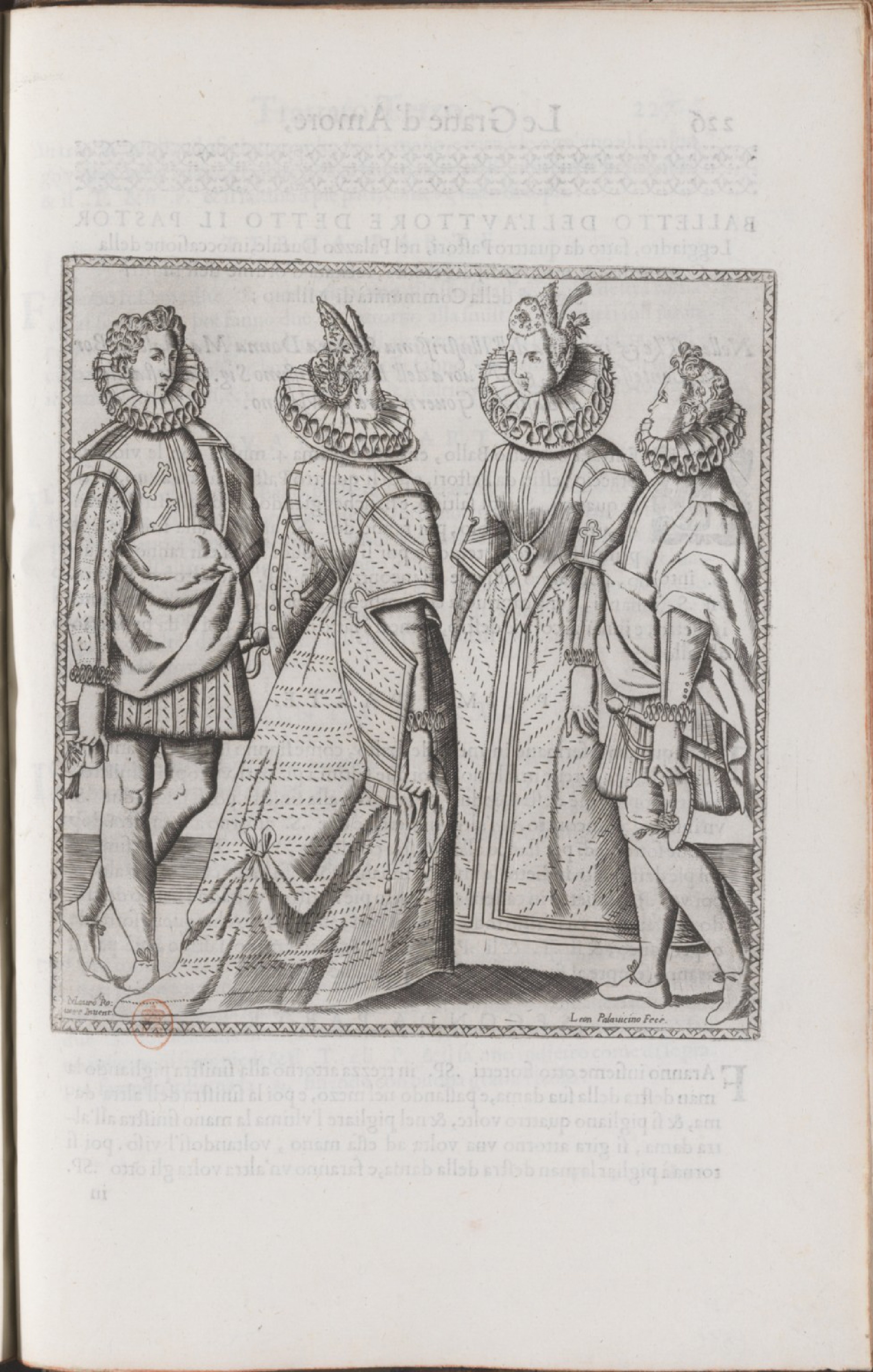
This plate is essential evidence for how Renaissance courtly dance worked as social performance, not just as choreographic abstraction. It shows that the dancer's body was always also a display of rank, fabric, and self-presentation—information no notation system could capture. For historians and dancers interested in reconstructing these dances, Negri's plates are the closest we have to eyewitness testimony about what the dancer was supposed to look like in motion.
What you are looking at
Four figures in rich Renaissance court dress stand in formal arrangement against a plain background, framed by a decorative border typical of printed treatises. From left to right: a man in a slashed doublet and short cape, a figure in an ornate patterned gown with a train, a woman in a high-waisted dress with vertical pleating, and another figure in similar court attire. All wear the characteristic high, ruffled collars (millstones) of early 17th-century fashion. The figures stand in a measured, composed stance rather than active movement—the positioning suggests the moment of pause or formal presentation that precedes or frames a choreographed sequence. The woman second from right holds her skirts, implying the potential for motion. No musicians or setting details appear; the focus is entirely on the dressed bodies and their spatial relationship.
The dancing
The four figures occupy a shallow stage space, arranged so that each is visible in near-profile or three-quarter view. None are in motion; instead, they present themselves in the formal, upright posture expected of high-born dancers. The woman in the center-right lowers her gaze and gathers her skirts slightly, a gesture of courtly decorum. The figures' arms rest naturally at their sides or make minimal, controlled gestures. The spacing suggests they are about to engage in a pattern dance—close enough to interact, distant enough to move through a measured sequence without collision. This is a moment of readiness rather than action.
The dance depicted
This plate depicts courtly dance of the late Renaissance/early Baroque period, most likely a pavane or branle—stately, processional dances that emphasized formation, decorum, and the display of rank and dress. The positioning and restraint suggest Negri's own teaching method, which combined Italian sophistication with formal French court models. The image does not freeze a moment of vigorous footwork or elevation; instead it shows the dancers in the composed attitude that allowed the audience to appreciate their apparel and status. This is courtly dance as social ritual and visual spectacle, a genre in which the dancer's body served the music and the geometry of the room as much as the reverse.
How it was made
This is an engraving, a process that allowed fine detail and was the standard medium for printed dance treatises in this period. The technique enabled Negri to render the intricate patterning of fabrics, the structure of the collars, and the folds of the heavy garments with precision—information crucial to readers who wanted to understand not just the steps but the full visual effect of courtly dance. Engravings circulated widely in print; this plate is one of many in *Le Gratie d'Amore*, which was distributed to courts and dance masters across Europe. The medium made Negri's work accessible to a learned, literate audience beyond his own pupils.
About this work
This is one of Cesare Negri's instructional plates from *Le Gratie d'Amore* (Milan, 1602/1604), a foundational treatise on Italian Renaissance courtly dance. Negri was the most celebrated dance master of his time, and this engraving exemplifies his method of teaching through the figure—static images of dressed dancers arranged in the formation that would generate a choreographed sequence. The plate shows four dancers in early 17th-century court dress, posed in the formal, measured attitude that defined haute danse in this period. Rather than capturing a leap or turn, it freezes the moment of presentation and spatial readiness that allowed the dance to unfold with geometry and grace.
The work sits at a crucial moment in dance's transition from oral tradition to printed notation. Unlike Caroso's earlier treatise (which Negri knew and built on), Negri's *Gratie* does not attempt to show footwork in detail; instead it offers the social and visual context of courtly dance—the dress, the deportment, the spatial patterns. For a reader consulting this plate alongside text and music, the image conveyed what a notation system could not: how dancers of rank actually appeared, and how their bodies occupied and transformed the space of the ballroom.
How to look at it
Look first at the arrangement: how do these four figures divide the space, and what pattern might their movement trace? Notice the dress in detail—the collars, the cut, the weight of the fabrics—because Negri's plates were as much about showing how clothes moved as about showing steps. Observe the posture: the upright spine, the controlled arm position, the minimal gesture. This is not the body at its most mobile; it is the body at its most formal and most visible. The plate asks you to imagine motion from stillness, to read from the pose and the fabric the potential for a measured, stately progression. This was the late Renaissance idea of grace: not the most movement, but the most control.
The artist
Cesare Negri (c. 1535–c. 1604), known as 'il Trombone,' was the most influential Italian dance master of the late Renaissance. Based in Milan, he served the ducal court and taught throughout Italy and France, gaining renown as an innovator in choreography and an elegant performer. His *Le Gratie d'Amore* (published in two editions, 1602 and 1604) became the standard reference for courtly dance across Europe. Unlike Fabrizio Caroso, whose *Il Ballarino* (1581) focused on the couple, Negri worked with larger formations and emphasized the synthesis of music, poetry, architecture, and dance as a unified art of spectacle. His theoretical contributions—on allegory, on the relationship between the body and music, on the moral education dance provided—placed him among the major humanist thinkers of his age.
The period
In the early 17th century, courtly dance was at its apex as an art form and a marker of social status. The courts of Italy and France were centers of intense patronage, and dance masters competed for position and fame by devising novel choreography and teaching methods. The printed treatise was still a relatively new form; Caroso's *Il Ballarino* (1581) had pioneered the idea of publishing dance for a wide audience of socially ambitious readers. By the time Negri published, the market was established, and readers expected both detailed instruction and elegant visual representation. The engraving technique allowed Negri to compete with Caroso on aesthetic grounds while offering a different pedagogical vision—one centered on formation, music, and the integration of dance into courtly life rather than on the technical mastery of the couple.
Where it lives
This engraving is from *Le Gratie d'Amore*, Cesare Negri's major treatise published in Milan in 1602 and again in 1604. The work circulated among courts and dance masters and survives in multiple copies in libraries across Europe and North America. It is one of the most important surviving dance treatises and a primary source for the study of Renaissance courtly dance.
Dance in this work
Questions about this work
Can you tell from the image what dance these people are about to do?
The formal posture, the restrained gesture, and the careful arrangement suggest a processional or formation dance—likely a pavane or branle, both of which emphasized geometry, decorum, and the display of rank and dress. Negri's text would identify the specific choreography, but the image conveys the tone: measured, orderly, and focused on visual effect as much as on footwork.
What is the difference between Negri's approach and Caroso's?
Caroso's earlier treatise focused on the couple and offered detailed notation of steps and positions for individual dancers. Negri's *Gratie d'Amore* emphasizes larger formations, the relationship between music and movement, and the integration of dance into courtly spectacle. His plates, like this one, show the social and visual context of dance rather than attempting to notate footwork.
Why is the dress so important in a dance treatise?
In Renaissance courtly dance, the dress was inseparable from the dance itself. The weight and volume of the fabrics, the height of the collars, the way skirts moved—these were all factors in how the body moved and how the dance looked. Negri's engravings, with their fine detail, allowed readers to understand the full visual effect of the dance, not just the steps.
Who would have read this book?
Dance masters, courtiers, and socially ambitious readers across Italy, France, and beyond. The treatise was expensive and beautiful, intended for readers of high status who could afford it and who had reason to learn courtly dances. It was as much a work of art and a status symbol as it was an instructional manual.
More Notation/Choreography artwork