49 works in this view — arrow keys or swipe to move between them.
Dance in Art
Group — Plate 88
Gregorio Lambranzi
- Medium:
- Copper-plate engraving
- Dance:
- Notation/Choreography
- Era:
- 1700s (Enlightenment/Minuet Era)
- Collection:
- Nuova e curiosa scuola de' balli theatrali (1716)
- Source:
- Library of Congress
- Rights:
- Public domain — free to use, share and adapt.
- Recorded as:
- Public Domain
Lambranzi's manual is one of the earliest European sources to document theatrical dance through engraved notation and figural illustration, making it foundational to the study of early 18th-century stage dance practice. This particular plate reveals the period's fascination with exoticized "Turkish" performance types and the satirical use of corpulent male bodies in comedic theatre—aesthetic choices that shaped European theatrical dance for decades. For historians of dance and spectacle, the work is invaluable evidence of how non-Western dance and bodies were imagined, staged, and circulated in early modern European entertainment.
What you are looking at
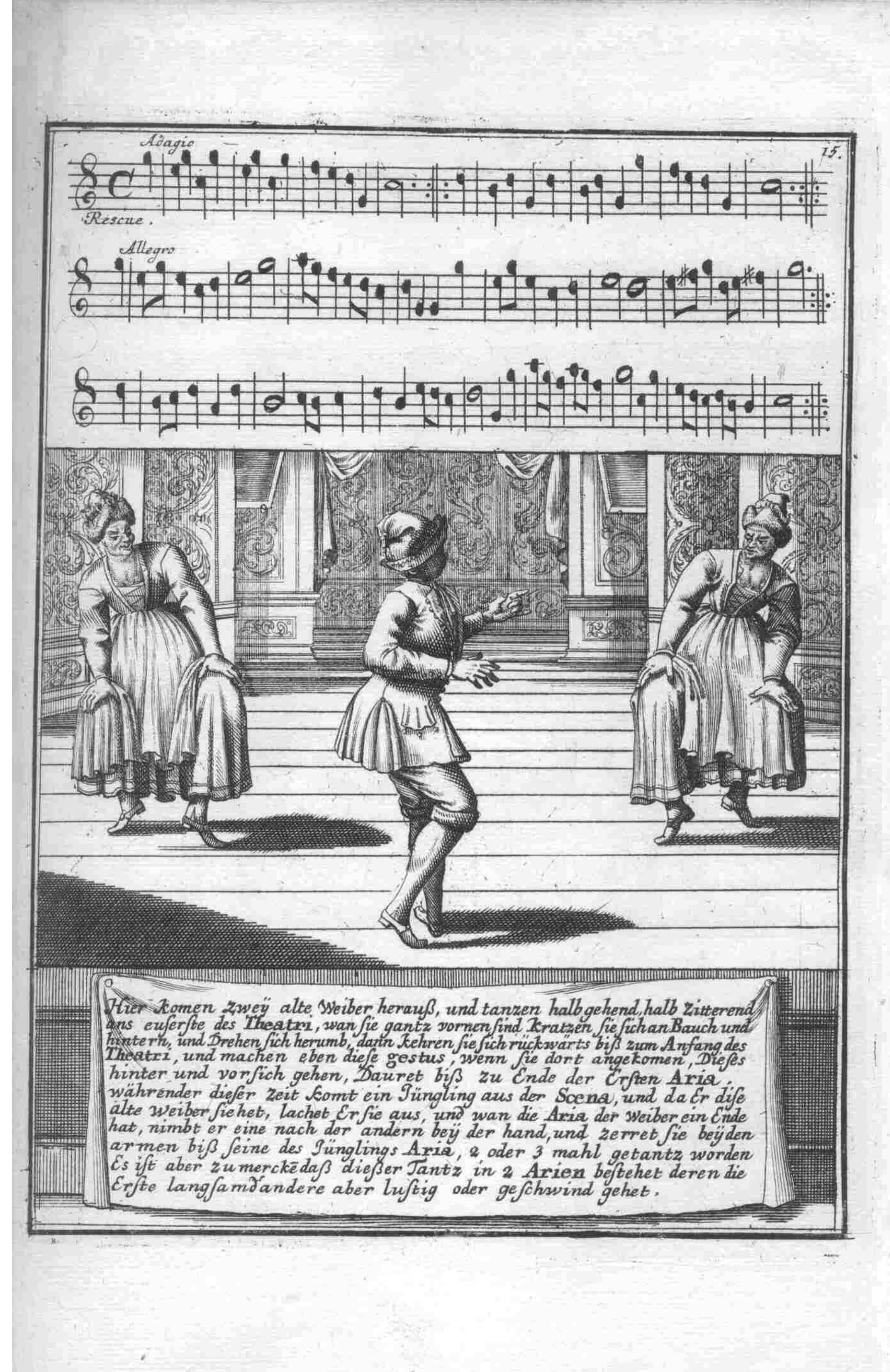
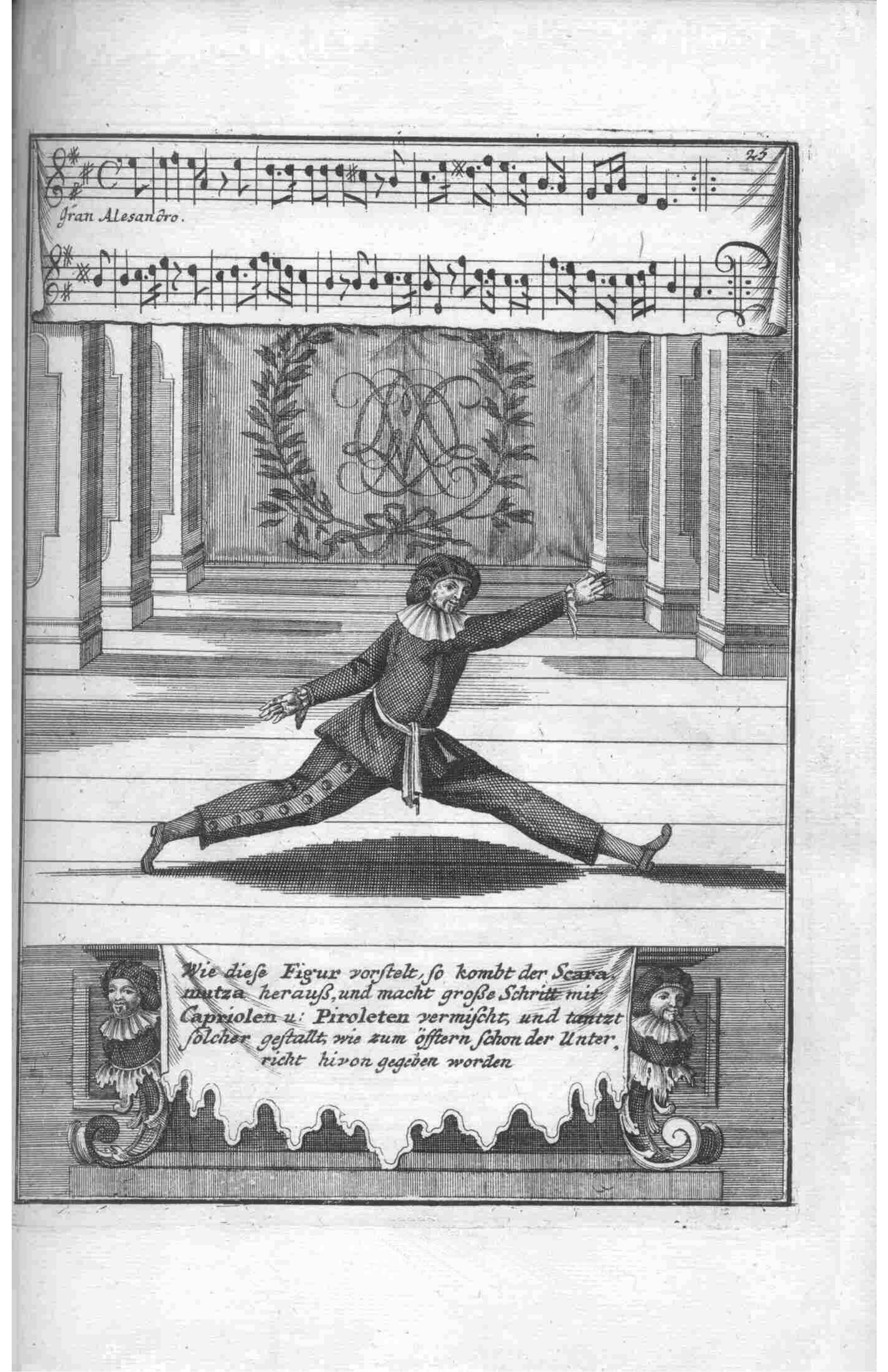
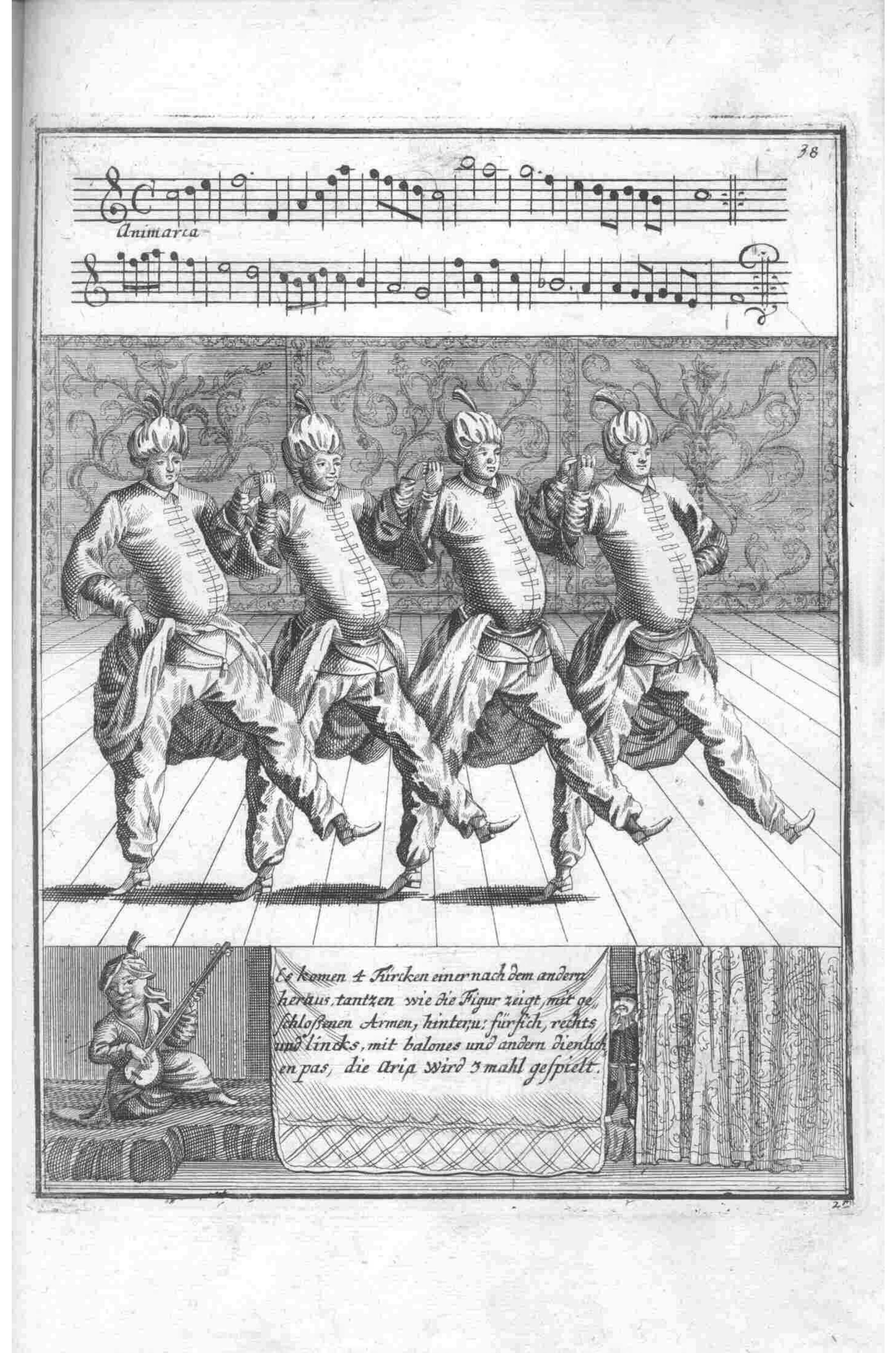
Four corpulent male figures in Ottoman dress stand in a staged interior with a patterned textile backdrop and wooden floor. Each wears a tall white turban, a long buttoned robe cinched at the waist, and loose breeches. They are arranged in a loose line across the stage, their bodies facing forward with legs spread wide in a straddle stance. Their arms are raised and bent at the elbows in similar poses, suggesting a synchronized group movement. The engraving captures them mid-gesture in what appears to be a theatrical or performative moment. Below the stage, a scroll contains German text describing the dance, flanked by two vignettes: on the left, a seated figure playing a wind instrument; on the right, draped curtains suggesting a theatrical setting.
The dancing
The four dancers present an identical or near-identical posture: legs in a wide second position or straddle, torso upright, arms raised with elbows bent at roughly 90 degrees and hands at shoulder height or slightly higher. The stance is stable and grounded, with weight distributed evenly. The uniformity of pose across all four figures emphasizes the group choreography. No closed holds or partner contact is visible; instead, each dancer occupies discrete space while maintaining formation.
The dance depicted
This appears to be a satirical or comedic theatrical dance from the early 18th century, possibly a *Türkentanz* (Turkish dance) or similar exoticized performance type popular in European court and commercial theatre of the period. The exaggerated corpulence of the figures, their synchronized heavy-legged stance, and the Ottoman costume all suggest parody or burlesque of Turkish court dance rather than an attempt at ethnographic accuracy. The wide straddle and raised-arm position do not correspond to documented Ottoman recreational or court dance forms, indicating instead a European theatrical convention for representing foreign bodies in motion. This work documents the body type and movement style that European audiences associated with Ottoman masculinity in performance.
How it was made
A copper-plate engraving, executed with fine cross-hatching to model form and create tonal variation. The technique allowed for precise detail in costume and physiognomy, and the print's capacity for reproduction made it a key medium for disseminating choreographic notation and theatrical imagery across Europe. The pairing of musical notation at top with illustrated figures below was a standard format in dance manuals and theatrical instruction books, enabling the work to function both as a visual document and a practical teaching aid.
About this work
This is Plate 88 from Gregorio Lambranzi's *Nuova e curiosa scuola de' balli theatrali* (Nuremberg, 1716), one of the era's most comprehensive and influential illustrated dance manuals. The work pairs a notated musical phrase with an engraved scene of four dancers in Ottoman costume performing a synchronized group movement on a theatrical stage. As a page from a manual intended for professional dancers, choreographers, and theatre practitioners, it functioned as both a record of a specific theatrical performance type and an instructional model for reproduction. The inclusion of musical notation above the figures explicitly links bodily movement to temporal and melodic structure.
How to look at it
Attend to the absolute uniformity of posture across all four dancers—this is a group choreography in which repetition and synchronization are the choreographic principle. Notice the wide, heavy-legged stance: the feet are placed well apart, the legs are straight and weight-bearing, and the body is upright rather than lifted. This contrasts markedly with the lighter, more elevated carriage of contemporary court dance (minuet, courante) and signals instead a grounded, earthbound movement vocabulary. The raised arms with bent elbows suggest a gesture of celebration or festivity, but the overall effect—combined with the exaggerated waistlines and the patterned costume—is comic or burlesque rather than noble or dignified.
The artist
Gregorio Lambranzi (c. 1680–1730) was an Italian dancing master and choreographer active in the German-speaking territories. He is known almost exclusively through the *Nuova e curiosa scuola de' balli theatrali*, published in Nuremberg in 1716, which contains roughly 100 engraved plates documenting a vast repertory of theatrical dances. The work represents a unique attempt to systematize and preserve dance knowledge through notation and illustration at a moment when most dance transmission remained oral and embodied. Lambranzi's manual influenced later European dance notation systems and remains one of the most detailed visual records of early 18th-century theatrical choreography.
The period
The early 18th century saw a flourishing of illustrated dance manuals across Europe, driven by the codification of court dance into a teachable system and the rise of professional theatrical dance in opera and commercial venues. Lambranzi's work belongs to the final generation of baroque dance documentation before the Cecchetti and Beaumont systematization of ballet technique in the 19th century. The period was also marked by European fascination with Ottoman culture—following the Treaty of Carlowitz (1699)—which found expression in "turquerie" across visual arts, theatre, and music. Satirical Turkish dances and the comic exaggeration of non-European bodies were stock theatrical types in the early 18th century.
Where it lives
This is a page from Gregorio Lambranzi's *Nuova e curiosa scuola de' balli theatrali*, a bound or loose-leaf collection of 100+ engraved copper plates published in Nuremberg in 1716. Copies are held in major libraries and archives throughout Europe. The work functioned both as a luxury illustrated book for collectors and connoisseurs and as a practical manual for dancers and choreographers seeking to learn or reconstruct dances from notation and figural cues.
Dance in this work
Questions about this work
How should I read the musical notation at the top?
The notation indicates the melody and temporal structure of the dance's musical accompaniment. Dancers and musicians would use this staff notation to align movement phrasing with musical meter. Early 18th-century theatrical dance was always set to music, and the notation ensures that the choreography and music can be reproduced together.
Was this a real Turkish dance or a European invention?
This is almost certainly a European theatrical invention—a "Türkentanz" or comic Turkish dance created for European audiences. The exaggerated silhouettes, the wide straddle stance, and the synchronized group formation do not correspond to documented Ottoman dance practice. Instead, the work reflects European stereotypes and fantasies about Turkish bodies and culture, filtered through the conventions of comic theatrical performance.
Why are all four dancers identical?
The uniformity reflects the choreographic principle of the piece: a group dance built on repetition and synchronization. All dancers perform the same movement phrase in unison, which was a common structure in early 18th-century theatrical group dances. The engraver may also have repeated a single figure for efficiency.
What was Lambranzi's manual used for?
The *Nuova e curiosa scuola* served dual purposes: as a luxury publication for wealthy collectors and connoisseurs interested in dance, and as a practical teaching tool for professional dancers, choreographers, and musicians. The pairing of notation with illustrations allowed users to study dances from the page and reconstruct them in practice. It was one of the first systematic attempts to document and preserve theatrical dance through print.
More Notation/Choreography artwork