49 works in this view — arrow keys or swipe to move between them.
Dance in Art
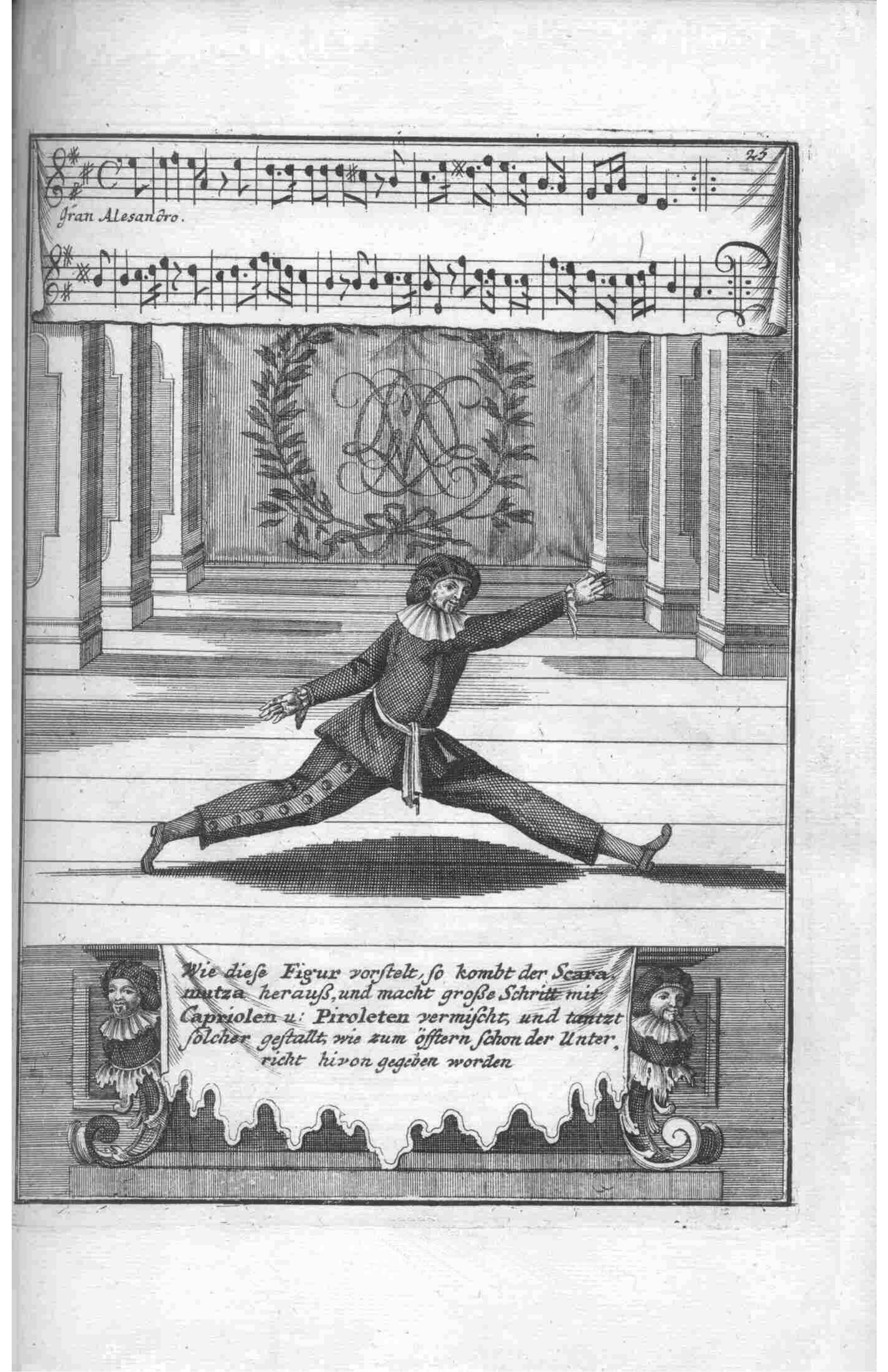
Acrobatic — Plate 93
Gregorio Lambranzi
- Medium:
- Copper-plate engraving
- Dance:
- Notation/Choreography
- Era:
- 1700s (Enlightenment/Minuet Era)
- Collection:
- Nuova e curiosa scuola de' balli theatrali (1716)
- Source:
- Library of Congress
- Rights:
- Public domain — free to use, share and adapt.
- Recorded as:
- Public Domain
For dance historians, this plate is primary evidence of what theatrical performers were actually trained to do in the early 18th century—not just the minuet or the gavotte, but also acrobatic feats that modern eyes might categorize as gymnastics. For researchers studying the history of contortionism, acrobatic dance, and the physical culture of theatre, Lambranzi is one of the earliest surviving systematic records.
What you are looking at
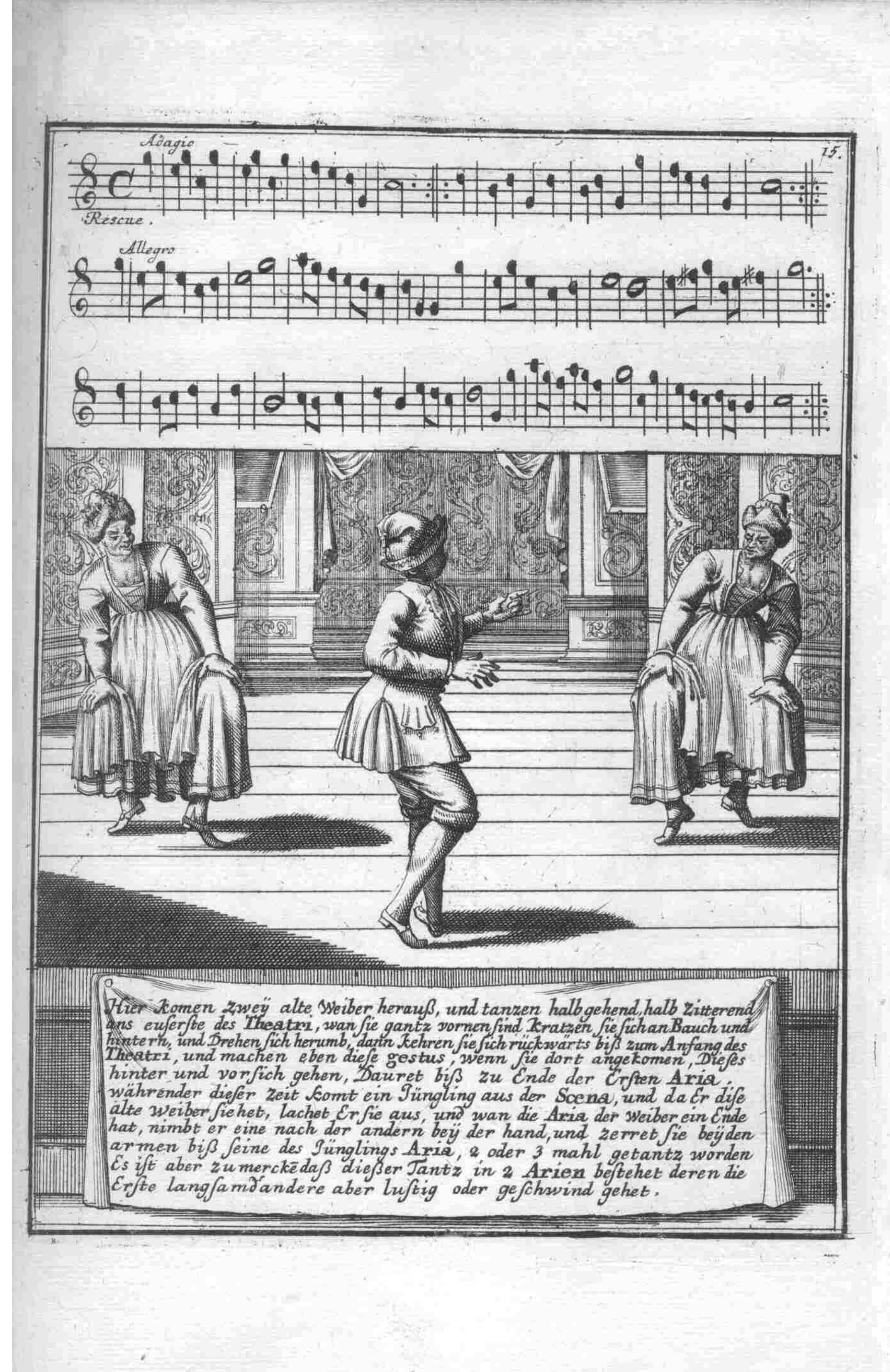
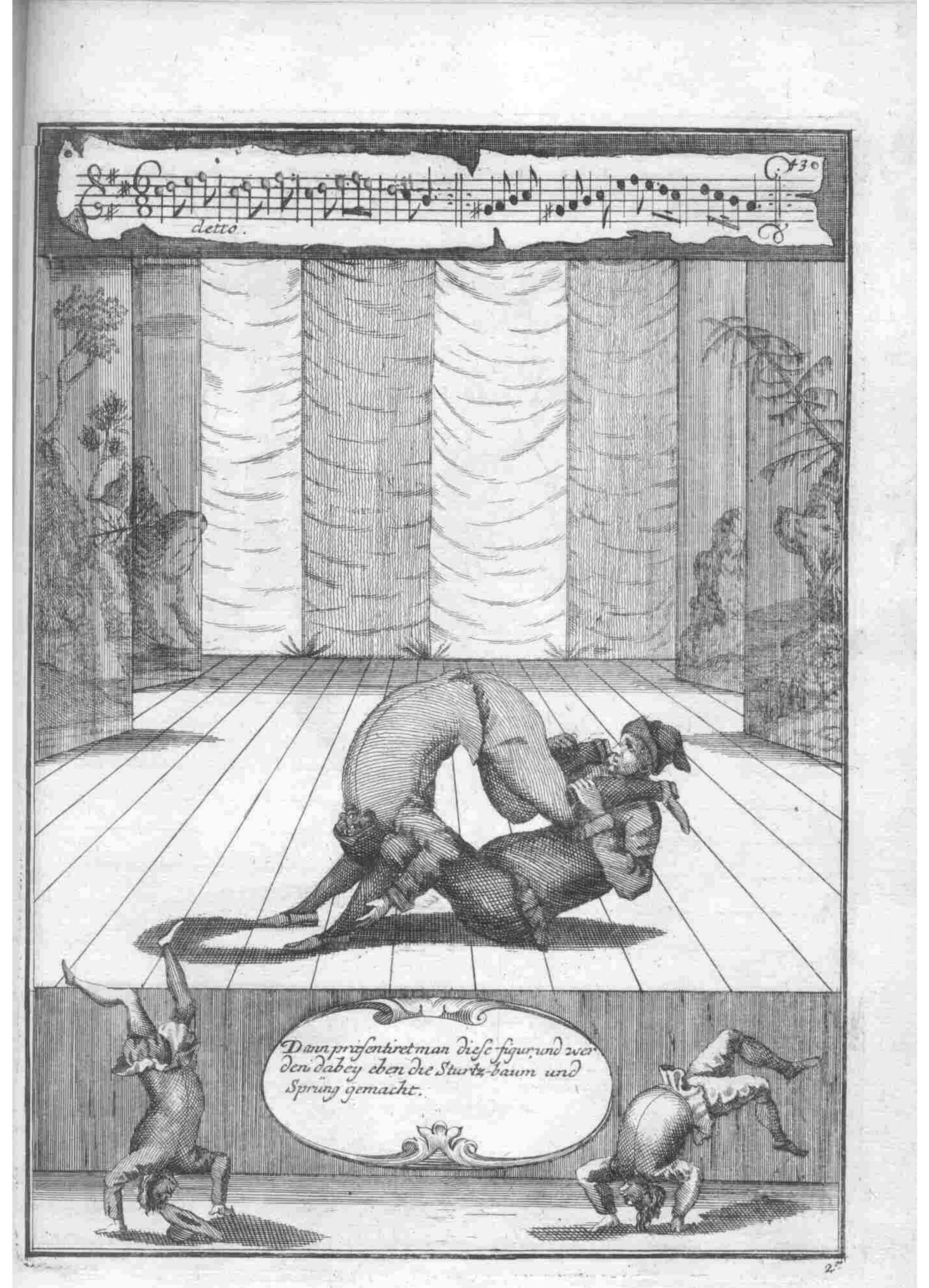
A male dancer in a curtained theatrical interior performs a deep contortionist pose on a wooden-floored stage. The figure bends sharply backward, with one leg extended high behind and arms wrapping around the torso, the body folded nearly in half in a posture of extreme flexibility. The stage is framed by tall columns draped with heavy swags of fabric—the architecture and drapery suggest a formal theatrical setting of the early 18th century. Two cherub or putto figures appear below the stage, flanking a scrolled cartouche containing German text. Musical notation is engraved at the top of the plate, paired with the choreographic instruction below, as is characteristic of Lambranzi's manual.
The dancing
A single male dancer, costumed in period dress with breeches and jacket, executes a severe spinal arch with the torso deeply flexed backward. The weight appears supported on one or both feet while the body curves in a near-U shape; one leg lifts away from the ground, demonstrating active control as well as extreme range. The arms are engaged in the fold, and the head is thrown back in the line of the spinal extension. This is not balletic port de bras or a conventional theatrical hold—it is a demonstration of the body's extreme plasticity.
The dance depicted
This is theatrical acrobatics or contortionism integrated into early 18th-century theatrical dance practice. The image records a technical feat performed in the context of ballet d'action or theatrical spectacle, where dancers were expected to demonstrate virtuosic physical control including extreme flexibility and contortions. Lambranzi's manual documents dances and movements that blurred the boundaries between balletic training, acrobatic display, and pantomimic theatre. This is likely a movement taught and performed in aristocratic contexts or public theatre.
How it was made
This is a copper-plate engraving, a technique requiring skilled hand-cutting of lines into a polished copper surface. The fineness of the parallel lines (hatching and cross-hatching) in the drapery and the precision of the anatomical contours show the engraver's ability to create tonal depth and texture. Engraving was the most durable and reproducible printmaking medium of the period and allowed wide distribution of instructional images; this work's inclusion in a bound manual meant it could circulate in the libraries of dance masters, theatre practitioners, and educated patrons across Europe.
About this work
This is a single plate from Gregorio Lambranzi's *Nuova e curiosa scuola de' balli theatrali*, one of the most influential treatises on theatrical dance and movement of the early 18th century. The plate pairs notated music with a choreographic figure—in this case, a contortionist pose that displays the extreme physical range expected of theatrical performers. The work documents not 'dance' in the modern sense but rather the grammar of theatrical movement as it was taught and performed in the courts and stages of the Holy Roman Empire. It sits at the historical intersection of ballet training, acrobatic performance, and bodily display.
Lambranzi's manual served both as instruction and as cultural record: it authorized certain movements as part of professional practice and circulated them across the network of European dance masters. This plate in particular captures a specific moment of aesthetic permission—a time when the extension of the body into extreme plasticity was considered theatrical and teachable, a mark of a performer's control and cultivation.
How to look at it
Observe the precision of the body's geometric distortion and the way the engraver has rendered the strain and control in the musculature through fine hatching. Notice that the pose is not slack or passive but achieved through active muscular engagement—the extended leg, the engaged arms, the lifted chest. The musical notation at the top invites us to imagine rhythm and timing: this contortion was not static but part of a continuous theatrical phrase, presumably timed to music. The cartouche below with its German text originally contained instruction for the performer—a verbal accompaniment to the visual and musical record.
The artist
Gregorio Lambranzi was a dance master, choreographer, and author active in Nuremberg in the early 18th century. His manual, first published in 1716, synthesized decades of practice in court and theatrical dance. The work is notable for its combination of written description, musical notation, and engraved figures—a multimedia approach to dance instruction that was innovative for its time. Lambranzi's practice bridged the Italian and German theatrical traditions and served practitioners across Europe.
The period
The early 18th century was a period of intense formalization and codification of dance technique. The minuet and other court dances were being standardized, but the theatrical and balletic vocabulary was far wider and more physically adventurous than the court dances we now associate with the period. Contortionism and acrobatic feats were not marginal to theatrical practice but central to it; performers were expected to command an enormous range of body positions and movements. This was also the era in which dance notation systems (Feuillet notation, used for the musical notation here) were being developed to capture and transmit choreography across distance and time. Lambranzi's manual is a record of this expansion of the body's theatrical possibilities.
Where it lives
This plate is one of approximately 120 engraved figures in the first edition of *Nuova e curiosa scuola de' balli theatrali*, published in Nuremberg in 1716 by the printer Johann Christoph Weigel. It is catalogued as Plate 93. The manual survives in institutional collections across Europe and North America and is recognized as a foundational document in dance history.
Dance in this work
Questions about this work
Was contortionism actually part of professional dance in the 1700s?
Yes. Lambranzi's manual, which is didactic and systematic rather than fantastical, includes numerous such movements as part of a dance master's expected curriculum. This was theatrical dance, not court social dance, but it was serious training. Performers were regularly expected to demonstrate extreme flexibility, jumping, turning, and acrobatic feats as part of their professional repertoire.
How do I read the musical notation at the top?
The notation uses the Feuillet system, a cipher notation developed for recording dances. It accompanies each choreographic figure in the manual. While the notation alone does not fully specify the contortion, it indicates tempo and rhythmic structure. A dance master consulting the manual would read both the notation and the engraved figure to reconstruct the movement.
Who was Gregorio Lambranzi?
Lambranzi was a celebrated dance master and choreographer in Nuremberg in the early 18th century. He synthesized Italian and German theatrical and court dance practices and produced what became one of the most widely circulated dance manuals in Europe. Little is known of his life beyond his professional output, but his manual establishes him as a systematic and innovative pedagogue.
Why is this in a dance history collection if it looks more like acrobatics?
Because early modern theatrical dance included what we now separate into different categories—dance, acrobatics, gymnastics, mime. Lambranzi's manual is evidence that these were unified in practice. A 'dance' in this era could incorporate any virtuosic bodily feat. Studying what dancers actually did, rather than what modern categories would allow, is essential to dance history.
More Notation/Choreography artwork