49 works in this view — arrow keys or swipe to move between them.
Dance in Art
Allegorical — Plate 3
Gregorio Lambranzi
- Medium:
- Copper-plate engraving
- Dance:
- Notation/Choreography
- Era:
- 1700s (Enlightenment/Minuet Era)
- Collection:
- Nuova e curiosa scuola de' balli theatrali (1716)
- Source:
- Library of Congress
- Rights:
- Public domain — free to use, share and adapt.
- Recorded as:
- Public Domain
This work is essential evidence for understanding how allegorical and theatrical solo dances were actually performed in the early 18th century—a period from which we have almost no other visual record. Lambranzi's engravings show us the posture, arm position, weight distribution, and spatial logic of Baroque theatrical training at the moment when that tradition was at its height and just about to be codified into what would become ballet.
What you are looking at
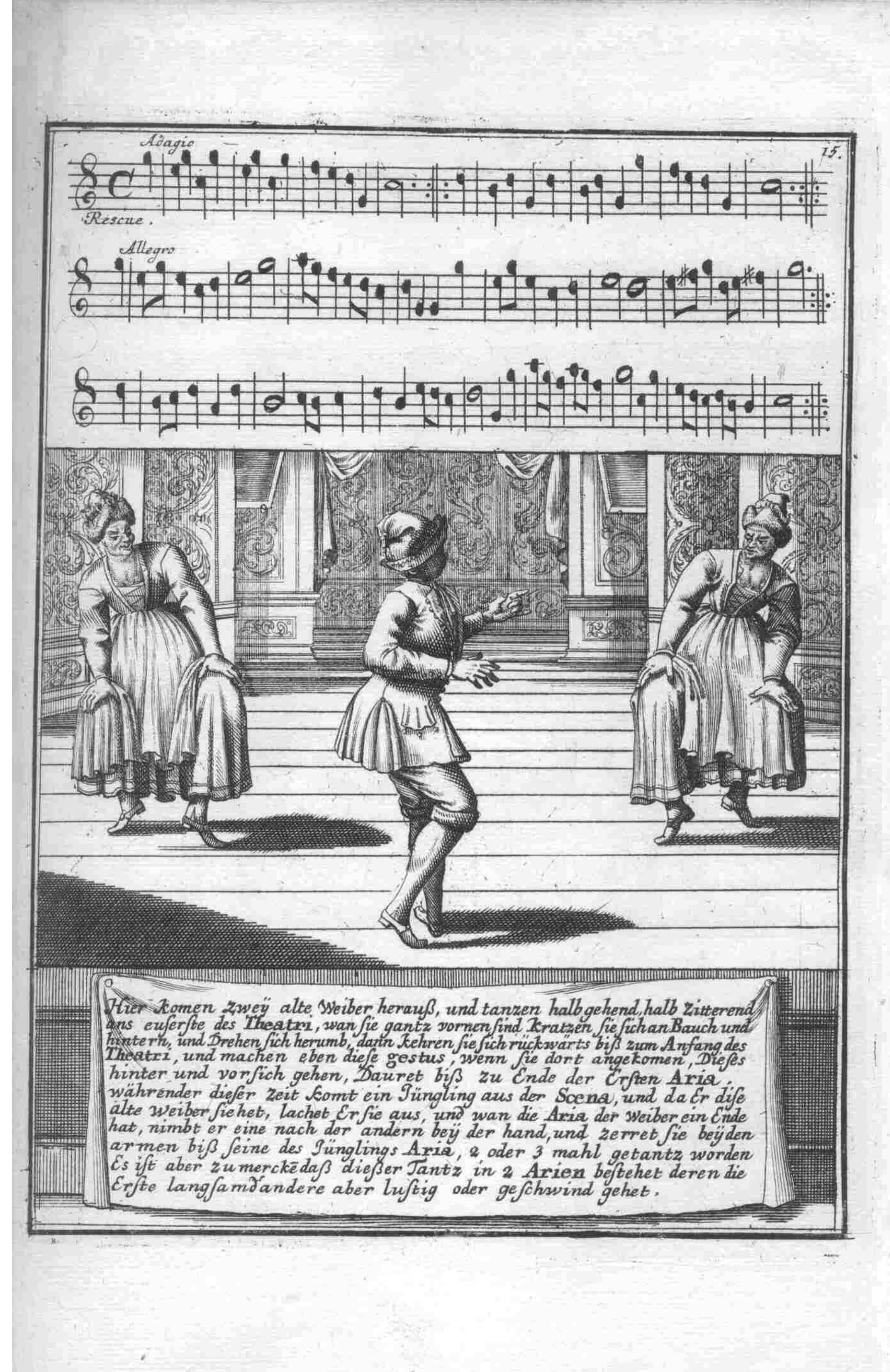
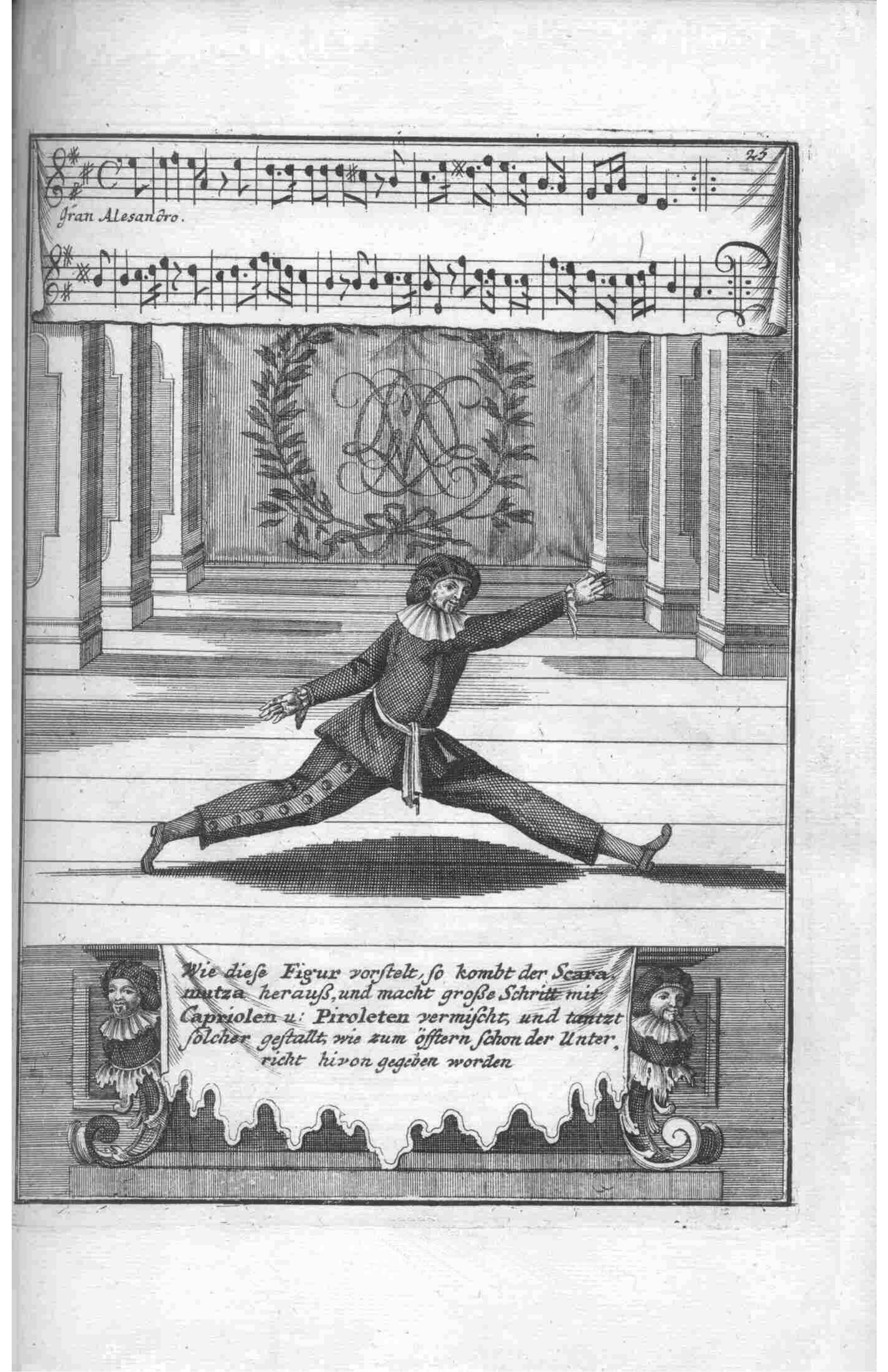
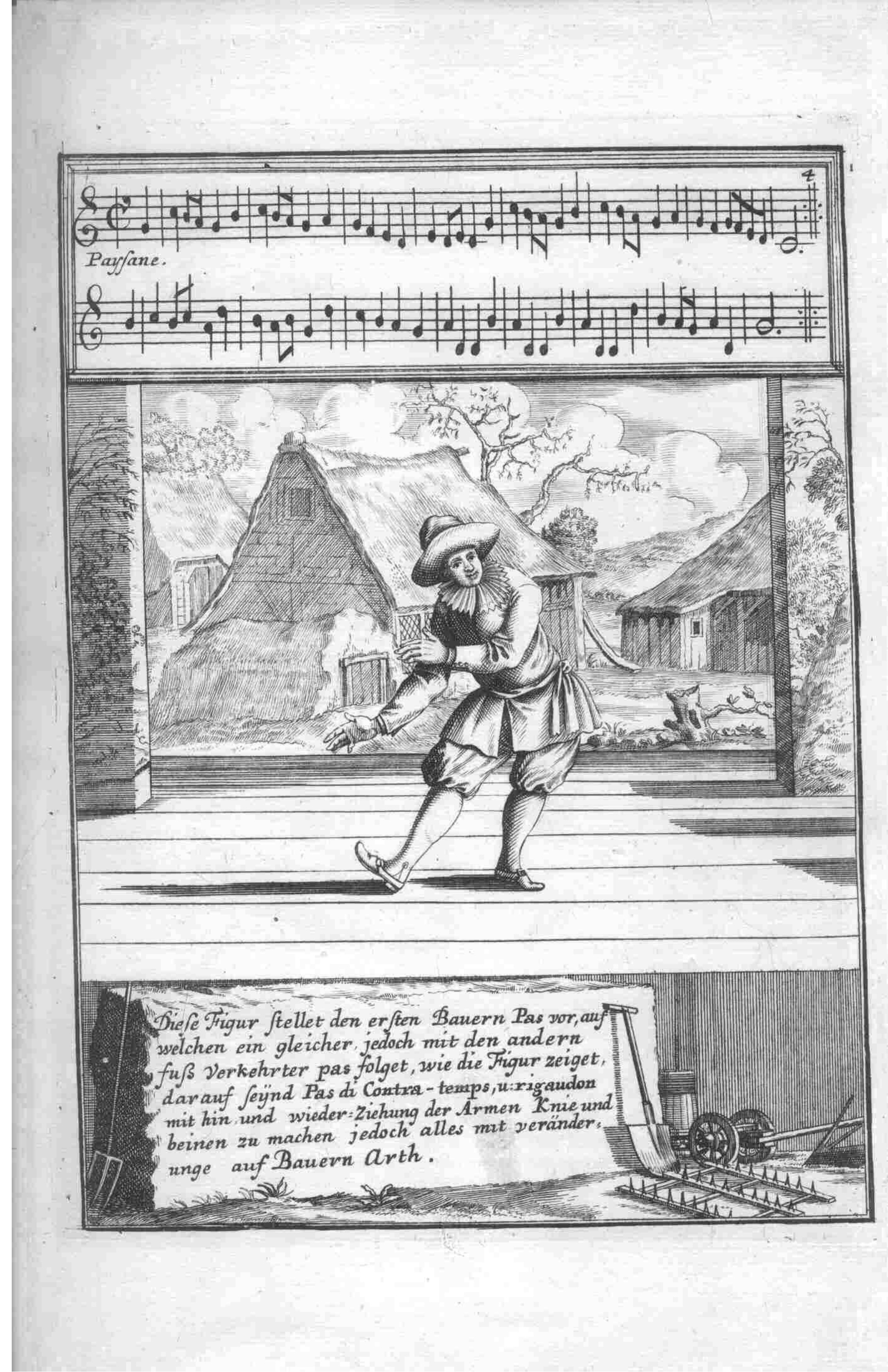
A solo figure in classical drapery performs on a shallow stage framed by a curtain and architectural proscenium. The dancer wears a wide-brimmed hat, fitted dark jacket, and knee-length skirt in the fashion of early 18th-century theatrical dress, with legs in stockings and feet in soft shoes. The stage is set with pyramidal scenery suggesting a countryside or arcadian landscape—peaked-roof buildings visible upstage, trees and clouds rendered in perspective. The dancer is captured mid-gesture, with one arm extended outward and the body angled in a dynamic contrapposto stance, the weight shifting through the supporting leg in a way that conveys elegant, controlled movement. The engraving is executed with fine crosshatching, giving volumetric form to the fabric and subtle modeling to the figure. Above the scene, two staves of music notation labeled 'Payfane' provide the choreographic accompaniment—this plate pairs visual with musical instruction.
The dancing
The single dancer stands in a weight-shifted pose with arms asymmetrically positioned—one extended into space with a gesture of offering or invitation, the other held closer to the torso. The body is upright but not rigid; the angle of the torso and the slight curve of the supporting leg suggest the controlled ease of trained court dancing. The feet are placed with the characteristic turned-out position of early Baroque technique, visible in the profile stance. The overall frame is open and linear rather than compact, with the limbs creating clear sight lines through the figure.
The dance depicted
This is a theatrical allegorical or mythological solo from Lambranzi's *Nuova e curiosa scuola de' balli theatrali*, a compendium of theatrical dance choreography published in 1716. The figure's pose and costume—classical drapery, hat, andarcadian setting—suggest an emblematic character rather than a named mythological figure, designed to be performed as a solo interlude or character dance in a theatrical context. The notation above indicates this was a set phrase with a fixed melodic and rhythmic accompaniment, a common practice for theatrical dances of the period. The open, extended arm position and the weight distribution visible in the leg suggest a dance that prioritized clarity of gesture and nobility of carriage—core values of Baroque theatrical training.
How it was made
This is a copper-plate engraving, a technique that allowed fine detail and multiple impressions from a single plate. The dense crosshatching, the precise modeling of light and shadow on fabric and flesh, and the clarity of the musical notation all demonstrate the control Lambranzi's engraver achieved. Engraving was the standard method for publishing dance instruction manuals in the early 18th century, as it could reproduce both image and notation with fidelity and durability; the technique made such manuals expensive and valuable objects, circulated among teachers, professional dancers, and educated patrons interested in theatrical spectacle.
About this work
This is one page from *Nuova e curiosa scuola de' balli theatrali* (*New and Curious School of Theatrical Dances*), Gregorio Lambranzi's groundbreaking 1716 compendium of theatrical choreography. Each plate in the work presents a solo or group dance in an engraved illustration paired with musical notation—a format that united visual documentation with musical score for the first time in dance pedagogy. The dancer depicted here wears the costume and carries the gesture of allegorical theater, a central form of court and public entertainment in early 18th-century Europe.
Lambranzi's work represents a crucial moment in the history of dance documentation. Unlike earlier dance manuals, which relied on text and geometric floor patterns, Lambranzi committed to engraved images of the human body in motion, recognizing that teaching dance required showing how the body actually inhabited space and time. The *scuola* became one of the most influential references for understanding how professional dancers moved in the Baroque period.
How to look at it
Look first at the relationship between the body and the ground. The dancer's weight is clearly supported by one leg while the other is poised or extended—a fundamental principle of Baroque dance. Notice the arm position: one is open and reaching, creating a diagonal line from the torso outward, while the other maintains a closer, more controlled relationship to the body. This asymmetry was central to the theatrical grammar of the period—it created visual interest and narrative possibility. The hat and costume signal that this is a character or role, not a generic dance figure. Finally, attend to the engrave's rendering of the fabric: the way the skirt catches light and falls tells you about the weight and cut of the material, and suggests how the dancer's motion would create shape and silhouette on stage.
The artist
Gregorio Lambranzi (fl. 1686–1730) was a dancer, choreographer, and dance master active primarily in Nuremberg. He is known almost exclusively through the *Nuova e curiosa scuola de' balli theatrali*, published in Nuremberg in 1716 and reprinted in a French edition in 1728. The work comprises 131 engraved plates—each showing a figure or group in theatrical costume and pose, with musical notation. Though Lambranzi's life and training are poorly documented, the sophistication and consistency of the *scuola* suggest he was an accomplished practitioner of both Italian and German theatrical dance traditions. The work was created late in his career and stands as his singular major contribution to the historical record.
The period
In the early 18th century, theatrical dance was rapidly professionalized and codified. Court ballet had given way to the public opera house; allegorical and comic characters danced between vocal numbers. The Baroque style—characterized by turned-out legs, lifted carriage, and gestures derived from courtly deportment—was the dominant vocabulary. This was the world of Marie Sallé and Marie-Anne de Camargo, though Lambranzi's work predates the famous reforms and innovations of the 1730s–1740s. At the same time, dance notation systems were being developed (notably by Raoul Auger Feuillet, whose *Chorégraphie* appeared in 1700), and Lambranzi's *scuola* participates in this new impulse to write down and circulate dance knowledge in fixed, reproducible form. Engraving made such knowledge mobile and permanent in unprecedented ways.
Where it lives
This plate is from the original 1716 Nuremberg edition of *Nuova e curiosa scuola de' balli theatrali*. The work was published in limited quantities and is now held in major research libraries and dance archives. The Library of Congress holds a copy.
Dance in this work
Questions about this work
How do we know what this dance actually looked like?
We don't fully—the engraving is a single frozen moment, not a film. But Lambranzi's images are consistent with other surviving evidence: the posture matches descriptions in other dance manuals, the costume is documented in paintings and engravings of the period, and the musical notation gives us the tempo and phrase structure. By studying many plates together, we can reconstruct the basic technique and style with reasonable confidence.
Why is this figure wearing modern-looking clothes?
These are not modern clothes—they are the fashionable dress of 1710s Europe. The hat, jacket, and skirt were typical of the period. For an allegorical dance, the dancer would wear a costume that signaled character or mythological identity while still reflecting contemporary fashion. Theatrical costume was always a mixture of fantasy and present-day style.
Who would have danced this?
A professional or semi-professional dancer working in the opera house or court theater. Lambranzi's *scuola* was designed for trained dancers and dance masters—not beginners. The level of control visible in the pose and the sophistication of the costume suggest this was a specialist performer, likely male (though women also danced theatrical roles in this period).
What does 'Payfane' mean?
It is the name or title of the dance and its musical accompaniment. Lambranzi labeled each plate with the title of the choreography. The meaning of 'Payfane' is uncertain—it may be Italian, German, or a dance master's invented name.
More Notation/Choreography artwork