49 works in this view — arrow keys or swipe to move between them.
Dance in Art
Comic Character — Plate 4
Gregorio Lambranzi
- Medium:
- Copper-plate engraving
- Dance:
- Notation/Choreography
- Era:
- 1700s (Enlightenment/Minuet Era)
- Collection:
- Nuova e curiosa scuola de' balli theatrali (1716)
- Source:
- Library of Congress
- Rights:
- Public domain — free to use, share and adapt.
- Recorded as:
- Public Domain
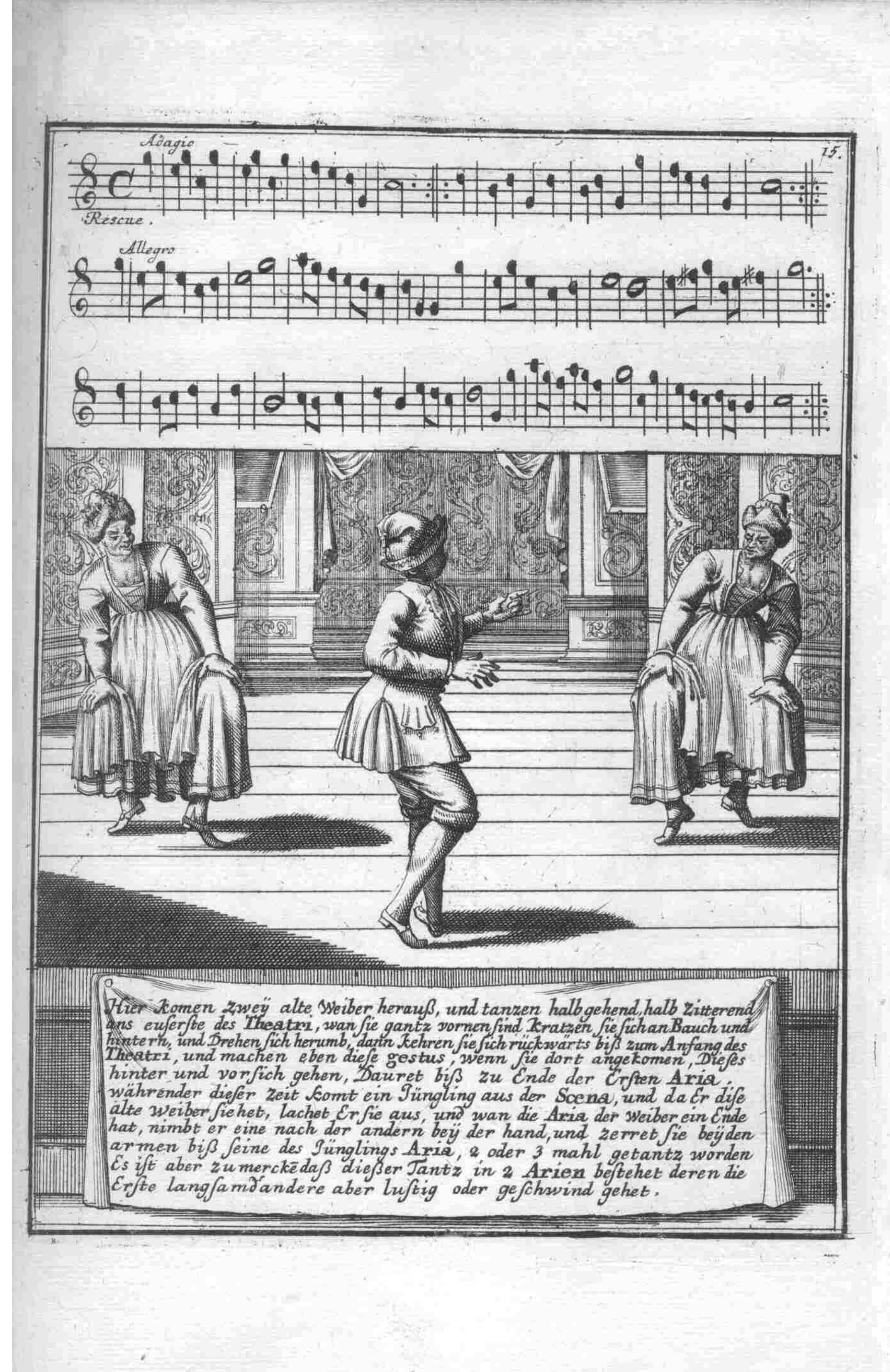
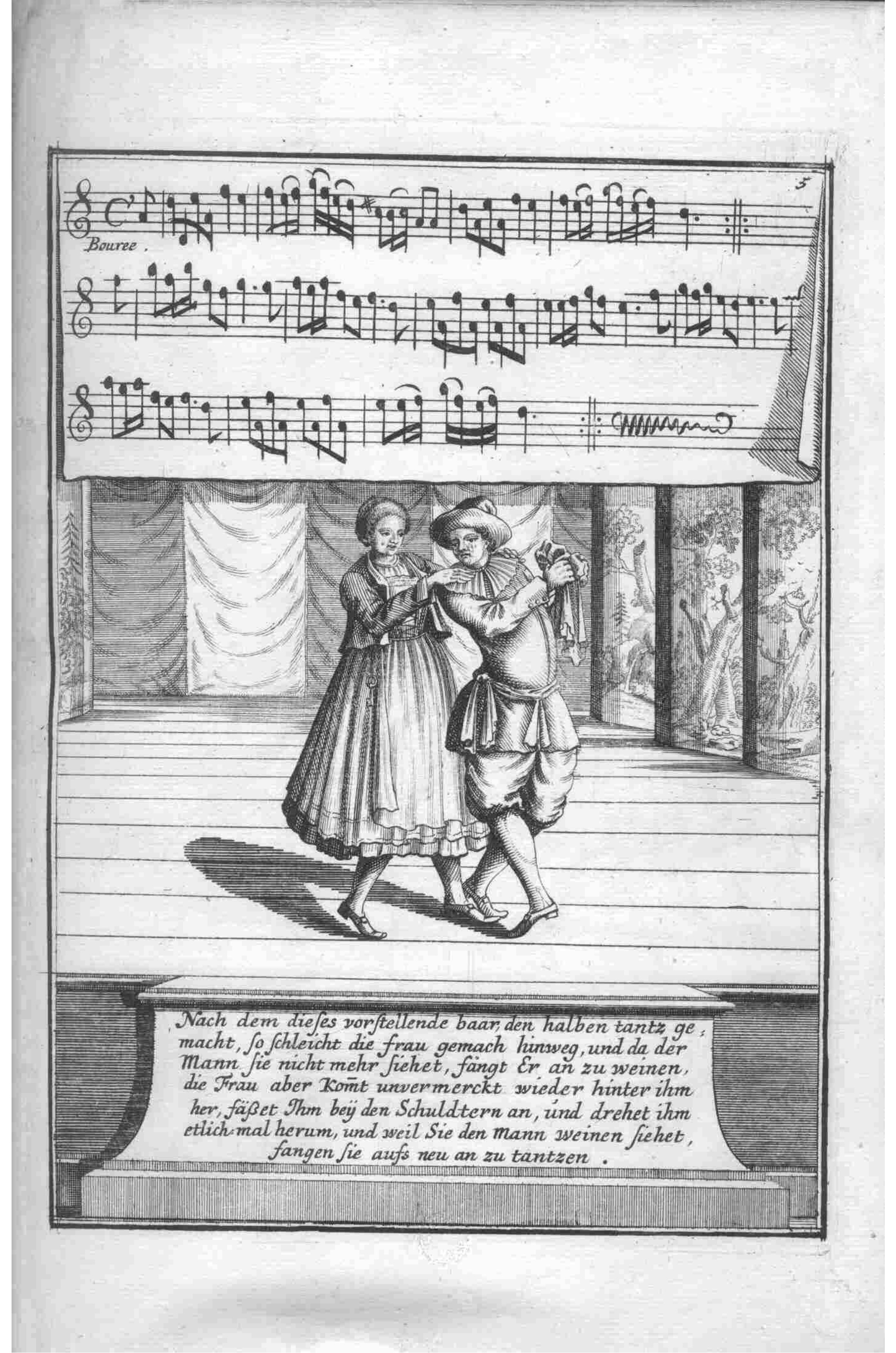
Lambranzi's plates are among the most detailed surviving records of how theatrical dance was choreographed, notated, and performed in the early 18th century. This image shows a moment of comic business and character acting on stage, evidence that theatrical dance was not confined to formal abstract movement but included mimesis, social observation, and humor. For dance historians, it is one of the clearest surviving sources for the appearance, costuming, staging, and dramatic purpose of early 18th-century theater dance.
What you are looking at
A woman and a rotund man with a belly stand center stage on a wooden floor, framed by theatrical curtains and architectural elements that suggest an interior chamber or palace room. The woman wears a long, full-skirted dress with light fabric and a fitted bodice; her posture is alert and formal. The man, dressed in period coat and breeches, leans toward her in a posture of comic exaggeration—his body weight shifted forward, belly prominent, in a gesture of appeal or entreaty. His right hand reaches toward her while his left is raised. The staging is theatrical and artificial: draped curtains hang in the background, and painted panels suggesting architectural detail frame the scene. A musical score occupies the top third of the page, labeled "Bourse" (or similar), written in three staves of baroque notation. German verse text appears below the image, explaining the dramatic scenario. The light is even and descriptive rather than naturalistic, typical of copper-plate engraving.
The dancing
Two figures stand in a roughly frontal plane, with their bodies angled toward each other in conversational proximity. The man's stance is notably unstable—weight forward on his toes, knees slightly bent, creating an impression of comic desperation or physical comedy. The woman stands more upright and composed, her full skirt suggests weight held back through the legs. Neither figure is in a closed ballroom hold; instead, they occupy the spatial vocabulary of theatrical mime and character comedy, with reach and gesture more important than partner frame.
The dance depicted
This is a theatrical comic dance or *ballo*, part of the early 18th-century tradition of character dances performed on stage as interludes or independent numbers. The scene illustrates a social comedy—a man pursuing a woman who maintains formal distance. The notation above indicates this was choreographed to a specific musical piece and performed by trained dancers in costume. The exaggerated, off-balance posture of the man signals *grotesque* or *comic character* dance—a recognized theatrical genre distinct from courtly minuets or formal dances. The verse caption provides narrative context that the dance was meant to illustrate.
How it was made
This is a copper-plate engraving, a technique that allowed fine detail and wide circulation through printing. The engraver has combined musical notation (itself engraved from moveable type or hand-cut symbols), figural scene, architectural framing, and text on a single plate—a common format for dance instruction manuals and theatrical prints of the period. The regularity and precision of line work is characteristic of professional engraving; the hatching and cross-hatching build tone and suggest depth. This format was ideal for circulation in bound books or as individual loose prints for performers, impresarios, and wealthy amateurs.
About this work
This engraving is a single plate from Gregorio Lambranzi's *Nuova e curiosa scuola de' balli theatrali* (*New and Curious School of Theatrical Dances*), published in Nuremberg in 1716. It documents a theatrical comic dance pairing music and choreography with narrative context. The work belongs to the early modern tradition of dance notation and theatrical instruction, in which engraved plates served as the primary medium for transmitting choreography across Europe. Lambranzi's manual was influential in shaping how theatrical dance was recorded, taught, and understood in the 18th century.
This particular plate illustrates the genre of *character dance*—comic, dramatically motivated movement performed by skilled dancers in costume and scenic setting. Unlike the abstract beauty of courtly dances, character dances told stories and exploited physical comedy, exaggeration, and mime. The pairing of score, image, and explanatory text made the manual a reference work for performers and a window into theatrical practice for readers who did not themselves dance.
How to look at it
Attend to the posture and weight distribution of the two figures—the man's off-balance, forward-leaning stance is the choreographic point, not accidental. His exaggerated gesture and the woman's formal reserve create a narrative of pursuit and refusal enacted through the body. Notice also the theatrical framing: the curtains, the stage floor, the architectural panel at right. These details tell us this is stage dance, not social dance, and that character and spectacle matter as much as technique. The musical notation at top should be read together with the image—it represents the specific piece to which this choreography was set.
The artist
Gregorio Lambranzi was a dancer, choreographer, and dance master active in Germany and Italy in the early 18th century. His *Nuova e curiosa scuola de' balli theatrali* (1716) survives in two editions and is one of the most important published sources for theatrical dance of the period. The manual collects comic, character, and theatrical dances with their music and choreographic notation, presented through engraved plates. Lambranzi's work reflects the conventions of the Italian theatrical tradition and the German courts where he worked; it was widely consulted and influenced how dance was taught and preserved in print.
The period
In the early 18th century, theatrical dance in Europe was dominated by Italian and French traditions, with strong regional variations in German courts. The baroque minuet was the height of courtly fashion, but theatrical performance encompassed a wider range of choreography, including comic character dances, dances of rural or exotic peoples, and dances embedded in dramatic narratives. Dance notation systems were being refined and published; Lambranzi's manual was one response to the challenge of recording movement for circulation in print. Engraving was the cutting-edge reproductive technology, and dance manuals printed with musical notation and figural scenes were prestigious and expensive objects, owned by courts, wealthy amateurs, and professionals.
Where it lives
This plate is from the first edition of Gregorio Lambranzi's *Nuova e curiosa scuola de' balli theatrali* (Nuremberg: Christoph Weigel, 1716). The work is a bound volume of engraved plates, each pairing music, choreography, figure, and explanation. The Library of Congress copy from which this image derives is a complete surviving example of this influential manual.
Dance in this work
Questions about this work
What is a 'comic character dance' and how is it different from a minuet?
A minuet is an abstract, formally structured courtly dance emphasizing symmetry, elegance, and precise geometry. A comic character dance, by contrast, uses exaggerated gesture, mimetic action, and physical comedy to represent a dramatic scenario or social type. In this plate, the comic effect comes from the man's desperate, off-balance posture and the social situation—a failed seduction—rather than from formal beauty. Character dances were performed on stage as part of theatrical productions or as entertainment interludes.
How would a dancer in the 18th century have learned this choreography?
A trained dancer or dance master would read the notation at the top of the plate—a system of symbols and numbers indicating steps and their timing. They would also study the engraved figure to see the posture, arm position, and spatial relationship of the two dancers. The German text below provides narrative context explaining what the dance represents. A dancer already trained in the vocabulary of theatrical dance would be able to reconstruct the movement from these clues; the manual served as a reference, not as a comprehensive how-to-begin guide.
Why is there music notated at the top?
In baroque and early 18th-century practice, choreography and music were inseparable. A specific piece of music determined the rhythm, phrasing, and length of the dance. The notation shows that this theatrical comedy was set to a particular baroque composition, which a musician would play while the dancer performed. The pairing of score and figure was standard in dance manuals of the period.
What does the German text say?
The text beneath the image provides a brief narrative explanation of the dramatic situation. It indicates that the dance was meant to represent a specific social interaction or comic scenario—in this case, apparently a man pursuing a woman who resists his advances. The text anchors the choreography to a recognizable comedic situation, which would make the dancer's exaggerated posture and gesture legible to an audience.
More Notation/Choreography artwork