48 works in this view — arrow keys or swipe to move between them.
Dance in Art
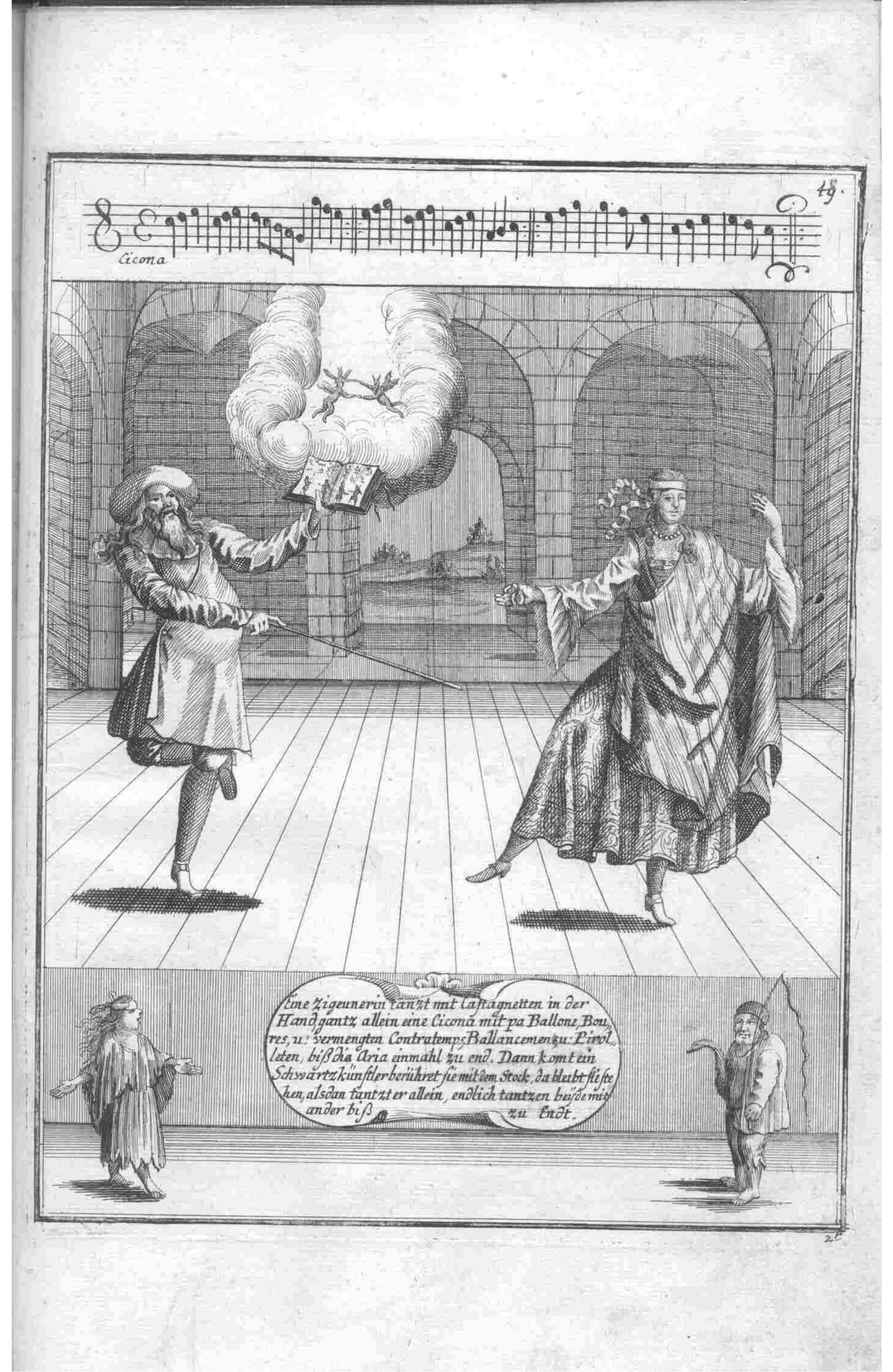
Solo Dancer — Plate 99
Gregorio Lambranzi
- Medium:
- Copper-plate engraving
- Dance:
- Notation/Choreography
- Era:
- 1700s (Enlightenment/Minuet Era)
- Collection:
- Nuova e curiosa scuola de' balli theatrali (1716)
- Source:
- Library of Congress
- Rights:
- Public domain — free to use, share and adapt.
- Recorded as:
- Public Domain
Lambranzi's manual is one of the earliest surviving systematic attempts to record and teach choreography through published instruction, making this plate evidence of actual theatrical practice at a moment when most dance knowledge was transmitted orally and by live example. For dancers and historians, the pairing of musical notation with the engraved scene reveals the inseparability of music and movement in theatrical dance of the period, and the manual itself shaped dance pedagogy and practice across the German-speaking world and beyond.
What you are looking at
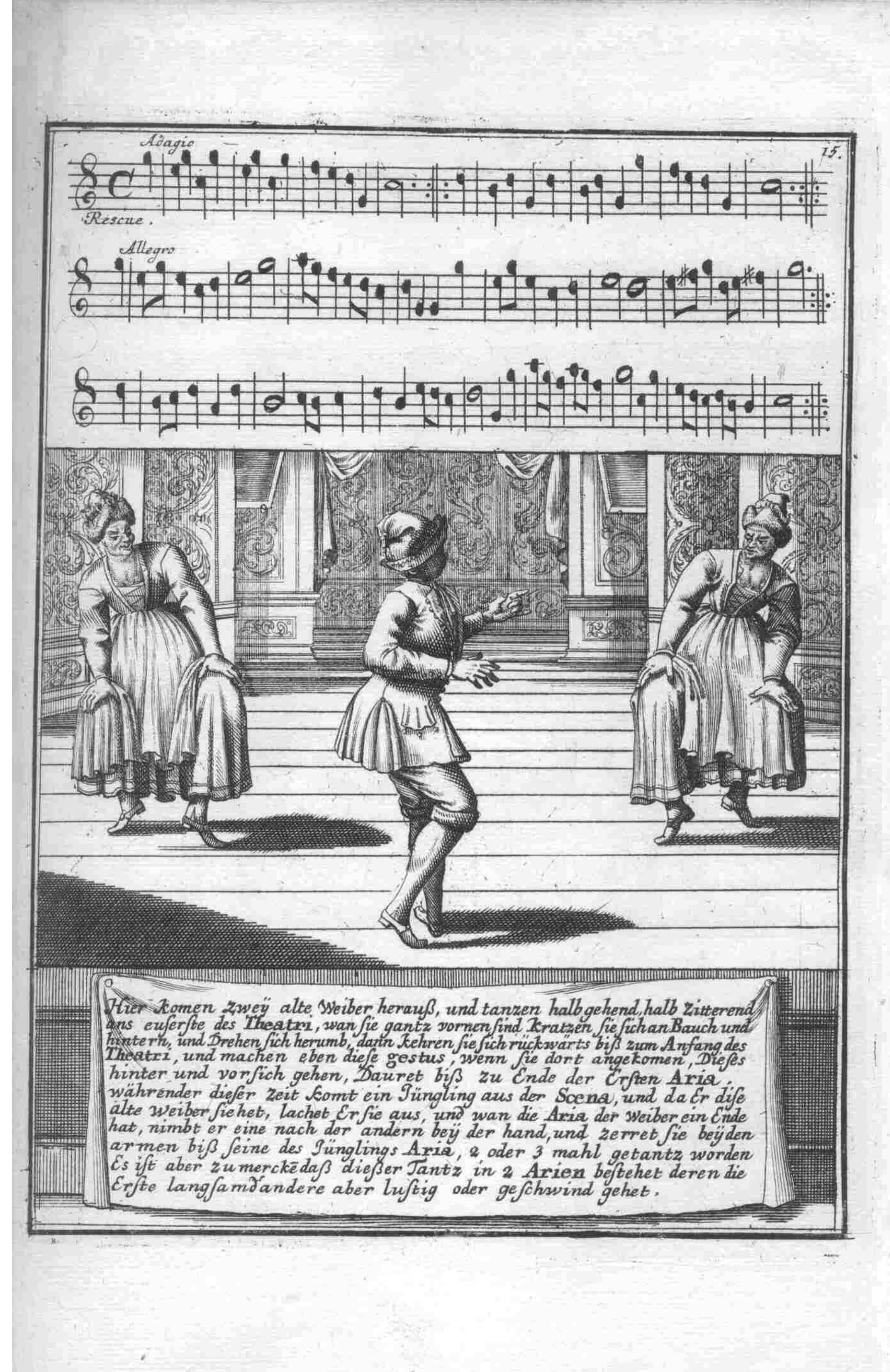
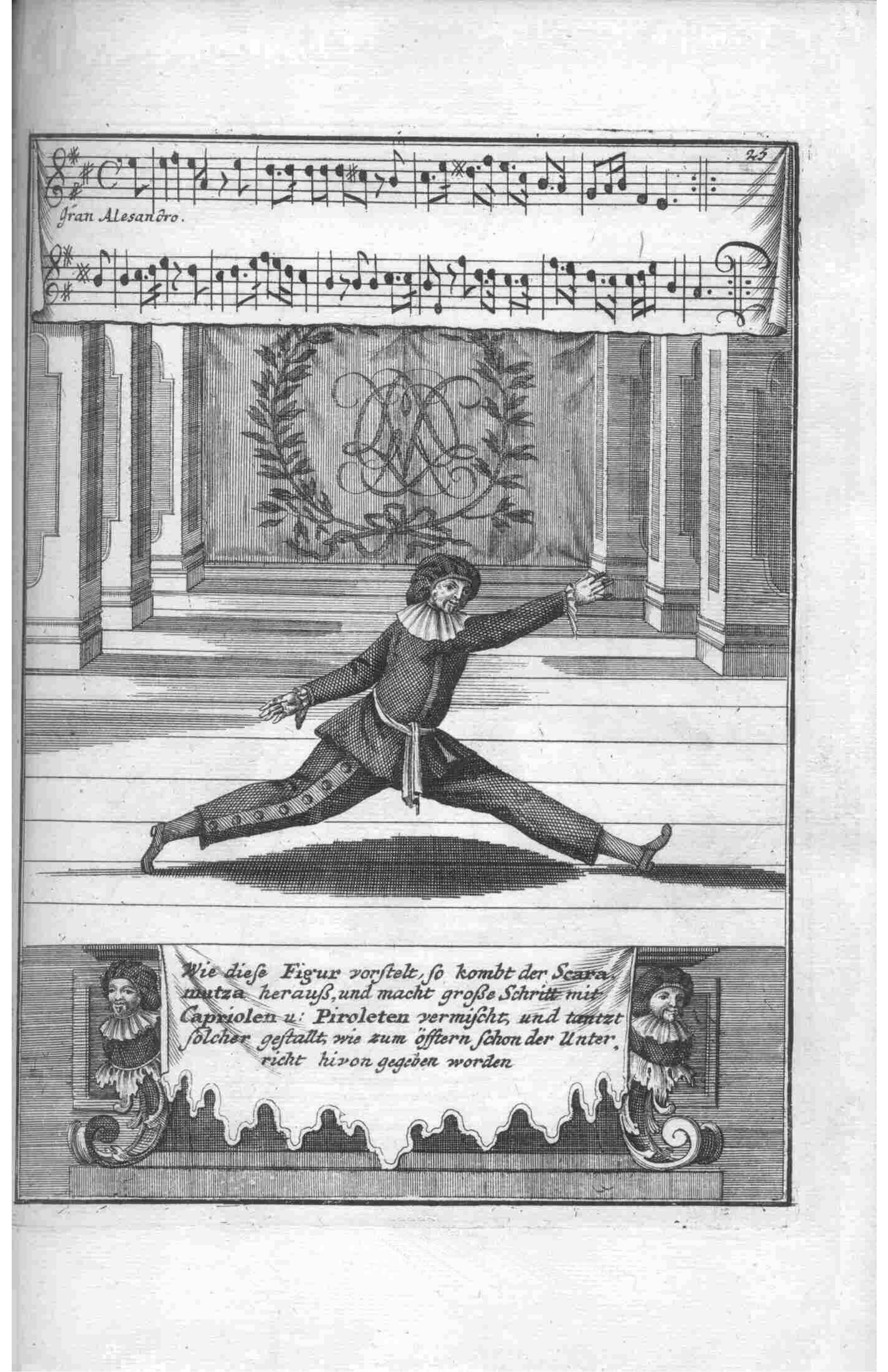
Two figures in 18th-century theatrical costume dance face-to-face on a shallow proscenium stage, framed by classical arches and a draped backdrop suggesting a palace interior. The figure on the left, bearded and wearing a long coat with buttoned front and a large plumed headdress, faces a second figure in a lighter dress with a fitted bodice and full skirt. Both are captured mid-motion in an animated dialogue-dance, their bodies angled toward one another with arms raised and gestures active. The stage is rendered in perspective with a polished floor receding into shadow; the composition emphasizes the performers' elegant bearing and the formality of their encounter. Below the stage scene, small figures in the margins—possibly musicians or spectators—and a German text cartouche complete the page.
The dancing
Both dancers stand upright in an open, conversational frame with no closed hold. The left figure's weight appears centered, with one arm extended upward and the other at mid-height, suggesting an expressive gesture mid-recitative. The right figure mirrors this openness, arms similarly positioned in a responsive pose. Neither dancer shows the balletic turnout or alignment associated with later classical ballet; instead, the stance is more naturalistic, with feet positioned for rhetorical gesture rather than virtuosic footwork. The interaction is dialogic—two bodies engaged in synchronized but independent conversation through movement.
The dance depicted
This is a theatrical recitative dance, a form of staged drama-in-movement central to 18th-century theatrical spectacle, particularly in the German-speaking regions and Italy. The notation at the top of the page, paired with this engraved demonstration of its execution, shows two dancers narrating or debating through coordinated gesture and movement. The costume—particularly the formal coat and plumed hat on the left—and the staged palace setting indicate this is noble or heroic courtship or dramatic discourse, not a social ballroom dance. The emphasis on reciprocal arm gesture and facial proximity suggests the dance was as much about emotional exchange and storytelling as locomotion.
How it was made
This is a copper-plate engraving, a medium that allowed for fine line work and tonal gradation through cross-hatching. The technique makes clear the didactic purpose: the notation at the top provides the musical score, while the engraved scene below demonstrates how a trained dancer would embody that score on stage. The precision of line and the careful rendering of costume detail and spatial perspective signal that this page was part of a published instructional manual intended for professional dancers, choreographers, and court musicians. Engravings permitted wide distribution and permanence in a way manuscript notation could not.
About this work
This is Plate 99 from Gregorio Lambranzi's 'Nuova e curiosa scuola de' balli theatrali' (Nuremberg, 1716), one of the most influential choreographic manuals of the early 18th century. The work pairs musical notation with engraved demonstrations of theatrical dance steps and scenes, creating a hybrid text that bridges music and bodily practice. This particular plate illustrates a recitative dance for two performers—a form of staged dramatic interaction through movement that was central to opera, ballet d'action, and theatrical spectacle across northern Europe. The manual itself was revolutionary in attempting to systematize and preserve choreographic knowledge through the combination of notation and visual example, making it invaluable evidence for how professional dancers moved, dressed, and understood the link between music and gesture in the early 18th century.
How to look at it
Pay attention to the pairing of notation and image: the musical score at the top is not merely accompaniment but is meant to be read in direct correspondence with the postures and gestures shown below. Observe the moment chosen—neither dancer is in a position of stable repose, but both are caught mid-gesture, with arms extended and bodies oriented toward dialogue. Note the absence of the turned-out positions and elevated carriage that would later define classical ballet; these dancers occupy a more naturalistic, rhetorical body. The setting—the shallow stage, the arches, the palace backdrop—anchors this as a professional theatrical event, not a ballroom or street scene.
The artist
Gregorio Lambranzi was an Italian dancing master and choreographer active in the early 18th century, based in Nuremberg. He is now known almost exclusively through his published manual, the 'Nuova e curiosa scuola de' balli theatrali' (1716), which exists in two editions (German and Italian versions). The manual demonstrates his ambition to codify and teach theatrical dance to a broad audience of professionals and amateurs, and reflects the broader 18th-century Enlightenment project of systematizing knowledge across disciplines. Beyond the manual, little is documented about his life or career.
The period
In the early 18th century, theatrical dance was undergoing rapid professionalization and formalization. The reign of Louis XIV had elevated ballet from court entertainment to an art form with its own academy and notation systems (most famously Beauchamp-Feuillet notation, which was emerging in the 1680s–1690s). Lambranzi's manual shows that by 1716, German-speaking regions were engaged in similar projects of codification and teaching. The period saw a growing distinction between social dances (minuets, bourées, country dances) and theatrical dances, and an increasing interest in dramatic action and emotional expression in staged movement—what would eventually become 'ballet d'action.' Lambranzi's recitative dances sit squarely in this context, emphasizing narrative and dramatic dialogue over pure virtuosity.
Where it lives
This plate comes from the first published edition of Gregorio Lambranzi's 'Nuova e curiosa scuola de' balli theatrali,' printed in Nuremberg in 1716. The work was published simultaneously in German and Italian versions and was widely distributed and consulted across Europe. The Library of Congress holds a copy of the original publication, from which this image derives.
Dance in this work
Questions about this work
What is a 'recitative dance'?
A recitative dance is a theatrical form in which two or more performers enact dramatic dialogue, debate, or courtship through synchronized movement and gesture rather than narrative pantomime or abstract steps. The term borrows from opera, where recitative is sung dialogue. In theatrical dance, it allows dancers to express emotion, character, and narrative content through coordinated gesture and spatial interaction. Lambranzi's manual documents several examples of this form.
How was this manual used?
Lambranzi's manual served as a teaching tool for professional dancers and choreographers who wanted to learn or teach theatrical dance steps and choreographic structures. Dancers would read the musical notation and study the engraved figures demonstrating how to execute the steps and gestures. It was also likely consulted by musicians, composers, and impresarios involved in opera and theatrical spectacle. The combination of notation and image made it more accessible than purely textual instruction.
Is this related to ballet?
Yes, but not in the modern sense. This is theatrical dance from the period when ballet was developing from court entertainment into a professional art form. Lambranzi's dances show the transition between social dances (like the minuet) and more dramatic, choreographed theatrical forms. Classical ballet as we know it—with codified positions, pointe work, and romantic narratives—emerged later in the 19th century.
What does the German text at the bottom say?
The text in the cartouche is a descriptive caption or stage direction explaining the dramatic context or character of the dancers shown. It is typical of Lambranzi's manual to provide such contextual notes alongside the notation and image, helping readers understand not just how to move but why and in what circumstance.
More Notation/Choreography artwork