47 works in this view — arrow keys or swipe to move between them.
Dance in Art
Group — Plate 100
Gregorio Lambranzi
- Medium:
- Copper-plate engraving
- Dance:
- Notation/Choreography
- Era:
- 1700s (Enlightenment/Minuet Era)
- Collection:
- Nuova e curiosa scuola de' balli theatrali (1716)
- Source:
- Library of Congress
- Rights:
- Public domain — free to use, share and adapt.
- Recorded as:
- Public Domain
Lambranzi's manual is one of the few surviving detailed visual documents of early 18th-century theatrical dance practice, showing how narrative and character were expressed through pose, gesture, and spatial relationship rather than through codified steps. The work reveals that theatrical dance of this period was fundamentally dramatic and musical—closer to contemporary opera-ballet than to the formalized technique that would emerge in the Romantic era. For historians of dance, theater, and music, these plates are rare evidence of what performers actually did on stage and how choreographers structured movement.
What you are looking at
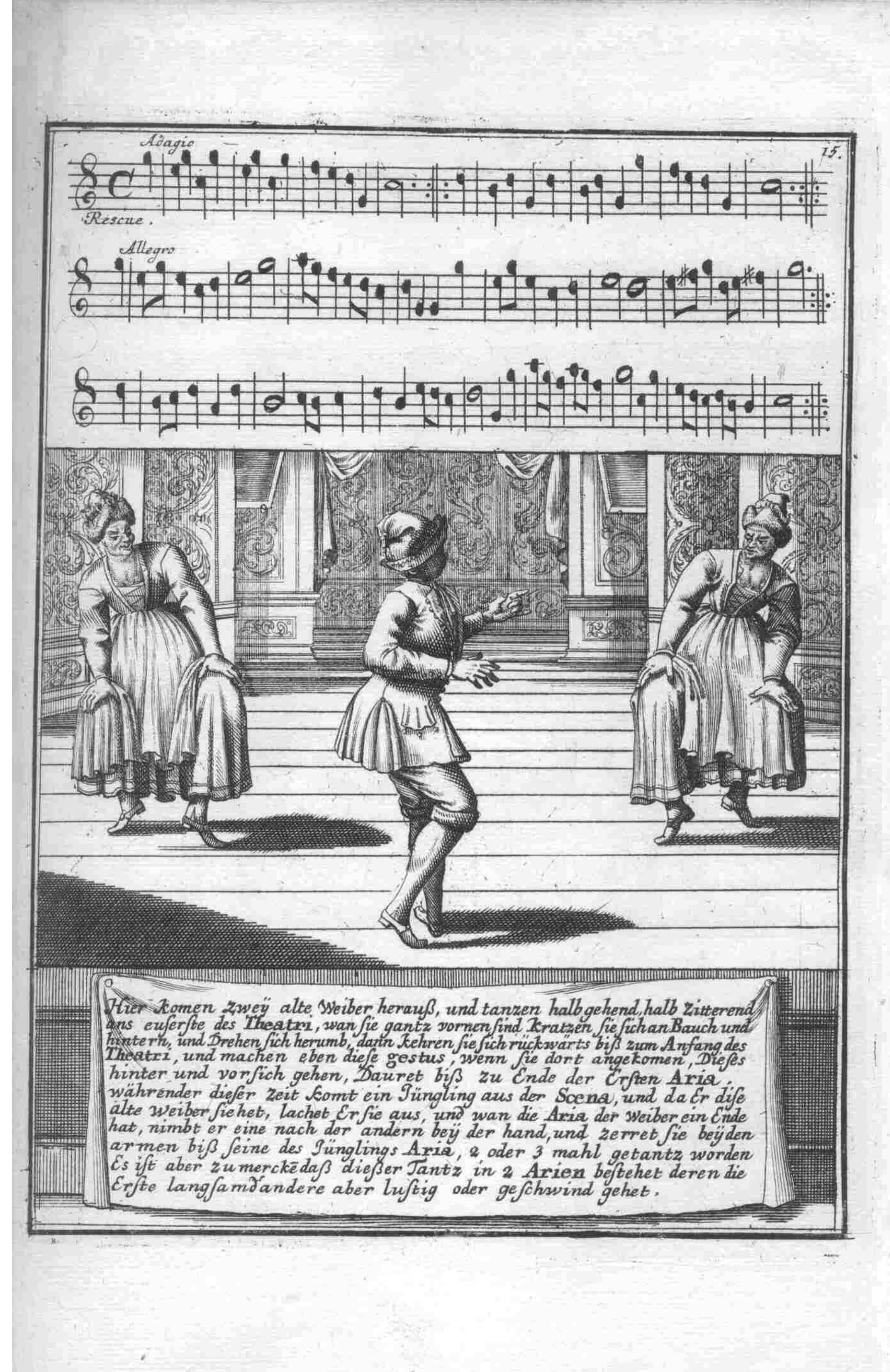
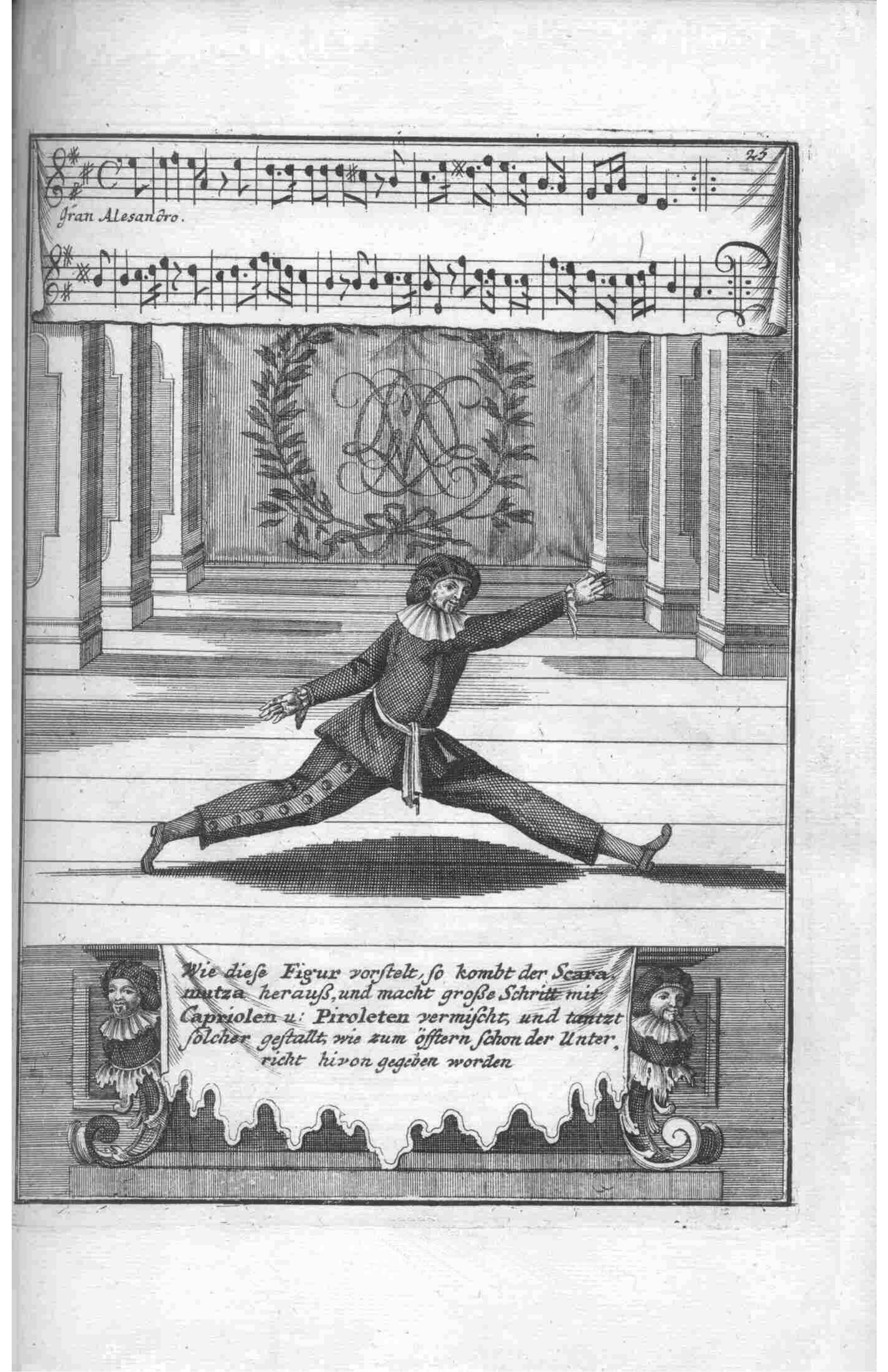
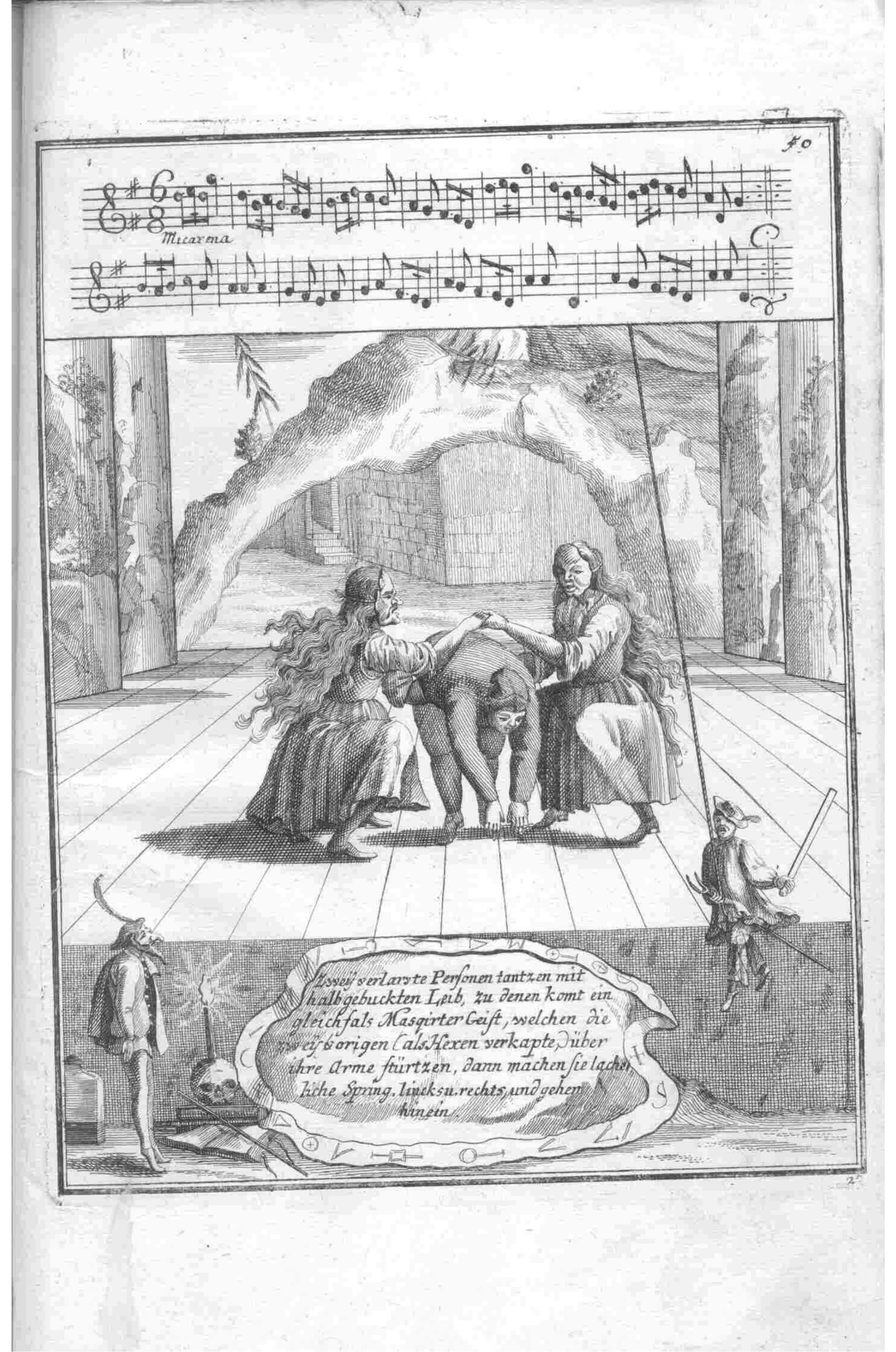
A theatrical scene set within a columned interior with arched apertures opening to distant architecture. Three figures in 18th-century dress occupy the stage: a woman with long curled hair in a light skirt stands at center-left with one arm extended toward a standing man in coat and breeches; a second woman, seated or kneeling at lower center, looks upward toward the standing man, her pose deferential or supplicant. The figures are arranged in a narrative tableau rather than a formal dance line. A dog appears at the lower right of the stage. The setting is shallow and theatrical, with a painted backdrop suggesting a classical interior. The engraving is finely detailed, with careful cross-hatching establishing volume and shadow. German verse in a cartouche below the stage describes the scene. At the top of the plate, two staves of musical notation labeled "Miarma" are engraved, suggesting the music that would accompany this choreography.
The dancing
The standing woman and man face each other at a conversational distance, their bodies upright and their posture refined. The woman's extended arm suggests an offer, greeting, or directional gesture; her weight appears centered. The kneeling or crouched figure at center-right has assumed a lower, more submissive position, looking upward—a pose that reads as theatrical pantomime rather than dance vocabulary. The bodies do not form a closed dance frame; instead they occupy separate zones within the stage picture, suggesting a dramatic action unfolding rather than partners executing a recognized dance hold or step.
The dance depicted
This plate depicts a theatrical dance scene—a *balletto d'azione* or narrative dance—rather than a formal social or concert dance. The action shown is primarily pantomime: the kneeling figure's gesture and gaze, the standing woman's arm extension, and the man's posture suggest a dramatic moment (possibly courtship, revelation, or appeal) set to music. The notation at the top confirms this is choreographed to a specific air (*Miarma*). The scene exemplifies early 18th-century theatrical dance practice, in which narrative gesture and classical pose were integrated with musical accompaniment. The identity of the specific plot or character roles is not evident from the image alone.
How it was made
This is a copper-plate engraving, a technique that allowed for precise line work, fine detail, and reproducibility. Engraving required skilled hand-incision into a polished copper plate; the resulting prints could be distributed widely, making this an effective medium for circulating dance instruction and theatrical scenarios across Europe. The fineness of the cross-hatching, the careful rendering of fabric texture and facial features, and the integration of musical notation with the image all indicate a sophisticated workshop practice. This technique was standard for illustrated dance manuals of the period and allowed detailed study of pose and gesture that woodcut could not achieve.
About this work
This is a plate from Gregorio Lambranzi's *Nuova e curiosa scuola de' balli theatrali* (Nuremberg, 1716), one of the most influential illustrated dance manuals of the 18th century. The work pairs musical notation with an engraved theatrical scene, showing how a specific musical air (*Miarma*) was choreographed as a dramatic action involving three characters. Rather than documenting a ballroom social dance or a formal ballet vocabulary, Lambranzi's plates capture the emerging tradition of *balletto d'azione*—theatrical dance-drama in which gesture, narrative, and music converge. Each plate in the collection similarly pairs music with a costumed, scenically framed dance action, making the manual a record of how early 18th-century performers transformed musical composition into staged movement.
How to look at it
Observe first the spatial relationship of the three figures: they are not in a line or in closed contact, but arranged as if mid-scene, each body in a distinct attitude. The kneeling figure's upward gaze and the standing woman's extended arm suggest a moment of dramatic communication rather than a step sequence. Look at the notation at the top of the plate—it is not a detailed system of step notation, but rather a melodic line that the choreography would have accompanied. The theatrical framing (the arch, the distant scenery, the dog) situates this as a staged action, not a lesson or a social dance. The engraver has chosen to freeze a moment of narrative intensity, not the moment of greatest technical display.
The artist
Gregorio Lambranzi was a German dance master and choreographer active in the early 18th century. Little is known of his life, but his manual *Nuova e curiosa scuola de' balli theatrali* (1716), issued in both Italian and German editions, was a major publication that circulated across Europe and was reprinted throughout the century. The work likely drew on Lambranzi's experience in theatrical dance and choreography. His approach—combining precise musical notation with detailed engraved scenes of costumed performers—made dance instruction visual and reproducible in a way that written description alone could not achieve. The manual was influential enough to be referenced and imitated by later dance masters.
The period
The early 18th century saw a shift in theatrical dance from courtly social forms toward more narrative and dramatic modes. The Baroque dance tradition, with its emphasis on courtly deportment and geometric spatial patterns, was being inflected with theatrical storytelling, character, and emotional expression. At the same time, the rise of illustrated printed manuals—Lambranzi's among the most sophisticated—reflected a growing market for dance instruction and a desire to codify and disseminate choreographic knowledge. Music and dance were understood as inseparable, and the pairing of notation with gesture was a logical extension of their union. This was also the era in which ballet was beginning its transition from court spectacle to professional theater, and the boundaries between social dance, theatrical dance, and pantomime were fluid.
Where it lives
This plate is from the Library of Congress copy of Lambranzi's *Nuova e curiosa scuola de' balli theatrali* (Nuremberg, 1716). The manual was issued in both German and Italian language editions; this appears to be from the German edition, as indicated by the German text in the caption below the stage. The work survives in multiple copies in European and North American collections and has been digitized and reprinted in modern facsimiles, making it one of the most accessible dance documents of its period.
Dance in this work
Questions about this work
What does the musical notation at the top tell us?
The notation labeled *Miarma* is the air or melody to which this scene was choreographed. Unlike modern step notation, it does not describe movement directly; rather, it indicates the musical accompaniment to which the performer would execute the gestures shown in the engraving. The pairing of music and image was essential to understanding how to perform the choreography.
Is this a social dance or a theater dance?
This is a theatrical dance—a *balletto d'azione* or dramatic ballet scene meant for performance on stage with scenery, costume, and music. It is not a social ballroom dance like a minuet or gavotte. The theatrical framing, the narrative gesture, and the inclusion of character costumes all indicate that this was professional entertainment, not social instruction.
Who was Lambranzi and why did he make this book?
Gregorio Lambranzi was an 18th-century German dance master whose manual was one of the most sophisticated illustrated dance instruction books of its time. By pairing engravings with musical notation, he created a portable record of choreography that could be studied, learned, and performed elsewhere—a significant innovation in an era before film or notation systems like Labanotation existed.
What is the narrative of this scene?
The specific plot is not identified in the surviving documentation, but the composition suggests a moment of courtship, supplication, or emotional revelation. The kneeling figure's posture and upward gaze, combined with the standing woman's gesture toward the man, suggest a dramatic triangle of emotion. Lambranzi's manual does not provide narrative descriptions, leaving interpretation to the reader.
More Notation/Choreography artwork