38 works in this view — arrow keys or swipe to move between them.
Dance in Art
Acrobatic — Plate 9
Gregorio Lambranzi
- Medium:
- Copper-plate engraving
- Dance:
- Notation/Choreography
- Era:
- 1700s (Enlightenment/Minuet Era)
- Collection:
- Nuova e curiosa scuola de' balli theatrali (1716)
- Source:
- Library of Congress
- Rights:
- Public domain — free to use, share and adapt.
- Recorded as:
- Public Domain
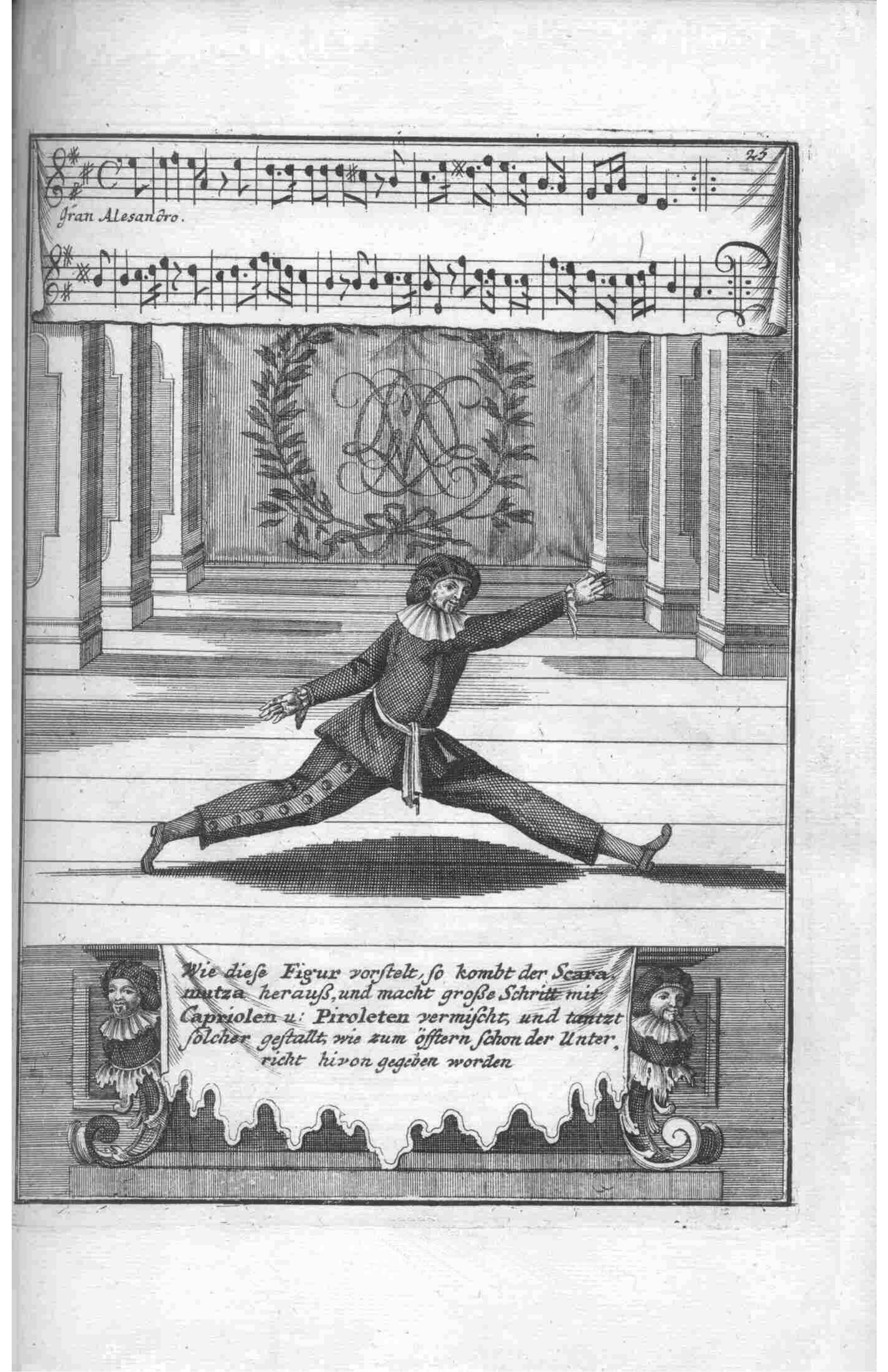
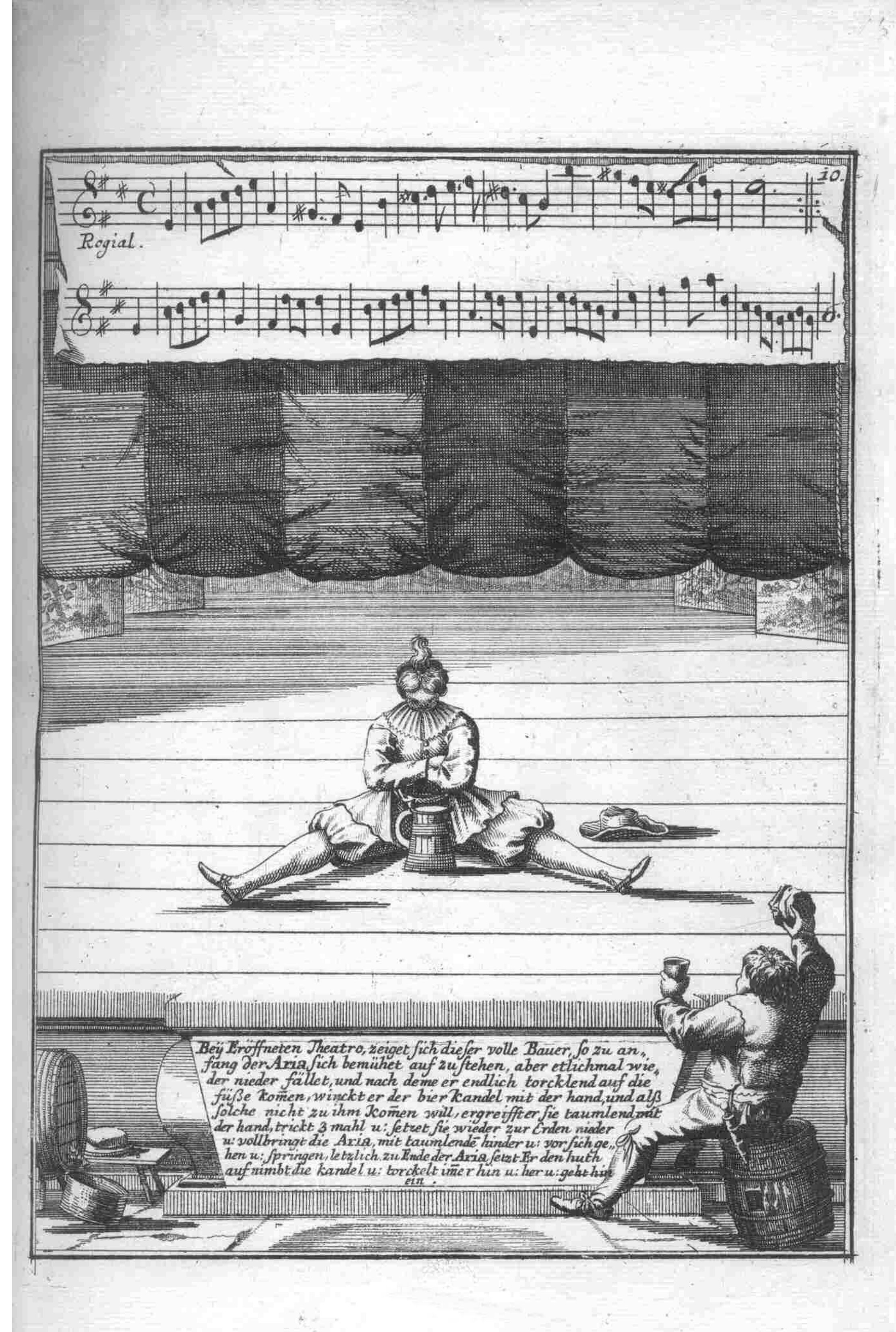
Lambranzi's manual is one of the few detailed records we have of how professional performers actually moved in early 18th-century theatre, and this plate shows an acrobatic skill that would be lost to ballet as the form became more codified. For historians of circus, acrobatics, and theatrical performance, it documents the long history of athletic display on the stage; for dance historians, it shows the moment before ballet narrowed its vocabulary and pushed acrobatics to the margins.
What you are looking at
A theatrical performer in elaborate early 18th-century costume sits on a stage floor in a dramatically splayed pose, legs extended wide to either side in a feat of flexibility. The figure wears a richly patterned jacket with a deep ruffled collar, hose, and shoes, with the hair dressed high—the costume of a professional stage performer. Behind, a curtained stage set with draped fabric creates the theatrical frame. At the bottom of the engraving, two other figures—presumably musicians or stagehands—observe from the wings. The print is annotated with musical notation at the top in two staves, marked "Regial" (likely Regia or a royal dance form), showing the musical accompaniment for the choreography being performed.
The dancing
The central figure demonstrates extreme flexibility, seated with both legs splayed maximally to the sides in what modern dance would call a splits position or full straddle. The torso is upright, the arms positioned across the body in a contained gesture. The body weight is supported through the seated base; the extreme lateral flexibility suggests either trained acrobatic skill or purposefully exaggerated theatrical posturing. The seated position itself is unusual for formal dance of the period and reads as a display of physical capability rather than a conventional step or figure.
The dance depicted
This plate illustrates theatrical acrobatic performance from the early 18th century, when stage athleticism and physical virtuosity were valued components of professional dance and entertainment. The pose is too extreme and too low to represent ballet proper, which was still emerging as a codified form; instead it shows the hybrid theatrical practice of the period that combined dance steps with acrobatic feats. The musical notation suggests this was a choreographed or semi-choreographed piece with a defined musical structure. The title "Acrobatic" in the catalogue is appropriate; this is acro-dance in a theatrical context rather than ballet, though the professional costuming and stage setting indicate this was high-level entertainment rather than street or fairground performance.
How it was made
This is a copper-plate engraving, a medium of high technical precision and significant labor cost that indicates serious publication. The fine parallel hatching used to model form, the precise rendering of costume detail, and the legible musical notation all demonstrate the technical demands of the medium. Copperplate engraving was used for disseminating choreographic instruction and theatrical imagery to a cultivated audience of courtiers, performers, and dance masters across Europe; this object is part of a bound manual, not a single print. The technique's precision allowed complex visual information—the exact costume, the exact body position, the exact musical measure—to be transmitted and reproduced with fidelity.
About this work
This is a page from Gregorio Lambranzi's *Nuova e curiosa scuola de' balli theatrali*, one of the most influential dance manuals of the early 18th century. It documents a specific theatrical acrobatic feat—a dramatic floor pose demonstrating extreme flexibility—paired with its musical score. The engraving records not ballet in its later codified form, but the broader performance practice of professional stage dancing of the period, which freely mixed refined steps, pantomime, and athletic display. Lambranzi's work was widely circulated among European dance masters and performers and served both as a record of contemporary practice and as a teaching tool.
The image is valuable because it captures a moment in the history of stage dance before the rigorous separation of ballet, gymnastics, and acrobatics that would emerge through the 19th century. It shows that theatrical virtuosity in this period was measured in range—the performer's ability to move through many modes of physical expression, from the refined to the acrobatic.
How to look at it
Attend to the exact position of the body: the precision with which the engraver has rendered the angle of the legs, the curve of the back, the placement of the arms. This is not a caricature or an approximation but a technical diagram, intended to communicate specific information to a practitioner who wanted to learn or reproduce the pose. Notice also the costume detail—the ruffled collar, the cut of the jacket, the shoes—which would have been instantly recognizable as fashionable stage dress of the period. The musical notation at the top should remind you that this was choreography in the full sense: a movement phrase set to music, not a random acrobatic stunt. The theatrical setting with curtains frames this as professional entertainment, not popular amusement.
The artist
Gregorio Lambranzi was a dancing master and choreographer active in early 18th-century Nuremberg. His *Nuova e curiosa scuola de' balli theatrali* (New and Curious School of Theatrical Dances), published in Nuremberg in 1716, is the most substantial surviving record of choreographed theatrical dance from the early 1700s. The work contains over 100 engraved plates, each pairing a musical piece with a precisely rendered figure demonstrating a step, combination, or acrobatic feat. Lambranzi worked in the tradition of theatrical dance masters, combining courtly refinement with popular entertainment; his manual was widely translated and remained in use as a teaching text throughout the 18th century.
The period
In 1716, ballet was still developing its systematic technique and vocabulary. The form had emerged from Italian Renaissance court spectacle and French courtly practice but had not yet crystallized into the five positions and codified steps that would define 19th-century academic ballet. Professional theatrical dancers of Lambranzi's time were expected to be versatile: skilled in refined court dances like the minuet and courante, capable of dramatic gesture and pantomime, and able to perform acrobatic tricks that would astonish an audience. The market for instruction manuals was growing as dance became increasingly professionalized and systematized. Copperplate engravings like those in Lambranzi's manual served both dancers seeking to learn new choreography and a broader cultivated public interested in understanding theatrical fashion.
Where it lives
This is page 9 from Gregorio Lambranzi's *Nuova e curiosa scuola de' balli theatrali*, published in Nuremberg in 1716. The copy is held by the Library of Congress. The manual was issued in a bound format and was widely distributed across Europe, making it one of the most influential dance instruction books of its century.
Dance in this work
Questions about this work
Is this ballet?
Not in the sense we understand ballet today. It is theatrical acrobatic performance from a period before ballet had codified its technique and restricted its vocabulary. Lambranzi's manual includes refined courtly dances, but also acrobatic feats, pantomime, and other forms of theatrical movement. This plate shows the acrobatic end of the spectrum.
Could a trained ballet dancer do this today?
Many could achieve the splits position, though the 18th-century way of holding and achieving it might differ from modern practice. What is harder to assess from the image alone is whether Lambranzi's performers trained specifically for extreme flexibility or whether this was a display move that stood apart from their daily technique, the way a circus performer might include acrobatics in a theatrical context.
Who was Lambranzi and why does his manual matter?
Lambranzi was a German dancing master whose 1716 manual is one of the few detailed choreographic records from early 18th-century Europe. It documents how professional stage dancers moved at a moment when ballet, gymnastics, and theatrical entertainment had not yet separated into distinct disciplines. The manual was widely copied and translated, and it remained influential for much of the century.
How do we know what the pose means?
The musical notation at the top pairs the movement with a specific musical form, labeled 'Regial.' The accompanying text (in German) would have given instructions or context. Lambranzi's notation system, though not as systematic as later Labanotation, records enough information to communicate the pose to a trained reader—someone familiar with dance language and the conventions of the period.
More Notation/Choreography artwork