37 works in this view — arrow keys or swipe to move between them.
Dance in Art
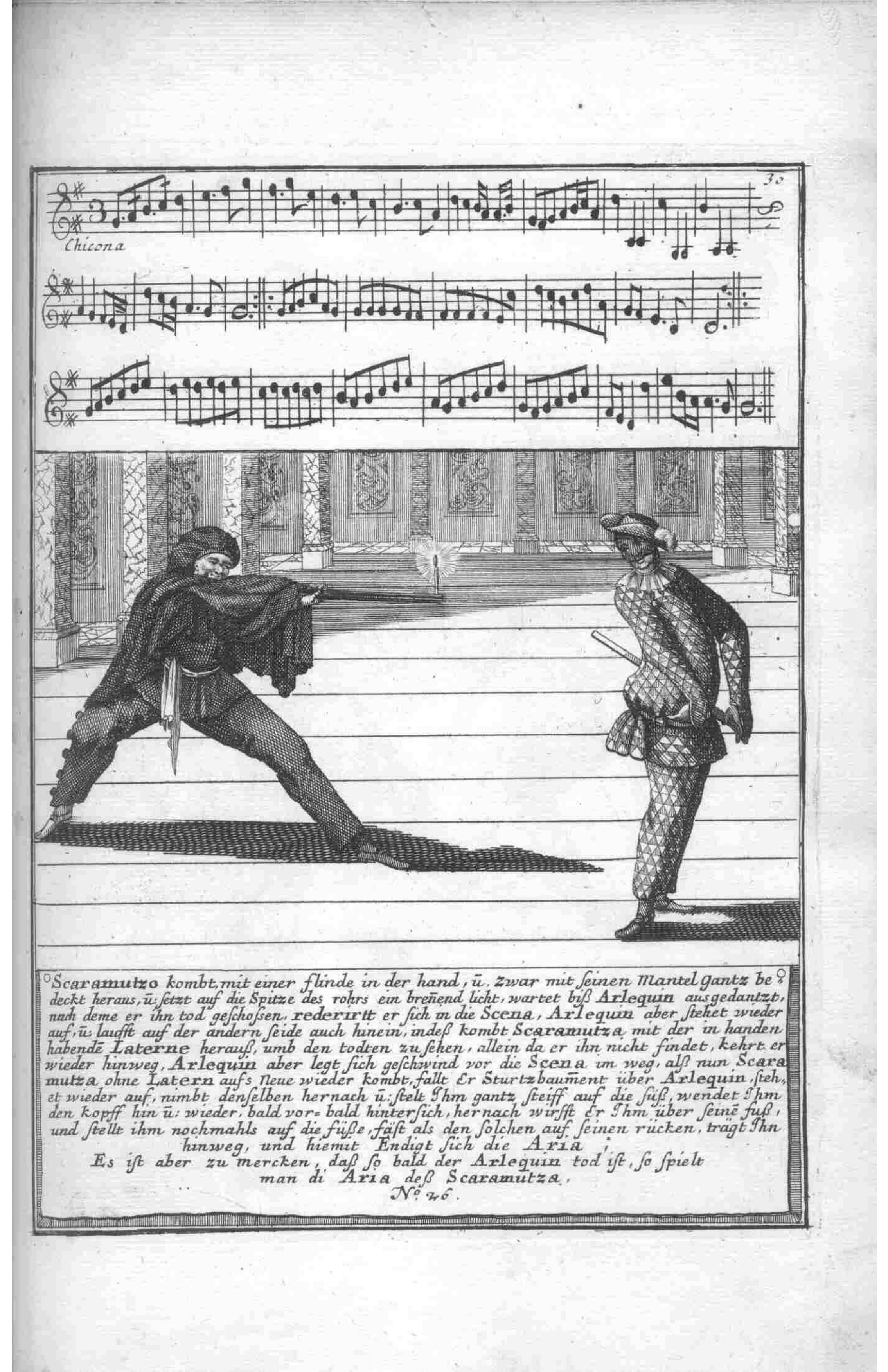
Combat/Duel — Plate 10
Gregorio Lambranzi
- Medium:
- Copper-plate engraving
- Dance:
- Notation/Choreography
- Era:
- 1700s (Enlightenment/Minuet Era)
- Collection:
- Nuova e curiosa scuola de' balli theatrali (1716)
- Source:
- Library of Congress
- Rights:
- Public domain — free to use, share and adapt.
- Recorded as:
- Public Domain
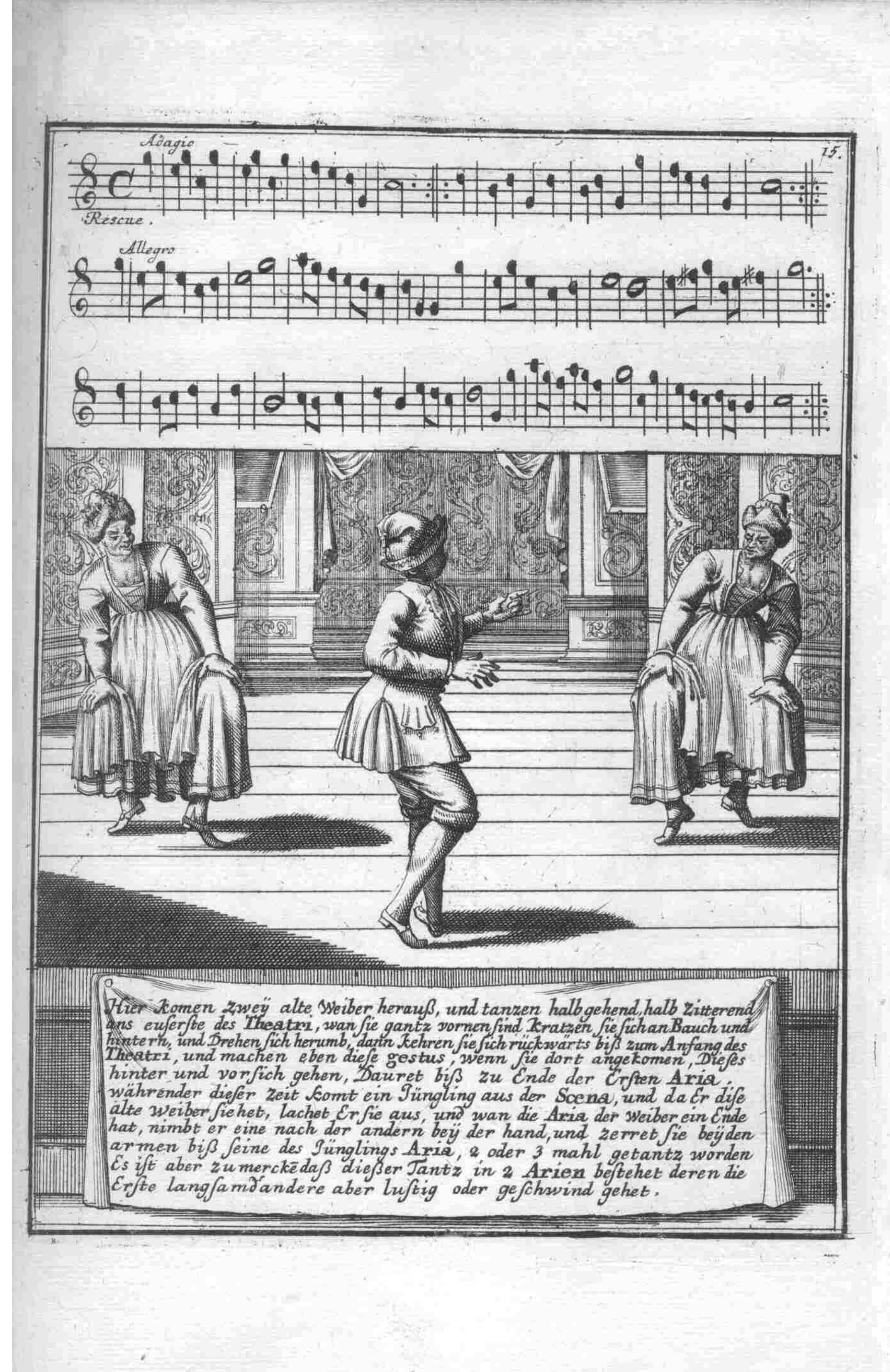
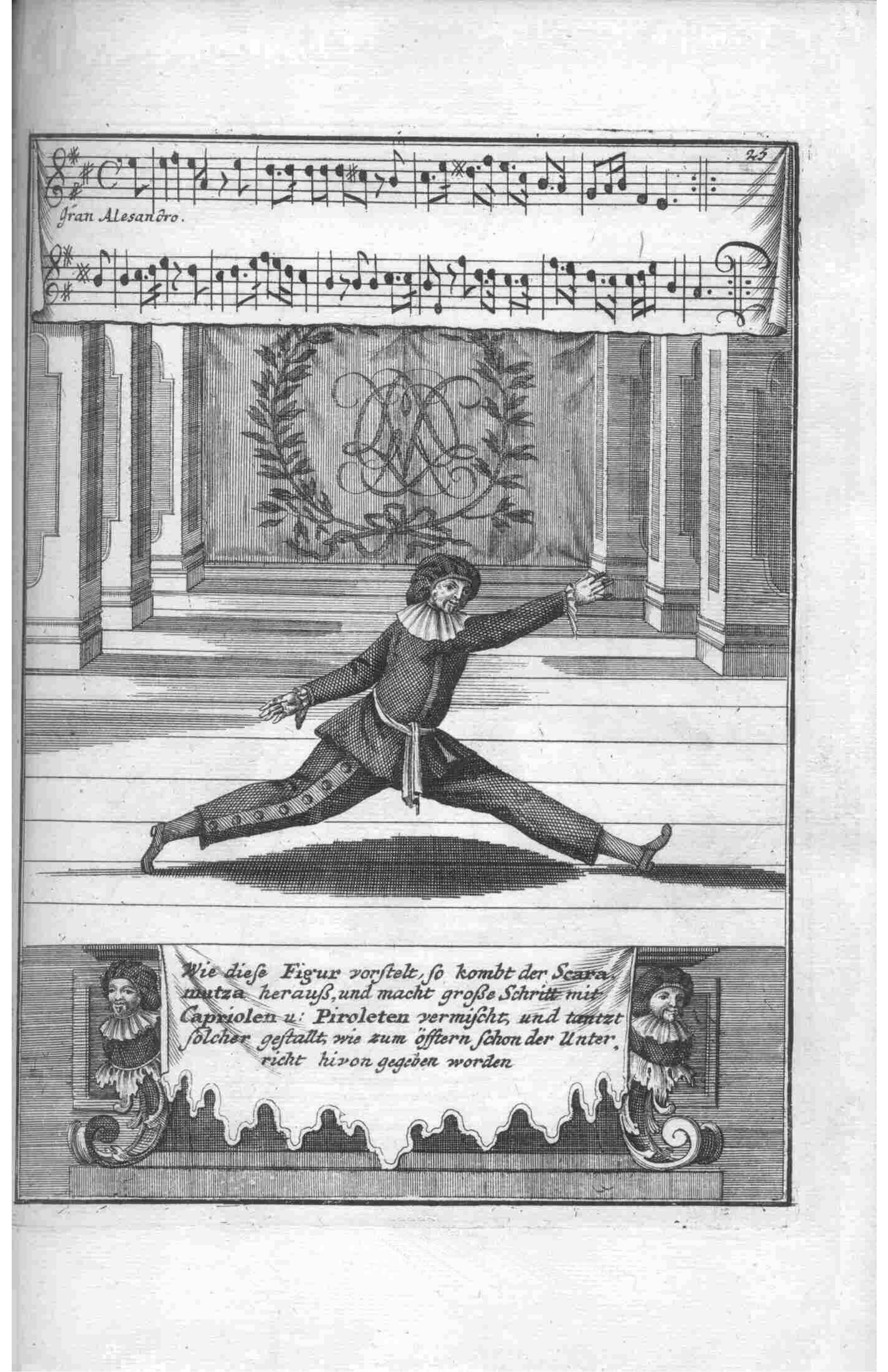
Lambranzi's manual is one of the earliest and most detailed visual records of Baroque theatrical dance, and this plate demonstrates that professional dance-makers of the period were composing choreography that mixed pure dancing with dramatic mime, combat simulation, and character interaction. For dancers and historians, the image reveals the physical vocabulary of stage action in the early 18th century: how bodies were shaped, how weight was deployed for dramatic effect, and how music was integrated with movement in real time. The work is essential evidence that 'dance' in this era encompassed far more than ballroom steps—it included theatrical storytelling through the moving body.
What you are looking at
A theatrical stage scene framed by a proscenium arch, with a painted backdrop depicting a distant landscape and classical structures. Three figures occupy the wooden stage floor, rendered in period costume: two women in full skirts with fitted bodices and head coverings stand at left and right, while a man in the center—wearing a feathered helmet, doublet, and hose—crouches or lunges forward in a pronounced asymmetrical pose. His weight is shifted dramatically onto his forward leg, his torso bent, one arm raised toward his chest or sword hilt. The stage is lit from above, casting clear shadows on the floorboards. A decorative border (likely representing ornate architectural framing or curtain trim) runs across the upper portion, and musical notation is engraved above the scene. Below the stage action, a block of German verse in italic script provides narrative or descriptive text.
The dancing
The central male figure adopts an exaggerated contrapposto stance with deep knee flexion and forward lunge—weight fully committed to the leading leg in a posture associated with combat, courtship display, or dramatic mime. His upper body is inclined forward, creating a serpentine line from head to heel. The two flanking women stand more upright, with hips set and arms positioned at mid-body, their skirts creating a triangular silhouette. Their stillness contrasts sharply with the male figure's kinetic energy and aggression. The spatial relationship suggests a dramatic moment: the crouching man faces or turns toward one of the women, implying narrative interaction rather than synchronized ensemble movement.
The dance depicted
This is a notation plate from Gregorio Lambranzi's theatrical dance manual, and the title 'Combat/Duel' combined with the engraved musical accompaniment and the male figure's pronounced aggressive posture suggests a choreographed dramatic action—likely a stage combat or amorous approach rendered as stylized dance-mime. The costume (military doublet, helmet, hose) and the women's formal dress place this within the theatrical traditions of the Baroque stage, where trained dancer-actors performed both literal dance and dramatic pantomime to musical accompaniment. The exaggerated lunge and the spatial triangle formed by three bodies points toward a scripted scenario of pursuit, wooing, or combat between characters rather than an abstract dance composition. The seated or crouching pose is uncommon in formal Baroque court dance but entirely consistent with stage action and mime-dances of the period.
How it was made
Copper-plate engraving, a technique that allowed fine detail, sharp lines, and repeatable prints suitable for a wide circulating manual. The engraver has used hatching and cross-hatching to model the bodies and establish spatial depth; the stage architecture is rendered in linear perspective, and the musical staff and notation at the top are as precisely executed as the figures themselves. The technique permitted Lambranzi (or his publishers) to pair notated music with a frozen visual moment, creating a hybrid document that could be read by trained musicians and dancers. Engraving was expensive and labor-intensive, indicating this manual was a prestigious publication aimed at professional or aspiring theatrical professionals rather than amateurs.
About this work
This is a single plate from Gregorio Lambranzi's *Nuova e curiosa scuola de' balli theatrali* (Nuremberg, 1716), one of the most influential dance manuals of the Baroque period. Each plate pairs a musical composition with a single choreographed action by a costumed performer on a theatrical stage. The 'Combat/Duel' plate depicts a dramatic moment of stage action in which a militarily dressed male figure lunges or crouches in an aggressive or amorous posture toward two women. The engraving is precise enough to convey specific costume detail, spatial relationships, and the quality of the performer's weight and balance. As a historical artifact, the plate is evidence of how Baroque theatrical practitioners notated, transmitted, and visualized dance-drama beyond simple social dancing—showing the integration of combat mime, theatrical costume, music, and bodily training into a single choreographic practice.
How to look at it
Attend first to the male figure's posture: the exaggerated forward lunge with bent knee and inclined torso was a striking and unconventional choice in a period dominated by upright, balanced movement. This is not the stance of a social minuet but of theatrical drama. Notice the contrast between his dynamic, asymmetrical weight placement and the more static, frontal presentation of the two women—this contrast is itself choreographic, signaling a moment of narrative intensity or character revelation. Observe how the artist has frozen the body mid-motion, capturing not a position of rest but a moment of transition or conflict, with the musical staff above suggesting that this pose was timed to a specific moment in the accompanying melody. The engraving technique allows fine detail in the folds of fabric and the modeling of the limbs, which convey the volume and weight of the body as it moves through space.
The artist
Gregorio Lambranzi was an Italian choreographer and dance theorist active in the early 18th century, based in Nuremberg. His *Nuova e curiosa scuola de' balli theatrali* (New and Curious School of Theatrical Dances), first published in 1716, is a two-volume compendium of choreography for the professional stage, featuring 110 numbered plates. Each plate combines musical notation with an engraved figure or group of figures performing a specific action or dance, often with a brief German or Italian caption. Lambranzi's manual represents a high point in the documentation of Baroque theatrical dance and was republished and translated multiple times, indicating its influence and authority among dance professionals across Europe. His work bridges the gap between the highly formal court dances of the period and the more narrative, character-driven theatrical action that would dominate 18th-century opera and ballet.
The period
In the early 18th century, theatrical dance was undergoing a gradual shift from the formalized, symmetrical language of court ballet toward more expressive, asymmetrical, and character-driven movement. The court dances—minuets, gavottes, courantes—were still dominant, but the professional stage (particularly opera and ballet d'action) was beginning to explore narrative content and dramatic mime. Lambranzi's manual captures this transitional moment: it includes courtly dances but also focuses heavily on theatrical action, character types (military, romantic, comic), and dramatic scenarios. The engraving technique itself was at the height of its refinement and accessibility in the early 18th century, allowing theoretical knowledge to circulate in printed form. This was a period when dance was becoming increasingly professionalized and documented, with multiple competing notation systems and an expanding market for instructional materials aimed at performers rather than amateurs.
Where it lives
This is Plate 10 from Gregorio Lambranzi's *Nuova e curiosa scuola de' balli theatrali* (Nuremberg, 1716), a two-volume printed manual of theatrical choreography. The work is held in the Library of Congress (as indicated by the source). Lambranzi's manual was an influential pedagogical and reference work, widely distributed and copied; copies are held in major libraries across Europe and North America.
Dance in this work
Questions about this work
What is the German text at the bottom?
The text provides a narrative or descriptive caption for the choreographed action, likely explaining the character's emotional state, the scenario, or the dramatic meaning of the movement. In Lambranzi's manuals, these captions often describe the character type (a soldier, a lover, etc.) and the intended effect of the action on the audience.
Why is the man crouching? Is this a real dance step?
The lunge and crouch are stylized stage action rendered as choreography—part of the vocabulary of theatrical mime and character portrayal. While Baroque court dances avoided deep knee flexion and asymmetrical weight, theatrical dances and combat simulations made use of exaggerated, dynamic postures to convey drama, aggression, or emotional intensity.
How was this manual used?
Professional dancers, choreographers, and theater practitioners used Lambranzi's manual as a reference and instructional text. The combination of musical notation and visual image allowed a performer to learn the choreography by studying the plate and relating it to the music. The manual was prestigious and expensive, aimed at trained professionals rather than amateurs learning social dances.
Does this show 'ballet' as we know it?
Not exactly. This is theatrical dance from the early 18th century, before the development of pointe work, trained corps de ballet, and the narrative ballet as a distinct form. It is closer to opera choreography and the dramatic mime that was integral to theatrical performance of the period.
More Notation/Choreography artwork