35 works in this view — arrow keys or swipe to move between them.
Dance in Art
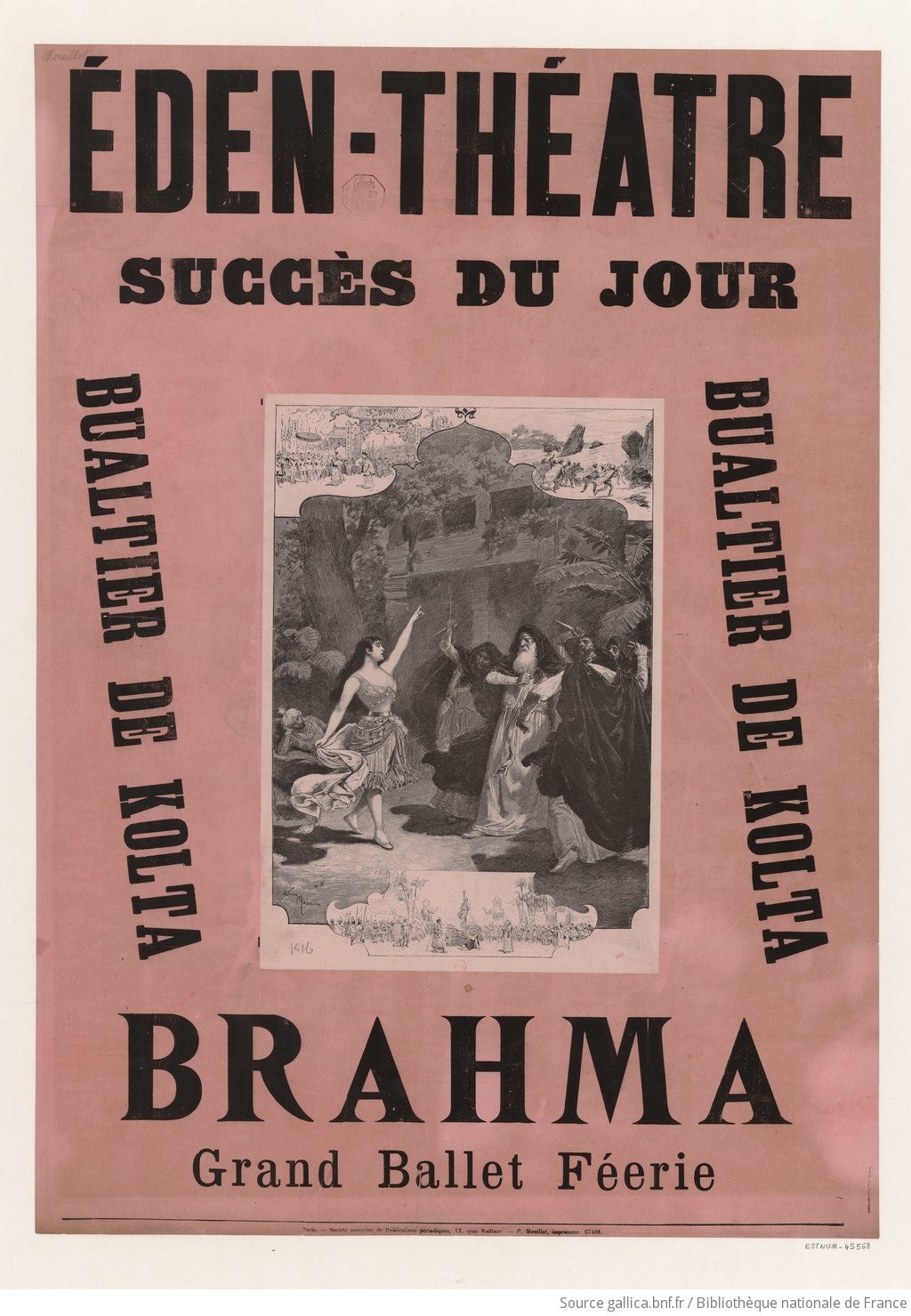
Eden-théâtre : succès du jour, Bualtier de Kolta [dans] Brahma, grand ballet féerie : [affiche] / Adrien Marie
Marie, Adrien (1848-1891). Illustrateur
- Era:
- Late 1800s (Victorian Ballroom)
- Source:
- Bibliothèque nationale de France (Gallica)
- Rights:
- Public domain — free to use, share and adapt.
- Recorded as:
- domaine public
Ballet-féeries are often dismissed as merely commercial spectacle, but they were the dominant theatrical dance form of their era and trained and displayed some of the period's most accomplished performers. This image records not just a single production but an entire apparatus of visual pleasure and technical innovation that shaped how Paris experienced dance in the 1880s. Understanding ballet-féerie is essential to understanding the social and aesthetic world that produced Diaghilev's Ballets Russes and the theatrical avant-garde of the early 20th century.
What you are looking at
This is a theatrical poster announcing the Eden-Théâtre's current hit, the grand ballet-féerie *Brahma*, featuring the celebrated dancer Bualtier de Kolta. The design is structured around a central engraved image—a scene from the ballet itself—framed by bold typography on a pink ground. The engraving depicts an exotic, orientalist setting with architectural elements suggesting an Indian temple or palace: a massive carved stone elephant dominates the composition, its trunk raised, while figures in flowing classical and pseudo-oriental drapery gesture and move around it. At left, a bare-breasted woman in a short skirt and jewelry assumes a pose of surprise or invocation; at right, draped female figures in more modest costume attend or react to the scene. The background is densely populated with crowds, suggesting a marketplace or processional moment. The overall effect is of spectacular theatrical machinery and exotic spectacle: the kind of grand ballet-féerie that dominated Parisian stages in the 1880s, promising transformation, magic, and orientalist fantasy to urban audiences.
The dancing
The central female figure at left stands in a classical contrapposto pose, her weight shifted, one arm raised in a gesture of wonder or prayer—a pose drawing on academic life-drawing convention but dressed in minimal costume to read as "exotic." The figures at right are more densely grouped, their bodies angled toward the elephant as if in reverential attendance; their arms and torsos suggest a kind of processional formality rather than vigorous dancing. The poses are statuesque and framed rather than dynamic; this appears to be a moment of spectacle and revelation rather than virtuosic movement. The composition privileges visual tableau over balletic technique.
The dance depicted
This is a *ballet-féerie*, a distinctly French theatrical form that flourished from the 1860s to the early 1900s, combining classical ballet with pantomime, acrobatics, trick effects, and exotic or fantastical themes. *Brahma* (also known as *Le Rêve de Brahma*) was a celebrated vehicle for spectacular stage machinery and orientalist fantasy. Bualtier de Kolta, known for his skill in aeralist and acrobatic performance as much as classical dancing, was the star of this production. The image captures not the pure choreography of ballet but the theatrical *mise-en-scène*—the integration of dance, dramatic gesture, costume, and mechanical spectacle that made these works famous.
How it was made
This is a color lithographic poster, a reproductive process perfectly suited to theatrical advertising in the 1880s. The central image is an engraving (likely wood or steel) inserted into the composition and framed by bold sans-serif type. This mixed technique—high-art engraving at the center, commercial printing at the borders—reflects the dual audience: the poster announces to the street-going public, while the engraved scene at its heart carries the authority and prestige of fine art, inviting closer inspection and suggesting the production's visual sophistication. The pink ground and heavy black type are characteristic of Belle Époque poster design.
About this work
This is an advertising poster for *Brahma*, a grand ballet-féerie staged at the Eden-Théâtre in Paris around 1886, featuring the star dancer and acrobat Bualtier de Kolta. The work documents the theatrical spectacular rather than the dance itself: its primary content is the promise of exotic scenery, transformation, and mechanical wonder. Within dance history, it captures a moment when ballet in Paris was evolving away from pure classical technique toward integrated theatrical entertainment—a moment when ballet shared the stage with pantomime, acrobatics, and elaborate visual effects, and when "exotic" themes could justify minimal classical costume and erotic display. The poster is a document of taste, technology, and commercial theater as much as of dance.
How to look at it
Notice the composition's division: the bold typography proclaims the work as commercial entertainment, but the central engraving invites aesthetic contemplation and claims fine-art legitimacy. The elephant is both symbol of exotic magnificence and mechanical marvel—the viewer is asked to admire both the design concept and the logistics of bringing it to the stage. Look at the minimal costume of the central figure and how it reads differently depending on whether you see her as a classical demi-goddess or as a woman partially undressed for commercial effect. The dense background crowd places the named star at a focal point while suggesting mass spectacle.
The artist
Adrien Marie (1848–1891) was a prolific illustrator and graphic artist working in Paris during the height of the Belle Époque poster era. He specialized in theatrical and entertainment imagery, producing designs for both commercial lithography and fine-art prints. His work is characteristic of the commercial graphic design of the 1880s: bold, legible, visually sophisticated, and designed to arrest attention and convey narrative or spectacle at a glance.
The period
In the 1880s, Paris ballet was in transition. The Romantic era's emphasis on ethereal pointe work and narrative emotion was giving way to a more eclectic, visually spectacular theatrical dance that incorporated acrobatics, transformation scenes, and increasingly exotic or fantastical themes. The rise of color lithographic printing technology and the competitive economics of the music-hall and boulevard theater drove innovations in poster design and visual marketing. The Eden-Théâtre itself was one of several new entertainment venues catering to a growing middle-class public eager for spectacle and novelty. Orientalism—the European fantasy of "exotic" Eastern and Indian aesthetics—was at its height as a commercial and artistic currency.
Where it lives
The work is housed in the Bibliothèque nationale de France, in the Gallica digital collection, indicating its status as a historical document of French theatrical life and graphic design. It is a mass-produced theatrical poster, not a unique object, and its survival reflects the BnF's practice of collecting ephemera that document cultural history.
Dance in this work
Questions about this work
What is a ballet-féerie?
A French theatrical form combining classical ballet with pantomime, acrobatics, trick effects (often involving mechanical apparatus), and exotic or fantastical stories. Popular from the 1860s through the early 1900s, ballet-féeries were the dominant form of theatrical dance in Paris for decades, oriented toward spectacular visual effect and novelty as much as choreographic sophistication. They were a major training and performance venue for dancers and helped establish many careers.
Who was Bualtier de Kolta?
A celebrated performer known for acrobatic skill, aerial work, and dramatic presence, as well as classical dance training. He was a star of the Paris music halls and theaters in the 1880s and specialized in the kind of physically demanding, visually striking roles that ballet-féeries demanded. Little detailed biographical information survives, but his repeated appearance as featured artist in major productions confirms his prominence.
Why is this poster important for dance history?
It documents the visual and commercial world of theatrical dance in the Belle Époque, showing how ballet was marketed, what audiences were promised, and what aesthetic values dominated. It reveals that 1880s Paris ballet was far more eclectic and spectacle-driven than classical ballet histories often acknowledge, and it shows how dance shared theatrical space with acrobatics, pantomime, and mechanical wonder.
What does the orientalism in this image tell us?
The pseudo-Indian setting, minimal classical costume, and exoticist iconography reflect European fascination with non-Western aesthetics as a source of spectacular and erotic novelty. The elephant, temple architecture, and draped figures encode "India" as a fantasy landscape available for theatrical appropriation and visual pleasure. This orientalist aesthetic was ubiquitous in late 19th-century entertainment and visual culture.
More dance artwork