49 works in this view — arrow keys or swipe to move between them.
Dance in Art
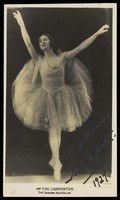
Tiki Carpenter in drag as "The dancing Australian". Photographic postcard, ca. 1927.
Unknown artist
- Dance:
- Ballet
- Source:
- Wellcome Collection
- Rights:
- Rights vary by item — check the source record before reusing this image. Source record ↗
- Recorded as:
- Check
This image complicates the separation between 'classical ballet' and 'popular dance' in the early 20th century by showing a performer trained in or costumed in ballet technique being marketed as a music-hall character act. It documents how ballet imagery circulated beyond concert stages — in cabarets, touring shows, and cross-dressed performance — and how performers borrowed ballet's visual authority for entertainment in genres ballet historians often overlook.
What you are looking at
A single figure poses against a dark background in a theatrical studio photograph. The dancer wears a classical tutu in pale silk or satin, fitted at the bodice and flaring to a short skirt that falls to mid-thigh. The tutu is supported by layers of stiffened net. The figure stands in an attitude or open pose: left leg extended to the side and back, right leg supporting, both arms raised to shoulder height or slightly higher in an open frame. The pose emphasizes line and turnout. The lighting is stark and directional, casting subtle shadow that models the body and tulle. The photographic card is aged sepia-toned, printed in halftone as was standard for theatrical postcards of the 1920s. Text appears at the foot of the card, identifying the subject.
The dancing
The dancer occupies the frame alone, in a balletic pose suggesting training in classical technique. The body shows clear turnout from the hips; the supporting leg is straight and engaged; the extended leg is lifted to hip height or higher, the foot pointed. The arms are positioned away from the body in an open port de bras, with elbows lightly bent. The posture is elongated, the neck extended, the gaze directed upward and away. This is a posed studio position rather than a moment caught in motion — a formal presentation of the body for public viewing.
The dance depicted
This is a studio portrait in the idiom of classical ballet, showing a dancer in a classical tutu executing what appears to be an attitude or développé. The image documents the dancer's body as trained in academic ballet technique. The title cryptically identifies the sitter as 'Tiki Carpenter in drag as "The dancing Australian"' — suggesting a cross-dressed performance or music-hall character dance rather than classical ballet proper, though the costume and pose are drawn directly from ballet convention. The identity and context of this performance remain unclear from the image alone; the theatrical postcard format suggests professional touring or cabaret rather than concert ballet.
How it was made
This is a photographic postcard produced by halftone printing, a process that converts continuous photographic tone into a pattern of dots readable by letterpress. Halftone postcards were the standard medium for circulating theatrical images of the 1920s, cheaper and faster than hand-tinted prints and more widely distributed than original photographs. The process allowed small theatres, cabarets, and touring performers to produce their own publicity and sell them to audiences; the card reads as a professional promotional object. The sepia tone and monochrome halftone are consistent with the catalogue date of circa 1927.
About this work
This is a studio portrait postcard of an unidentified performer in classical ballet dress, dating to the 1920s. The subject is identified in the text as 'Tiki Carpenter in drag as "The dancing Australian"' — a theatrical character rather than a conventional ballet dancer, though the costume, pose, and technical training evident in the body all reference classical ballet idiom. The work documents a moment in early 20th-century entertainment when ballet imagery was co-opted for music hall, cabaret, and cross-dressed performance; the boundary between classical and popular dance was more porous than later histories suggest. The postcard's status as a mass-produced promotional object tells us about the distribution of dance knowledge and the commercialization of the dancing body in the 1920s.
How to look at it
Look at the pose first: this is a fully developed classical ballet position, executed with visible training and control. Now read the title. The collision between what the body displays — academic ballet technique — and what the text claims — a drag act, a character called 'The dancing Australian' — is the work's content. Attend to how the postcard format and theatrical context frame this moment: this is not a concert-hall ballet, but a performer using ballet's visual language for cabaret or music-hall entertainment. The sepia halftone printing is also part of the content: this is how dance circulated as ephemera and commerce, not as archive or documentation.
The artist
The photographer is not recorded. The postcard was sourced from the Wellcome Collection, indicating it entered a medical or scientific archive rather than a dance or theatre collection — a reminder that dance ephemera often survives in unexpected institutional contexts. Halftone postcards of this era were produced by many printers; without a publisher's mark or studio signature clearly legible, attribution is not possible from the image alone.
The period
In the 1920s, classical ballet was being consolidated as a high-art form through the Russian Imperial Ballet and Ballets Russes touring companies, yet ballet imagery remained accessible and was freely adapted for popular entertainment. Music halls, cabarets, and revues incorporated ballet dancers, borrowed tutus and pointe shoes, and created hybrid acts that mixed ballet technique with comedic or character performance. Cross-dressed or gender-nonconforming performance was a live tradition in early-20th-century entertainment; this postcard documents that tradition alongside ballet's expansion beyond concert stages. The halftone postcard itself was the dominant form of theatrical publicity before film, allowing performers and small companies to produce and sell images that would circulate beyond their immediate venue.
Where it lives
The postcard is held by the Wellcome Collection, which specializes in medical history and the history of science and medicine; its presence there indicates it was collected as ephemera rather than as a dance document. The Wellcome's holdings include theatrical and popular-culture material adjacent to its core mission. No accession number or further provenance is recorded in the available catalogue data.
Dance in this work
Questions about this work
Who was Tiki Carpenter?
The catalogue record and image alone do not identify the performer. 'Tiki Carpenter in drag as "The dancing Australian"' appears to be a stage name or character name, but without additional sources, the performer's biographical identity, career, or performance context cannot be established from this postcard.
Is this ballet or drag performance?
It is both. The body is trained in classical ballet technique and the costume is a classical tutu, but the title indicates a cross-dressed or character-based theatrical act. This suggests a genre hybrid common in 1920s entertainment — using ballet's visual vocabulary and technique within cabaret, music-hall, or drag performance rather than concert ballet.
What does the 'Australian' reference mean?
The title gives no context. It may refer to the performer's origin, or to a character or sketch based on Australian themes or stereotypes. Without additional documentation, the meaning of this subtitle remains unclear.
Why is this in a medical archive?
The Wellcome Collection holds social and cultural ephemera beyond strict medical history, including theatrical material. This postcard likely entered the collection through a general acquisition of early-20th-century printed material rather than being collected for its dance-historical significance.
More Ballet artwork