49 works in this view — arrow keys or swipe to move between them.
Dance in Art
Dancer
Unknown artist
- Source:
- Cleveland Museum of Art
- Rights:
- Public domain — free to use, share and adapt.
- Recorded as:
- CC0 (Public Domain)
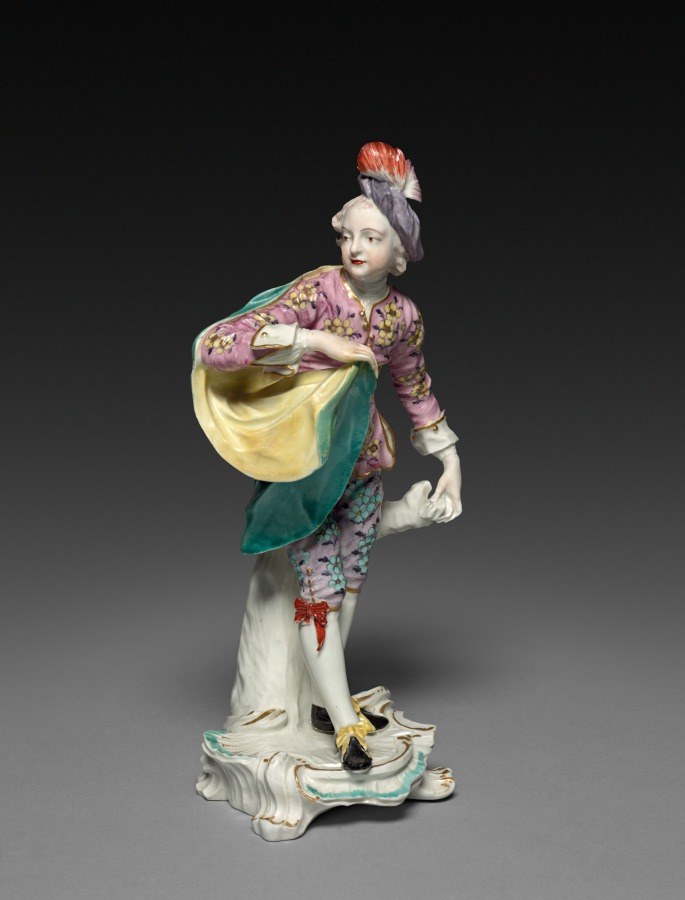
Porcelain dance figures are among the few three-dimensional records we have of how eighteenth-century court dancers actually posed and held their bodies. The figure's posture, arm position, and frame provide evidence for how the formal dance vocabulary taught in manuals like Feuillet's notation was translated into actual bodily practice. The costume details—the specific cut of the jacket, the heeled shoes, the turban—are equally valuable records of theatrical and ballroom dress that historians of dance and fashion depend on.
What you are looking at
A porcelain figure depicts a young male dancer in mid-movement, captured in an elegant pose that suggests the theatrical vocabulary of eighteenth-century court dance. He stands on a scrolled, shell-decorated base painted with green and blue accents. His pale porcelain skin contrasts sharply with his costume: a fitted jacket of rose-pink silk embroidered with yellow flowers and gold details, pale stockings, and dark heeled shoes with gold buckles. A flowing yellow-green drapery sweeps across his body from his left side, as though caught mid-gesture or mid-turn. His posture is poised and refined, with his weight centered and his frame upright in the manner of formal dance instruction. A distinctive grey turban with orange-red ostrich feathers crowns his head, suggesting either an exotic 'character' role or the fashionable turban style of the period. The figure's delicate face shows the serene expression characteristic of porcelain court figures of this era.
The dancing
The dancer is a single figure in an upright, composed stance with shoulders back and frame open. His left arm is extended forward and slightly outward in a gesture that is graceful but restrained, while his right arm hangs naturally at his side. His weight appears centered over his legs, which are straight but not locked. The posture and arm positions suggest a vocabulary of controlled, balletic movement rather than vigorous street dance. The body is elegant and elongated, with the characteristic proportions of porcelain court figures designed to embody aristocratic refinement.
The dance depicted
This appears to represent an eighteenth-century court or ballroom dancer, most likely engaged in a formal dance such as a minuet, gavotte, or other Baroque social dance. The turban and exotic costume elements suggest this may be a 'character' or 'pantomime' figure within a theatrical context—the kind of stylized ethnic or fantasy costume that appeared in court ballets and masquerades of the period. The refined posture and upright frame are entirely consistent with the formal vocabulary of European court dance as taught through the eighteenth century. The artist has captured not a moment of vigorous movement but rather a composed, balletic stance that demonstrates the dancer's control and elegance.
How it was made
This is a painted porcelain figure, hand-modeled and decorated with glazes and overglaze painting in multiple colors. The technique allowed for remarkable detail in the costume, facial features, and decorative elements—the embroidery of the jacket, the stockings, the feathers. Porcelain figures of this kind were produced in major European manufactories (Meissen, Sèvres, Derby, Vienna) primarily for aristocratic collectors and were displayed as ornamental sculptures in cabinets and on mantelpieces. The figure was cast in separate pieces (body, arms, legs, base) and assembled, then painted with the meticulous detail that made such figures expensive luxury objects. The technique reflects both technical virtuosity and the high market for dance and theatrical imagery among the wealthy.
About this work
This is an eighteenth-century porcelain figure of a young male dancer in a formal, composed pose, dressed in the silks and feathers of a court ballroom or theatrical costume. It captures the visual language of Baroque and Rococo dance as it was performed and idealized by the European aristocracy. The porcelain medium—expensive, durable, and designed for display in the homes of the wealthy—tells us that dance imagery was not merely documentary but aspirational, a marker of refinement and taste. The work belongs in a gallery of dance in art because it records not just what eighteenth-century dancers wore, but how they moved: upright, controlled, elegant, and deliberately artificial.
How to look at it
Look at the figure's posture and frame: the upright spine, the open shoulders, the composed arm positions. These gestures embody a deliberate, learned vocabulary—this is not a naturalistic pose but a refined, stylized one. The exotic costume (the turban, the embroidered jacket) suggests a named character role within a ballet or court entertainment. Notice how the yellow-green drapery flows from one side: this may represent a moment of movement, or it may simply be a compositional choice to add elegance and visual interest. The technical virtuosity of the porcelain itself—the modeling of the face, the hand, the feet—demonstrates the material value placed on images of dance in this period.
The artist
The artist is not recorded. The figure was almost certainly produced in a major European porcelain manufactory in the mid-eighteenth century, most likely Meissen (Saxony), Sèvres (France), or Vienna. These manufactory workshops employed specialized modelers and painters working from designs by court artists and dance masters. Individual artisans within such workshops are typically unknown to history, though their work was signed with the factory mark. The style and quality suggest a work by a skilled modeler with access to live dance instruction or theatrical costume.
The period
In the eighteenth century, dance was an essential courtly art, taught to nobles alongside music and languages as a mark of breeding. The formal court dance system—based on the five positions of the feet and codified in manuals of dance notation—was highly standardized across Europe. Simultaneously, theatrical dance was becoming a distinct profession: court ballets incorporated characters from commedia dell'arte and exotic lands, and traveling dance masters brought fashionable steps from one court to another. Porcelain figures of dancers became fashionable collectibles from roughly 1740 onward, as porcelain manufactories developed the technical capacity to model complex human figures with elaborate costumes. These figures also responded to the period's fascination with 'character' roles and exotic dress in theatrical spectacle.
Where it lives
The object is part of the Cleveland Museum of Art's dance-related art collection. The museum's designation of this work as part of a specialized collection focused on dance indicates its recognition as a significant historical record of dance practice and imagery.
Dance in this work
Questions about this work
What does the turban mean?
The turban suggests this figure represents a 'character' or exotic role within a court ballet or masquerade rather than a dancer performing a social dance. Eighteenth-century court entertainment frequently incorporated costumed characters from fantasy, commedia dell'arte, and imagined distant lands. The specific color and style of the feathered turban was fashionable in the mid-eighteenth century and appears in portraits and theatrical prints of the period.
Is this a record of a real dance or a fantasy?
It is both. The porcelain figure uses real costume pieces and body positions from actual eighteenth-century dance, but it also idealizes and theatricalizes them. The exotic costume is entirely plausible for a named theatrical role; the composed pose is the kind taught in dance manuals and demonstrated by professional dancers. The figure is not a direct transcript of a moment in performance, but rather an idealized embodiment of a dance type.
Could this figure have been a gift or commissioned for a specific patron?
Yes. High-quality porcelain figures were expensive and typically purchased or commissioned by aristocratic collectors. This figure may have been ordered by a patron who was interested in dance, theater, or simply the fashionable collecting of porcelain. Some manufactory records show that figures were commissioned to commemorate specific performances or to represent favorite dancers or roles, though without documentation we cannot determine this figure's original commission.
What does the pose tell us about how people really danced?
The upright frame, the turned-out legs, the controlled arm positions, and the general composure are entirely consistent with the formal dance vocabulary codified in eighteenth-century notation systems and manuals. The pose demonstrates the fundamental principles taught to all courtly dancers: turnout, verticality, and controlled, deliberate movement. This is exactly how a trained dancer would have held their body in a formal dance context.
More dance artwork