28 works in this view — arrow keys or swipe to move between them.
Dance in Art
Ballet des muses
Unknown artist
- Medium:
- Dance:
- Ballet
- Source:
- New York Public Library
- Rights:
- Public domain — free to use, share and adapt.
- Recorded as:
- public_domain
Court ballet is the ancestor of modern theatrical ballet, and this engraving is evidence of the sophisticated performance vocabulary and allegorical ambitions that shaped ballet's development. For historians of dance, courtly gesture, and 17th-century French culture, it reveals how dance was integrated with architecture, costume, and classical learning to create a total artwork—a precedent for the later European ballet tradition.
What you are looking at
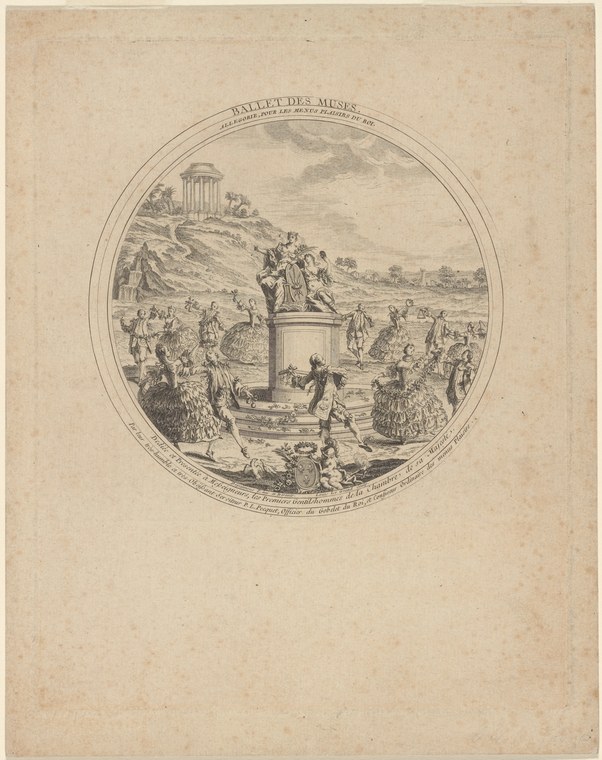
A circular engraving depicts an outdoor celebration centred on a monumental pedestal or altar, likely commemorating the Muses in classical tradition. In the foreground, elegantly dressed figures in 17th-century court costume—women in full skirts and fitted bodices, men in breeches and doublets—engage in formal dance. The scene radiates outward in concentric rings of activity: pairs and groups perform in the immediate circle around the monument, while beyond them crowds of spectators and additional dancers populate the middle distance. The background shows a pastoral landscape with a classical temple or rotunda atop a distant hill, establishing an idealized Arcadian setting. The composition is dense with movement yet hierarchically organized, with the monument as the fixed focal point and figures arranged at varying distances to create depth. The engraving's fine lines and careful cross-hatching create a luminous quality characteristic of 17th-century court imagery.
The dancing
The dancers adopt the formal, upright posture of courtly dance: women hold their skirts, moving with controlled elegance; men are positioned at their sides or opposite them in paired configurations. Arms are extended gracefully, often raised or positioned to frame the body in classical poses. The dancers' weight appears centered and held, with no evidence of jumping or vigorous footwork—the movement vocabulary is the restrained, gliding style of court dance. Groups of three to five dancers form loose configurations rather than tight holds, and several figures are positioned mid-gesture, suggesting the moment between steps rather than an explosive leap.
The dance depicted
This work almost certainly depicts a *Ballet de cour* (court ballet), a theatrical form combining dance, music, and spectacle that dominated French court life in the 17th century. The Ballet des Muses was likely a specific court entertainment, though which production among several bearing this name is unclear without stronger dating or attribution. The allegorical subject—Muses as patrons of the arts—was a favourite of court ballet. The visual evidence shows the characteristic features of court ballet: formal procession and grouping, costume as narrative and status marker, and the integration of dance into an elaborate dramatic and architectural setting. The dancers move in the measured style of the *haute danse* (high dance) vocabulary of the period.
How it was made
This is an engraving, executed with the precision typical of mid-to-late 17th-century court documentation. The circular format and the fine parallel lines (hatching) creating tonal modulation are diagnostic of copper-plate engraving. The technique allowed for wide circulation of court spectacles to courtiers, diplomats, and the educated public who could not attend performances in person—these prints were essential to the cultural authority of the French crown. The high level of detail and the monumental framing suggest this was a significant commission, likely issued to commemorate the original performance.
About this work
This engraving documents a *Ballet de cour* titled (or subtitled) *Ballet des Muses*, a form of courtly theatrical spectacle central to 17th-century French culture. Court ballets were allegorical pageants combining dance, music, verse, and elaborate costume, performed by nobility and professionals at the royal court. They were instruments of statecraft and artistic prestige, and their documentation through high-quality engravings was itself a form of cultural assertion. The circular composition and hierarchical arrangement of figures, with the monument to the Muses at the centre, reflects the formal aesthetics of court ballet and its role in an ordered, divinely sanctioned social hierarchy. This work belongs in a gallery of dance because it is a primary document of how an entire court culture understood dance as spectacle, allegory, and political statement.
How to look at it
Observe the monument at the centre—it is not merely decoration but the structural and symbolic anchor of the composition. The dancers' positioning relative to it (circling, facing, processing) suggests choreographed geometry rather than spontaneous joy. Notice the women's skirts: their full, heavy fabric limits the stride and suggests a gliding, turning movement rather than traveling steps. The background landscape, with its distant classical temple, establishes an Arcadian, timeless realm—court ballet claimed to transport spectators from the present court into a world of myth and allegory. Finally, note the overall formality and symmetry: even amid the crowded scene, the arrangement follows principles of order and hierarchy that reflect courtly society itself.
The artist
The artist is not recorded. However, the style and quality are consistent with the royal atelier of engravers that documented court ballets in 17th-century France, likely working under royal commission or for the court's official printmakers. Court ballet documentation was a specialized and prestigious genre, and these engravings were often produced by multiple hands, with design, engraving, and publication coordinated by the crown or the court's artistic establishment.
The period
The 17th century saw the *Ballet de cour* at its zenith as a form of courtly expression and political pageantry, particularly under Louis XIV. These spectacles showcased the nobility's accomplishment in dance, verse, and music, and by extension, the power and cultural authority of the crown itself. The allegorical subject matter—here, the Muses as patrons of the arts—allowed courts to present themselves as custodians of classical learning and civilization. Simultaneously, the engraving medium was becoming the primary technology for the reproducibility of court imagery, allowing performances that occurred in the palace to circulate through the learned world as prints. This intersection of live spectacle and printed documentation was central to the cultural power of the court in this period.
Where it lives
This engraving is held in the New York Public Library. It is catalogued as a print from an unknown era and by an unknown artist, which is typical for court ballet documentation, where prints were often produced as parts of larger series and individual attribution was not always preserved or emphasized.
Dance in this work
Questions about this work
What is a 'Ballet de Cour'?
A court ballet was an elaborate courtly entertainment, typically allegorical, that combined dancing by nobility and professionals with music, verse, and elaborate staged sets. These spectacles were central to 17th-century French court life, especially under Louis XIV, and served as both entertainment and political assertion of royal power and cultural authority.
Why is the Muses the subject?
The Muses—goddesses of the arts in classical mythology—were favourite allegorical figures in court ballet. By invoking them, the court positioned itself as the heir to classical learning and the patron of all the arts. The choice reflected the aspirations of the French court to embody civilization, taste, and enlightenment.
Why was this engraved and printed?
Engravings of court ballets circulated widely among the nobility, the diplomatic corps, and the educated public who could not attend performances in person. These prints extended the court's cultural reach and authority, allowing the spectacle to be remembered, discussed, and admired far beyond the palace walls.
What can you tell about the dance from this image?
The dancers' upright, centered posture and the graceful, measured positioning suggest the *haute danse* (high dance) vocabulary of 17th-century court dance. The emphasis on elegant pose, symmetrical grouping, and processional arrangement shows that court dance was as much about visual hierarchy and decorum as it was about footwork.
More Ballet artwork