30 works in this view — arrow keys or swipe to move between them.
Dance in Art · 2013
Ballet des muses
Unknown artist
- Medium:
- Dance:
- Ballet
- Source:
- New York Public Library
- Rights:
- Public domain — free to use, share and adapt.
- Recorded as:
- public_domain
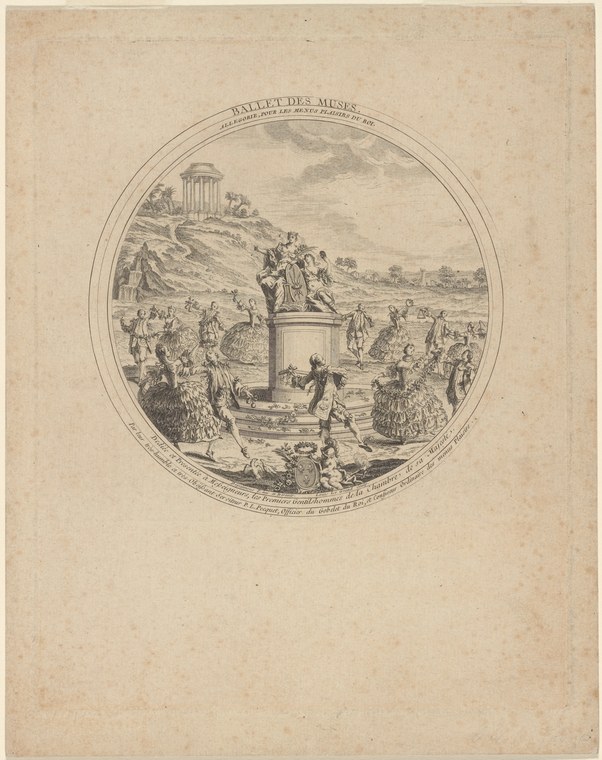
The Ballet des Muses represents a crucial moment in dance history: the formal codification of court ballet as a courtly art form in which members of the aristocracy themselves participated. This image, as a circulated engraving, tells us how such performances were memorialized and imagined for audiences beyond the court—what was considered worth recording and celebrating about them. For historians, it offers visual evidence of costume, scale, spatial organization, and the fusion of dance with architecture and ceremony that defined early modern court culture.
What you are looking at
A large outdoor gathering in a classical setting, dominated by a monumental statue on a pedestal at center. The composition is circular, with dozens of elegantly dressed figures arranged around the monument in what appears to be a formal celebration or ceremony. In the background, a temple or classical structure sits atop a hill, with rolling landscape beyond. The foreground shows the densest clustering of figures—women in elaborate dresses with full skirts, men in period dress—some standing in groups, others arranged in processional or dance-like formations. The engraving technique renders the scene in fine parallel lines that create depth through atmospheric perspective; the sky is suggested with light clouds. The gathering has the character of a stately court ceremony, with the monument as its focal point. The title "Ballet des Muses" inscribed at top suggests this depicts an allegorical performance or entertainment dedicated to the Muses.
The dancing
The figures vary considerably in pose: some stand in upright, formal stances typical of court dress; others appear to be in motion or gesture. Several groupings suggest coupled dancing or paired movement, with arms extended and bodies oriented toward partners. The women's voluminous skirts and the men's fitted breeches and coats are consistent with 17th-century court dress. The density of figures and their arrangement around the central monument suggest a grand ballet de cour in which groups of nobles would have processed and danced in geometric formations. Footwork is not clearly legible at this scale, but the overall composition emphasizes formal positioning and ceremonial arrangement over vigorous movement.
The dance depicted
This is a ballet de cour, a form of aristocratic theatrical spectacle that flourished in 17th-century France and Italian courts. The Ballet des Muses was likely one of several such entertainments commissioned as court festivities; such ballets often celebrated rulers and abstract concepts through allegorical tableaux and coordinated processional movement. The figures here do not appear to be executing virtuosic technique but rather moving in the stately, geometrically ordered manner characteristic of court ballet, where precision of formation and symbolic grouping mattered more than individual display. The outdoor setting and monumental context suggest this may commemorate an actual performance or idealize the type.
How it was made
This is an engraving, executed in the fine linear hatching technique typical of 17th-century reproductive prints. The medium allowed wide circulation of an image of a court spectacle to audiences who could not attend, and the elaborate inscription and composition suggest this was a formal commemorative document. The circular framing and the careful perspective construction are deliberate choices that emphasize the ceremonial and ordered nature of the event. The technique's precision and the print's evident care in composition indicate this was a high-status commission, likely intended to record and celebrate a significant court entertainment.
About this work
This engraving documents or depicts a Ballet des Muses, a courtly spectacle from the 17th century (the exact date is unclear from the record, but the dress and style point to that era). Such ballets were theatrical performances combining music, poetry, and coordinated movement, performed by nobility and court professionals as part of state celebrations. The work belongs to the history of ballet de cour, an ancestor of modern theatrical ballet, and records a moment when dance was inseparable from courtly ceremony, visual spectacle, and political performance. The engraving as a medium allowed knowledge of these ephemeral events to survive and circulate beyond the court itself.
How to look at it
Pay attention to the formal arrangement of the figures around the monument: this is not a representation of spontaneous movement but of carefully choreographed procession and formation, which was the essence of court ballet. Notice the contrast between the density of figures and the open space around the central statue—the composition emphasizes geometric order. The observer should consider that the "dance" here consists of stately, symbolic movement and precise spatial positioning rather than the jumps and turns we associate with later theatrical ballet. The engraving's circular framing reinforces the ceremonial, orderly nature of the spectacle.
The artist
The artist is not recorded. However, the quality and formal composition of the engraving suggest it was produced by a professional printmaker in a court or major urban center, likely commissioned to commemorate the performance. The style is consistent with 17th-century reproductive engraving, a medium used to disseminate images of court spectacle and cultural achievement.
The period
The ballet de cour emerged in Renaissance Italy and was enthusiastically adopted by the French court, particularly under the patronage of the Medici and later the Bourbons. By the 17th century, such ballets were the primary form of court entertainment, blending dance, music, poetry, and visual spectacle in allegorical narratives often celebrating the ruler. This was a period in which dance was not yet professionalized or separated from courtly social life; aristocrats, including the king himself, performed alongside professionals. The engraving as a medium for recording such performances reflects the growing importance of documenting courtly life and achievement for a wider educated public.
Where it lives
The work is held in the New York Public Library collection. It appears to be a historical engraving, likely from the 17th or early 18th century, acquired as a document of court entertainment and spectacle.
Dance in this work
Questions about this work
What is a ballet de cour?
A ballet de cour was a form of aristocratic entertainment that combined dancing, music, and poetry, performed primarily by members of the nobility themselves. These spectacles, popular in 16th- and 17th-century courts, particularly in France and Italy, celebrated rulers and expressed courtly ideals through elaborate allegorical narratives. Unlike later ballet, which became a professionalized art form, court ballet was an amateur pursuit of the aristocracy and a form of political ceremony.
Who were the Muses and why would a ballet be dedicated to them?
In classical mythology, the nine Muses were goddesses who inspired poetry, music, dance, and the other arts. A Ballet des Muses would use this allegorical framework to frame the entertainment as a celebration of artistic achievement and courtly refinement. Such dedications were common ways to flatter patrons and connect court entertainments to classical learning and cultural prestige.
How do we know this is a dance performance and not just a gathering?
The title explicitly names it a ballet, and the formal, geometric arrangement of the figures—their coordinated positioning and the way some appear to be in paired formations—reflects the choreographic principles of court ballet. The setting in a classical landscape with a monument suggests an idealized, allegorical context rather than a documentary one. However, the image is a representation or commemoration, not a direct record of movement, so details of actual steps and technique are not visible.
More Ballet artwork