36 works in this view — arrow keys or swipe to move between them.
Dance in Art · 2013
Habit de ballet
Unknown artist
- Medium:
- Dance:
- Ballet
- Source:
- New York Public Library
- Rights:
- Public domain — free to use, share and adapt.
- Recorded as:
- public_domain
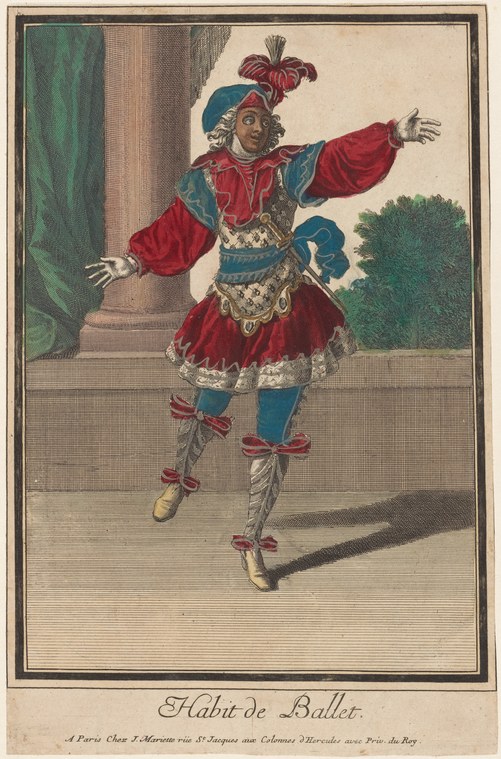
The image documents the visual spectacle and material culture of ballet de cour, a form fundamental to the emergence of ballet as a theatrical genre. It shows that 17th-century court ballet was as much about costume, display, and social performance as about movement technique, a principle that shaped European dance aesthetics for centuries.
What you are looking at
A single figure in theatrical dress occupies the center of the composition, posed in an exuberant contrapposto stance against a simplified backdrop of classical architecture and vegetation. The dancer wears a richly decorated costume in red and blue silk: a red doublet with gold ornamental trim, a short red skirt with white lace edging, blue hose, and red ribbon ties at the knees and ankles. A tall red plume adorns the head, and the face is darkened—consistent with the theatrical blackface conventions of 17th-century European court spectacle. The figure's arms are extended in an open, animated gesture, with the weight shifted onto one leg while the other appears lifted or extended. The ground plane is rendered in soft perspective with light hatching; the setting is a noble courtyard or garden loggia. The print is hand-colored with translucent washes over fine engraved lines, giving the fabric and plumage vivid jewel-like qualities.
The dancing
A single dancer occupies the full height of the composition in a pose of theatrical exuberance. The weight rests on one leg while the other is extended or lifted; both arms reach outward at shoulder height in an open, welcoming frame. The carriage is upright and buoyant, with no closed partnered hold. The extended limbs and animated facial expression convey joy and display rather than technical precision. This is a figure designed to be seen and admired, posed as much for the portrait as for the dance itself.
The dance depicted
This is a costume study for a ballet de cour, the elaborate courtly spectacle form that dominated French court entertainment in the 17th century. The title 'Habit de Ballet' (Costume of Ballet) confirms it depicts a character or role rather than a specific choreographic moment. The costume—richly ornamented, theatrical rather than naturalistic, and featuring blackface—was typical of court ballet costumes, where nobility and wealthy amateurs performed in allegorical and fantastical guises. The pose captures the dancer in a moment of performed delight and display, consistent with the expressive vocabulary of court dance. The standing figure is not engaged in complex footwork; the emphasis is on noble bearing, costume magnificence, and the visual spectacle of the unified whole.
How it was made
This is a hand-colored engraving, a reproductive technique that allowed costume studies and dance imagery to circulate widely among European courts and their imitators. The engraved line work provides fine detail—the gold embroidery, the texture of silk and lace, the feather plumage—while hand-coloring in translucent washes preserves the luminosity of the original painted designs. Such prints served as a form of court documentation and as models for dressmakers and costume makers. The imprint line at bottom indicates this was published in Paris, confirming its role in disseminating courtly fashion and dance knowledge.
About this work
This is a costume study for a dancer in the French court ballet tradition, a form in which nobility performed in elaborately costumed allegorical and fantastical roles. The engraving documents both the visual spectacle of 17th-century court dance and the elaborate sartorial investment it required. The single standing figure, posed in an attitude of animated grace, represents a professional dancer or noble amateur in performance mode—a moment frozen not to show technique but to display the magnificence of costume and the bodily confidence of the performer. Such costume prints circulated widely, allowing the cultural prestige and aesthetic innovations of the French court to influence European courts and their aspiring imitators.
How to look at it
Attend to the costume first: the engraver has lavished detail on silk texture, embroidery, lace, and plumage, indicating that visual magnificence was a primary goal of the form. The pose is one of repose and display rather than mid-movement; the figure is shown as it would appear stationary or in a slow, stately passage. The classical architecture and garden setting identify this as a noble entertainment, not a popular or vernacular dance. The animation of the arms and the lift of the face suggest joy and courtly refinement—the emotional register of the performance.
The artist
The artist is not recorded. The print bears only a publication imprint indicating Paris origin. Such costume and dance studies were often produced by court artists or commercial print shops working from designs by court designers or dancers themselves. The fine engraving and hand-coloring suggest professional production for a courtly or wealthy urban audience.
The period
Ballet de cour flourished in France under Louis XIV (r. 1643–1715), at its peak a form blending dance, music, poetry, and visual spectacle in which the king and nobility performed. By the late 17th century, as professional dancers began to replace amateurs, the form evolved toward the theatrical ballet that would emerge in the 18th century. This print dates to a moment when court ballet was codifying its movement vocabulary and when costume and display remained central to its aesthetic. The use of blackface reflects period conventions in court masquerade and spectacle without which this image cannot be understood historically, though it is now recognized as a profound offense.
Where it lives
The work is held in the New York Public Library collection. It is identified as a print from a Paris publication (imprint visible at bottom), likely from the late 17th or early 18th century, and forms part of the library's holdings of historical dance and costume documentation.
Dance in this work
Questions about this work
What is a ballet de cour?
Ballet de cour was a form of courtly entertainment in 16th- and 17th-century France in which nobility and wealthy amateurs performed in elaborately costumed allegorical and fantastical spectacles combining dance, music, poetry, and visual design. It was a form of social and political performance as much as dance, and a precursor to professional theatrical ballet. This costume study documents one dancer's role within such a spectacle.
Why is the figure's face darkened?
The darkened face reflects theatrical conventions of 17th-century court masquerade and spectacle in which performers adopted fantastical or allegorical personas. This practice is now recognized as a deeply offensive racial caricature. Understanding its historical context does not justify it but is necessary for honest engagement with the period's visual culture.
Is this a record of an actual performance?
This is a costume study, not a documentation of a specific performance. It shows the type of costume and the posed deportment of a dancer, likely created to be circulated among courts or used as a reference for costume makers. It represents an ideal or type rather than a unique historical event.
How was this print made and distributed?
This is a hand-colored engraving, a technique that allowed designs to be reproduced and circulated. The fine line work was created by engraving on a copper plate; each impression was then hand-colored with watercolor or gouache. Such prints were valuable objects for courtly audiences and served as documents of fashion, costume design, and court aesthetics.
More Ballet artwork