38 works in this view — arrow keys or swipe to move between them.
Dance in Art · 2019
Scene de ballet
Unknown artist
- Medium:
- Dance:
- Ballet
- Source:
- New York Public Library
- Rights:
- Public domain — free to use, share and adapt.
- Recorded as:
- public_domain
This print provides rare visual evidence of how ballet was staged and presented in the 18th century, showing the setting, scale, crowd, and formal arrangement of a theatrical or court ballet. For historians and dancers, it documents the integration of dance into aristocratic spectacle and the classical vocabulary of port de bras and carriage in the period before Romantic ballet. The engraving's circulation among collectors and patrons reveals how ballet was understood and valued as a subject worthy of fine printmaking and preservation.
What you are looking at
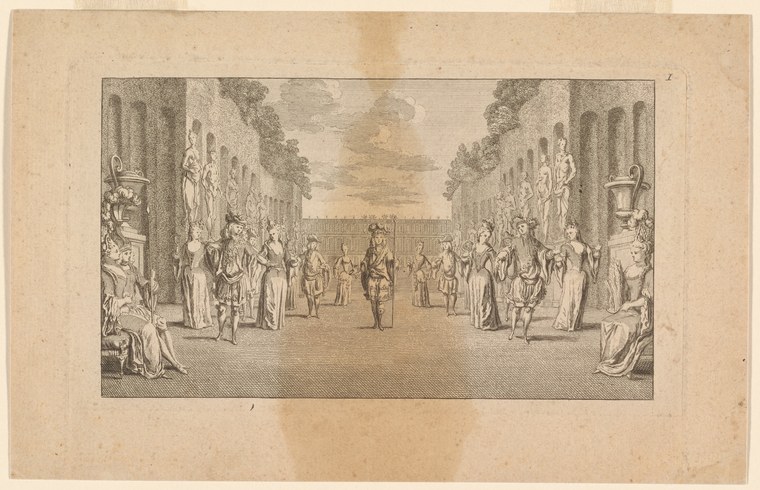
An engraved print depicting a formal ballet scene set in a classical colonnade with fluted columns lining both sides of a long gallery. The ground is open and paved; trees are visible at the far end under a clouded sky. A crowd of figures in 18th-century dress occupies the space, arranged in loose clusters rather than as a rigid corps. In the foreground, both near and far sides of the scene, statuary in niches breaks the colonnade. The composition draws the eye down a deep perspective toward the center-back of the space, where the action appears to concentrate. The print is rendered in the formal tonal manner of 18th-century engraving, with careful attention to light, shadow, and architectural detail. The scene reads as a public court occasion or grand theatrical performance, with the classical setting lending authority and grandeur to the gathering.
The dancing
The figures are distributed across the floor with some standing in formal poses and clusters suggesting courtship or conversation. Several women in the foreground are positioned in classical ballet carriage—upright, with arms held in positions suggesting port de bras rather than everyday gesture. Men in formal court dress (breeches, coats) stand in attendance. The depth of field and loose grouping suggest this is a social gathering or formal scene within a ballet narrative rather than a regimented ensemble moment. No active leap, turn, or precise footwork is clearly rendered, though the women's posture and arm positions indicate the balletic vocabulary of the era.
The dance depicted
This is a scene de ballet—likely from an 18th-century theatrical ballet or court entertainment. The setting, dress, and formal arrangement suggest either a court ball within a ballet narrative, or a scene of aristocratic life that forms the dramatic frame for a ballet performance. The women's carriage and port de bras follow the conventions of French noble style ballet of the mid-to-late 18th century, when ballet was still danced primarily by aristocrats and professionals trained in court manner. The scene captures a moment of repose or social interaction rather than virtuosic dancing, which is typical of the dramatic scenes that frame dance spectacles in Romantic-era narrative ballets or court divertissements.
How it was made
This is an engraving, likely produced by direct engraving or etching on copper plate and printed to paper. The tonal rendering through line-work, cross-hatching, and careful modulation of light and dark is characteristic of 18th-century European printmaking. Engravings of this scale and finish were expensive to produce and indicate circulation among educated, wealthy audiences—likely collectors, dancers, and patrons of the theater. The architectural precision and compositional formality suggest the work was either commissioned to document a specific performance or created as a memento of court spectacle for a collector's cabinet.
About this work
This engraved print documents a scene from an 18th-century ballet or court entertainment, showing an aristocratic gathering in a classical setting. The formal arrangement, dress, and balletic carriage of the figures indicate a formal theatrical moment, likely from a ballet of the French noble school or court tradition. The engraving's finish and scale suggest it was created for a educated audience of patrons and professionals—a record of a specific performance or a celebration of courtly taste and balletic culture.
The work sits within the tradition of ballet as a courtly and aristocratic practice, before the Romantic era transformed the art and before the professional ballet company became the norm. It captures the moment when ballet was still closely tied to court protocol and courtship ritual, and when the setting—the colonnade, the architecture, the formal gathering—was as important to the spectacle as the dancing itself.
How to look at it
Attend to the posture and arm positions of the women in the foreground and middle distance: the carriage of the upper body, the placement of the arms, the lift through the spine. These reveal the balletic vocabulary of the era. Note the architectural setting and formal arrangement—the colonnade frames the scene and lends it gravity, while the scattered grouping suggests a moment of social gathering rather than performance. Look at the depth of field and the way the eye is drawn toward the center: this compositional choice emphasizes the formal, ceremonial nature of the occasion. The print's formal finish and careful rendering of light and shadow create an atmosphere of solemnity and grandeur around what might otherwise read as a simple gathering.
The period
This work dates to the 18th century, an era when ballet was the art form of choice for celebrating aristocratic taste and courtly accomplishment. In France and across Europe, court ballets and theatrical ballet spectacles were commissioned to mark state occasions, royal celebrations, and elite social life. The French noble school of ballet, codified by the Académie Royale de Danse (founded 1661), dominated performance, emphasizing turnout, symmetry, and the formal vocabulary of arms and carriage visible in this print. The engraved print was a standard medium for documenting and celebrating such occasions, allowing a performance to be preserved and circulated among patrons who could not attend or wished to own a record. By the time of this print, theatrical ballet was beginning to shift toward narrative and spectacle, moving beyond the pure court dance into more dramatic forms—a transition visible in the way this scene frames dance within a larger dramatic context.
Where it lives
The work is held in the New York Public Library collection and is listed as a print. The catalogue record provides no artist attribution, date, or title beyond 'Scene de ballet,' indicating it may be catalogued as an anonymous 18th-century print or one whose maker and provenance are not yet fully established.
Dance in this work
Questions about this work
Is this a record of an actual performance?
It is likely one of two things: either a commemorative print made after a specific court or theatrical ballet, or a more general celebration of ballet as an aristocratic practice. The formal finish and fine engraving suggest it was made for a patron or collector, rather than as a casual record. Without artist attribution or a documented provenance, we cannot say whether it depicts a named performance or is a more generalized scene.
What is the setting supposed to be?
The classical colonnade, statuary, and open ground suggest a grand hall, palace gallery, or the garden setting of an opera or ballet narrative. The architecture is Italian Renaissance or classical in style—possibly meant to evoke antiquity, a common conceit in 18th-century court spectacle and baroque opera. It may also depict a specific known venue, but this cannot be determined from the image alone.
How do I recognize this as ballet rather than just a formal gathering?
The title, the upright carriage and formal arm positions of the women (especially visible in the foreground), and the formal costume mark this as ballet. The women's posture follows the ballet vocabulary of the period: turned-out legs, lifted spine, arms in positions that frame the body balletically. This is not how people stood naturally in the 18th century; it is the trained carriage of court dance.
More Ballet artwork