29 works in this view — arrow keys or swipe to move between them.
Dance in Art · 2019
The Daikagura dance
Unknown artist
- Medium:
- Engraving
- Era:
- Pre-1700 (Renaissance/Baroque)
- Source:
- New York Public Library
- Rights:
- Public domain — free to use, share and adapt.
- Recorded as:
- public_domain
This image is rare evidence of how acrobatic performance was integrated into Japanese dance-theater prior to the codification of Kabuki, and it captures the aesthetic priorities of the period—extreme flexibility, emotional intensity, and the display of the body's technical potential. For dancers and historians, it documents a genealogy of contortion and acrobatic movement in East Asian performance that predates modern circus arts.
What you are looking at
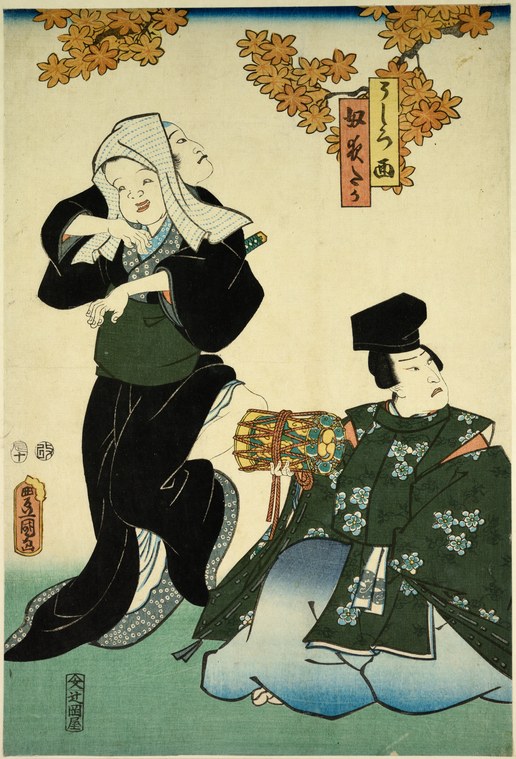
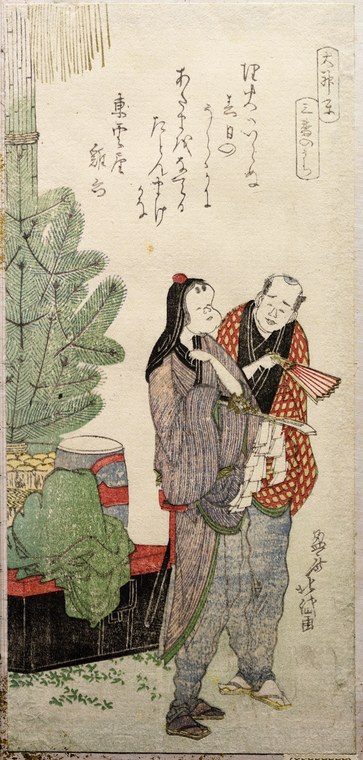
A Japanese woman in a vivid red patterned robe and white undergarments crouches or bends forward with exaggerated flexibility, her body folded almost double. Her head tilts back and to the side with mouth open in an expression of theatrical abandon. In her raised right hand she holds a rope or cord that loops upward toward the top of the composition, where sketches of faces and figures appear in the upper margin—likely studies or notes. To the right stands a tall potted plant with thick green foliage. The print is executed in the delicate style of Japanese woodblock engraving, with careful attention to the patterning of textiles and the subtle modeling of flesh. The figure dominates the lower two-thirds of the sheet; the upper portion is reserved for calligraphic inscriptions and compositional notes, suggesting this is a study or preparatory sheet rather than a finished artwork for display.
The dancing
A single female figure, her body articulated in a striking posture of extreme forward flexion—the torso folded toward the thighs, the spine curved in an arc that reads as both acrobatic and expressive rather than balletic. The raised arm trails the rope with apparent ease; the counterbalancing of weight across the folded frame suggests muscular control and deliberate training. The expression—mouth open, head thrown back—indicates that this is a moment of exertion or ecstatic expression, not a static pose.
The dance depicted
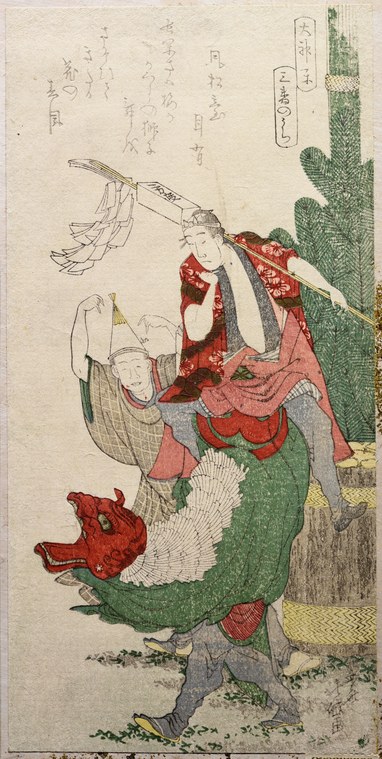
This appears to depict a moment from daikagura (大歌舞), a form of ritual performative entertainment combining music, acrobatics, and dance that emerged in early modern Japan. The extreme flexibility and acrobatic contortion visible here align with daikagura's incorporation of acrobatic movement and contortionism alongside dance proper. The rope held aloft and the theatrical intensity of the pose suggest a moment of virtuosic display—a feature central to daikagura performance, which was often competitive and designed to astonish audiences. The figure's gender and the richly patterned dress are consistent with the performer tradition, though daikagura encompassed both male and female performers.
How it was made
This is a hand-colored woodblock print in the Japanese tradition, executed with the precision characteristic of Edo period prints. The technique allowed fine linear work for the rope and facial features, while the application of pigment—particularly the vivid red and careful modeling of the white garments—creates volume and movement. The presence of sketches and notes in the upper margin suggests this may have been published as a study print or in a series documenting performance types, implying circulation among educated audiences interested in contemporary theater and performance culture.
About this work
This is a Japanese woodblock print documenting a moment of extreme acrobatic flexibility within daikagura, a form of pre-modern Japanese performance entertainment. The work is dated to the pre-1700 era according to its holding record, placing it within the foundational period of daikagura's development. The sheet functions as both a visual document of a performance style and a display of technical skill in the rendering of the human body at its limit—a subject that fascinated Japanese artists of the period. The inclusion of compositional notes suggests it may have served pedagogical or archival purposes within a workshop or publishing house.
How to look at it
Attend to the moment the artist has chosen: not the completion of a jump or a balanced pose, but the moment of maximum flexion—the body pushed to its limit and held there. The rope anchors the composition and reads as a prop, suggesting this is not merely a gymnastic feat but a performed act with narrative or theatrical purpose. The expression on the figure's face—open-mouthed, eyes rolled—signals that this is entertainment designed to provoke astonishment and laughter rather than admiration for grace alone.
The artist
The artist is not recorded in the catalogue. The quality of the line work and the sophistication of the composition suggest a trained workshop hand, likely working within the commercial woodblock printing industry of Edo-period Japan. The inclusion of calligraphic notes indicates literacy and status beyond that of a mere reproductive craftsman.
The period
Daikagura emerged in the late Muromachi and Edo periods as a form of popular entertainment distinct from (though eventually influential upon) Kabuki. The early 17th century saw rapid development of performance styles that combined shamanic and ritual elements with acrobatics, music, and comedy. Japanese woodblock printing was establishing itself as a medium during this era, and prints documenting performance types served both as entertainment and as a form of cultural documentation. The aesthetic valorization of extreme physical feats visible in this print reflects broader early modern fascination with the body's capacity for transformation and astonishment.
Where it lives
The print is held in the New York Public Library collection. It arrived in Western institutions as part of the wave of Japanese cultural material that entered American collections in the late 19th and early 20th centuries, though its original context and circulation history are not recorded here.
Dance in this work
Questions about this work
What is daikagura?
Daikagura (large entertainment) was a form of Japanese performance that combined shamanic ritual, acrobatics, music, and comedy. It developed in the late medieval and early modern periods and was performed at shrines, in streets, and for nobility. The form emphasized spectacle and physical virtuosity, particularly contortionism and acrobatic movement. It eventually influenced the development of Kabuki.
Is this dance or acrobatics?
In early modern Japanese performance, the distinction is not rigid. Daikagura incorporated both dance and acrobatics as integrated elements of a single performance tradition. The body's movement—whether described as dance, acrobatics, or something else—served narrative and entertainment purposes simultaneously.
How do we know this is daikagura and not something else?
The catalogue record identifies the work as documenting the daikagura dance. The extreme flexibility, the theatrical costume and expression, and the prop (rope) are consistent with documented daikagura performance, though the image alone cannot definitively rule out related performance types of the same period.
More dance artwork