45 works in this view — arrow keys or swipe to move between them.
Dance in Art
Horse ballet
Unknown artist
- Medium:
- Dance:
- Ballet
- Source:
- New York Public Library
- Rights:
- Public domain — free to use, share and adapt.
- Recorded as:
- public_domain
Horse ballets represent a now-extinct form of courtly dance performance that demands the integration of horsemanship, music, choreography, and political symbolism—demonstrating that the history of dance extends far beyond human dancers on a stage. This print provides rare documentary evidence of how Renaissance and Baroque courts organized, choreographed, and used performance spectacle as an instrument of power and cultural expression. For historians of both dance and European court culture, it offers a concrete visual record of a complex, labor-intensive, and expensive form of theatrical entertainment that rivaled any human dance performance in its ambition and coordination.
What you are looking at
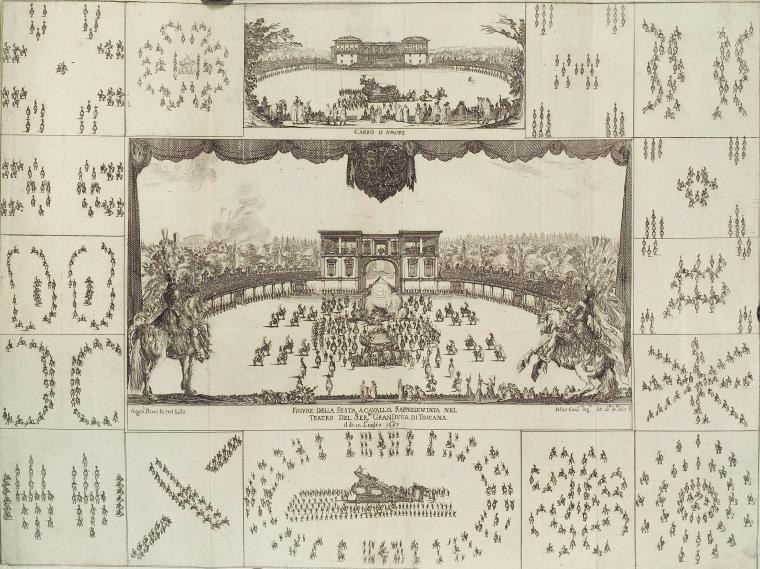
This engraved print depicts a structured equestrian performance arranged in a formal amphitheater or arena setting. The composition is organized around a central circular arena surrounded by tiered spectator seating filled with hundreds of uniformed soldiers or courtiers standing in tight formation. At the top center, an ornate building with classical architecture presides over the space. The arena floor itself features geometric patterns and is dominated by a large sculptural monument or fountain in the center. Mounted on horses, costumed performers execute choreographed figures and formations across the arena floor, moving in precise lines and patterns. The entire scene is rendered with architectural precision, suggesting this depicts an actual historical event—likely a court entertainment from the 16th–17th centuries when such elaborate horse ballets were performed for European nobility. Smaller panels surround the main image showing detailed troop formations and deployment patterns, suggesting a record of military or courtly organization.
The dancing
The horsed performers wear ornate costumes and maintain formal, upright postures in the saddle, typical of haute école or classical riding. They move in strict geometric formations—lines, circles, and intricate patterns—across the arena floor rather than in the loose, naturalistic groupings of social dance. The soldiers or courtiers in the stands occupy precisely marked positions, suggesting this was a choreographed, hierarchical display rather than spontaneous movement. Multiple riders coordinate their movements simultaneously, indicating a long rehearsal process and a strict choreographic plan.
The dance depicted
This depicts a horse ballet (ballet équestre), a courtly performance art that flourished in Renaissance and early Baroque Europe, particularly in Italy, France, and the Holy Roman Empire. Horse ballets combined haute école horsemanship with theatrical spectacle, musical accompaniment, and often allegorical narratives. Mounted performers executed carefully choreographed figures—circles, weaving patterns, and geometric formations—while maintaining perfect posture and control. These events were staged as political theater, combining military display, noble pageantry, and artistic refinement. The participants were typically aristocratic riders or professional horsemen, and the performances served to demonstrate courtly sophistication, political power, and command of both man and beast. This particular print documents the scale and formal organization such spectacles could achieve.
How it was made
This is an engraving, likely 16th or early 17th century, executed with the precision and architectural clarity typical of court documentation engravings. The technique allowed for fine detail, careful perspective, and the reproduction of a complex image in multiple copies—essential for recording and circulating images of royal or noble spectacles. The arrangement of the main scene with surrounding diagrammatic panels suggests this functioned as both an artistic record and a practical diagram, allowing viewers who had not attended the event to understand its scale, organization, and symbolic structure. The even, detailed line work and the careful rendering of architectural and human figures indicate this was made by a skilled printmaker working from eyewitness accounts or preparatory drawings.
About this work
This engraving documents a horse ballet, a sophisticated court entertainment that combined horsemanship, choreography, and political theater. The print shows the full spectacle—the formal arena, the precisely arrayed spectators, the mounted performers executing geometric formations, and ancillary diagrams of troop deployment. Horse ballets emerged from Renaissance Italy and were adopted by French, German, and other European courts as a way to showcase noble refinement, military power, and artistic command. This print serves as both a historical record of a specific performance and a visual proof of an entire genre of dance and spectacle that has largely vanished from historical memory.
How to look at it
Observe first the central arena and the rigid geometry of the mounted performers' movements—circles, lines, and patterns that follow mathematical rather than naturalistic logic. Notice how the spectators are arranged in defined blocks, not scattered casually, emphasizing that this was a carefully managed, hierarchical display. Look at the ornamental architecture that frames the scene, suggesting this took place in a specially constructed or specially decorated space of considerable expense. The surrounding panels function as a visual archive, breaking down the army-scale coordination required; they show that producing such a spectacle demanded the same planning and notation as a military campaign. Finally, observe the formal, upright bearing of the mounted riders—this is not rough horsemanship but a refined, codified art form in which control and precision are the visible markers of nobility and cultivation.
The period
Horse ballets flourished in the 16th and 17th centuries as a preferred entertainment of wealthy courts, particularly in Italy (where they originated), France under the Medici queens, and in the Habsburg lands. They emerged from medieval tournament traditions and the courtly valorization of the skilled, educated horseman (the miles literatus or chevalier), blending Renaissance humanist ideals with the continued prestige of horsemanship. The same courts that commissioned these spectacles also developed ballet as a human dance form—indeed, the word "ballet" and the conceptual framework of choreographed, narrative-driven, politically purposeful performance were first refined in these horse entertainments before being transferred to human dancers. The architectural precision, the geometric formations, and the emphasis on coordinated group movement visible in this print influenced the development of court ballet as it evolved in the 17th century.
Where it lives
This print is held by the New York Public Library. It is an engraved historical document, likely created in the 16th or early 17th century to record and disseminate an image of a court spectacle that would have been too elaborate and ephemeral to preserve in any other way.
Dance in this work
Questions about this work
Were horse ballets actually dance?
Yes, though we do not usually think of dance as equestrian. The performers executed choreographed movements, responded to music, and arranged themselves in aesthetic patterns for an audience. The geometry, the coordination, and the ornamental purpose—to display beauty, control, and cultural refinement—are all consistent with what we mean by dance. The only unusual element is that the dancers were mounted on horses rather than moving on foot.
How often were horse ballets performed?
They were occasional, extremely expensive spectacles, typically commissioned to celebrate state occasions, dynastic alliances, royal visits, or military victories. A single horse ballet might involve dozens of trained riders, musicians, elaborate sets, and months of rehearsal. They were not regular performances but grand, one-time or rare events that made news and required documentation.
Who performed in these ballets?
Typically aristocratic amateurs or professional horsemen and riders retained by the court. Participation was a mark of honor and a way for nobles to display their wealth, training, and loyalty. The performers were rarely professional dancers; instead, they were nobles, soldiers, or servants with advanced horsemanship who learned choreography specifically for the event.
Did horse ballets influence the development of ballet?
Yes. The terminology, the aesthetic principles, the idea of courtly dance as a political and cultural statement, and the emphasis on geometric group formations all developed in horse ballets before being applied to human dancers. The concept of choreography as a deliberate, notated composition also emerged from these spectacles.
More Ballet artwork