46 works in this view — arrow keys or swipe to move between them.
Dance in Art
Habit de ballet
Unknown artist
- Medium:
- Dance:
- Ballet
- Source:
- New York Public Library
- Rights:
- Public domain — free to use, share and adapt.
- Recorded as:
- public_domain
Court ballet is the direct ancestor of classical ballet; this image shows the costume, technique, and theatrical context from which that tradition emerged. For anyone studying the early history of ballet or the relationship between dance, costume, and courtly display, this is a primary source of rare specificity—it shows a real body in motion, not a static portrait.
What you are looking at
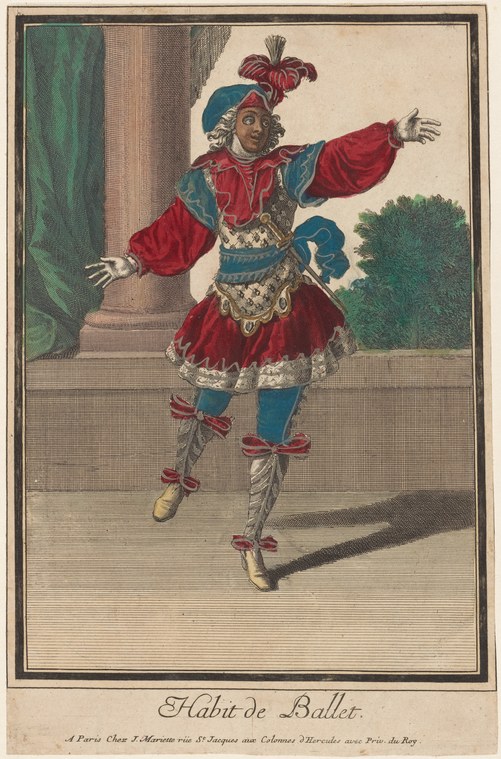
A single dancer in theatrical costume strikes a dynamic pose on a bare stage or performance space, with classical architecture—a fluted column and stone wall—visible behind. The figure wears a striking red and blue ensemble typical of 17th-century court ballet: a short red skirt with white lace trim, a blue bodice, red puffed sleeves, and blue hose with red ribbon rosettes at the knees and ankles. A tall feathered headdress in red and blue crowns the head. The dancer balances on one leg in an attitude of exuberance, the free leg bent and the arms spread wide in a gesture of joy or theatrical address. The pose suggests mid-movement, with considerable elevation and control. The print is hand-colored in the characteristic palette of 17th-century fashion prints, with delicate cross-hatching and line work creating volume and texture in the fabrics.
The dancing
A single dancer, shown in three-quarter view, stands in what appears to be a balletic attitude or elevation, supporting their weight on one leg while the other bends beneath them. Both arms extend outward at shoulder height in a welcoming or expansive gesture. The torso is upright and controlled, the head held high beneath the elaborate headdress. The pose suggests trained, courtly movement rather than folk or vernacular dance—the body is composed and the lines are graceful, with careful management of the limbs.
The dance depicted
This is a figure from court ballet (ballet de cour), the aristocratic dance spectacle of the French royal court in the 17th century. The costume, pose, and presentation are consistent with the theatrical dances performed by nobles (and sometimes professional dancers) in elaborate court entertainments from roughly the 1580s to the 1700s. The figure may represent a specific character or generic court dancer, but the print itself—titled 'Habit de ballet' (Ballet Costume)—is a fashion and performance documentation, showing the viewer what a ballet performer of quality looked like in motion. The elevated pose and controlled frame suggest training in the formal techniques being codified in this period.
How it was made
This is a hand-colored engraving or etching, a reproductive print technique that allowed multiple copies to circulate widely. The fine line work and cross-hatching create modeling and shadow, while the hand coloring in watercolor or gouache adds the jewel tones of the costume. As a print, this was likely part of a fashion or theatrical documentation series—circulated among the educated and courtly classes to show the modes of dress and performance current in Paris. The technique's accessibility meant such images reached a broad audience and influenced fashion and theatrical practice across Europe.
About this work
This is a documentary fashion print from the French court, showing a performer in the costume and pose of a ballet de cour dancer. The print preserves not only the elaborate and expensive clothing—the feathered headdress, the puffed sleeves, the ribboned hose—but also the physical bearing and technique of early modern court ballet, at a moment when that dance form was becoming formalized and theorized. The figure's controlled, elevated pose and the careful composition of the image show how ballet was understood as a disciplined and courtly art, not a folk entertainment. This is one of the primary visual documents of how bodies moved and were dressed in 17th-century theatrical dance.
How to look at it
Attend to the pose: the dancer is captured mid-elevation, balanced on one leg with the other bent, suggesting the vertical, lightness-seeking aesthetic that would become fundamental to ballet. Notice the turned-out leg position and the upright carriage of the torso—these are not accidental or naturalistic but deliberate, trained positions. Look at the costume's function: the short skirt, the clear leg line, and the absence of heavy drapery all enabled the display of the legs and feet, which by this period were becoming the focus of technical display in dance. The feathered headdress and jewel-bright colors signal this as courtly, aristocratic entertainment, not peasant or popular dance.
The period
This print dates to the era of the ballet de cour, the dominant theatrical dance form of the French Renaissance and early Baroque court (roughly 1550–1670). Ballet de cour was a courtly spectacle combining poetry, music, and dancing by the nobility, often with allegorical or mythological themes. It was closely tied to royal power and the display of courtly refinement. During the 17th century, as ballet became more professionalised and codified—particularly after the founding of the Académie Royale de Danse in 1661—fashion prints documenting ballet costumes and performers became a way of circulating knowledge of the form and its techniques throughout Europe. The elevated, turned-out, upright posture visible here reflects the aesthetic principles being systematized in early ballet technique.
Where it lives
This print is held by the New York Public Library. It is part of their collection of historical dance, costume, and performance documentation.
Dance in this work
Questions about this work
What is a 'habit de ballet'?
'Habit' means costume or dress. A 'habit de ballet' is the full outfit worn by a performer in court ballet: the coat or bodice, skirt, hose, shoes, headdress, and accessories. These prints documented fashionable and theatrical costume, showing both the clothing and the body adorned in it.
Who danced in court ballet?
In the early court ballet tradition, the dancers were usually members of the nobility—kings, queens, princes, and courtiers—for whom dance was a mark of education and refinement. By the 17th century, professional dancers were increasingly hired to perform alongside nobles. The distinction between amateur courtier and professional performer gradually sharpened.
How is this different from the ballet we see today?
The techniques are related but distinct. Court ballet emphasized courtly bearing, geometric patterns, and allegorical content; modern ballet emphasizes speed, height, and virtuosity of the legs and feet. This dancer's pose—controlled, upright, moderate in extension—reflects the aesthetic of trained court movement rather than the pushed, hyperextended lines of Romantic or Classical ballet.
Why are there so many fashion prints of dancers?
Dance was central to aristocratic display and courtship in this period. Fashion prints circulated images of how to dress, how to move, and what was fashionable in both clothing and behavior. A print like this one combined fashion documentation, performance imagery, and aspirational display—it was a medium for spreading courtly culture.
More Ballet artwork