47 works in this view — arrow keys or swipe to move between them.
Dance in Art
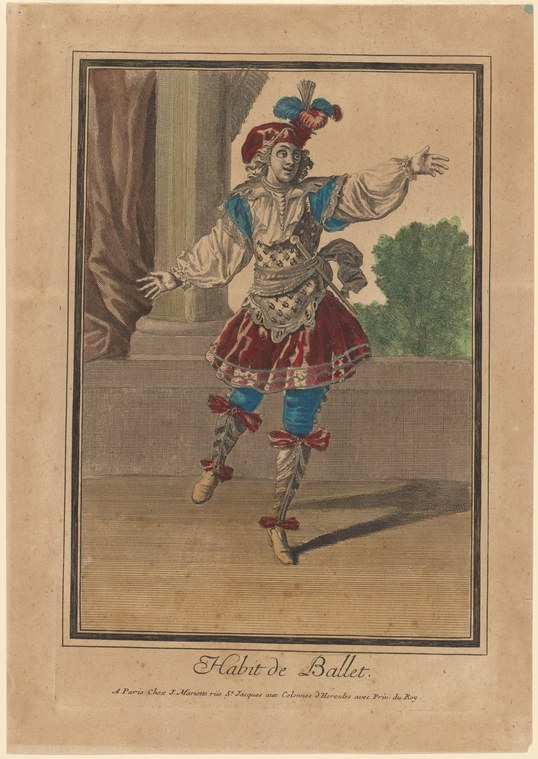
Habit de ballet
Unknown artist
- Medium:
- Dance:
- Ballet
- Source:
- New York Public Library
- Rights:
- Public domain — free to use, share and adapt.
- Recorded as:
- public_domain
This is one of the few surviving visual documents of how professional stage dancers actually moved and dressed before the Romantic era; it shows that early ballet emphasized theatrical character and elevation rather than the turned-out technical vocabulary that later became mandatory. For historians of dance and costume, it is direct evidence of the visual language of a performer and the deliberate choices—in dress, makeup, pose, and expression—that constituted stage presence in the period before ballet became codified.
What you are looking at
A solo dancer in theatrical dress occupies the center of a shallow stage or platform, caught mid-leap in a moment of energetic performance. The figure wears a richly decorated costume comprising a white chemise with blue accents, a deep burgundy skirt with ornate embroidery and scalloped hem, and blue stockings with red-trimmed garters at the knees. A tall feathered headdress crowns the figure, and the face is painted in theatrical style. The dancer's body is suspended in a dynamic pose—one leg extended, the other bent, arms outstretched in an open, animated gesture—against a muted background of stone architectural elements (a column or wall at left, suggestions of foliage at right). The figure casts a distinct shadow on the stage floor, anchoring the moment in a real space lit from above. The overall impression is of a performer executing a practiced, show-stopping leap during a theatrical entertainment.
The dancing
The single dancer demonstrates a vertically oriented jump or hop, with the body weight launched upward and the legs in an open position—one stretched forward or upward, the other bent. Both arms are extended outward at shoulder height in an open frame, palms visible, suggesting joy and abandon rather than the controlled port de bras of later classical ballet. The torso is upright and the head tilted slightly, facing the viewer. The pose shows the kind of explosive elevation and rotund, play-like energy characteristic of early professional stage dance, executed with apparent ease and control.
The dance depicted
This is an image of a theatrical dancer in the habit (costume) of an early professional ballet performer, likely from the late 17th or early 18th century. The inscription 'Habit de Ballet' and the French attribution indicate this is documentation of a stage costume and performance style that preceded the systematized technique of Romantic ballet. The open, exuberant quality of the pose and the painted face suggest this is a comedic or character performer rather than a serious heroic dancer, possibly a role from the commedia dell'arte-influenced entertainments that dominated early European stage dance. The leap and arm position are consistent with the vocabulary of court ballet and early professional spectacle that emphasized line, height, and theatrical visual impact.
How it was made
This is a hand-colored print, likely an engraving or etching from the 17th or early 18th century, with the delicate application of watercolor or gouache to define the costume details, skin tones, and background. The fine line work of the underlying print is visible in the architectural elements and the shadow on the floor. This technique—reproductive engraving with hand coloring—was the standard means of circulating images of performers and costumes before lithography; each print was individually colored, making subtle variations between impressions. The distribution of such prints served both as documentation of celebrated performers' costumes and as a form of theatrical publicity and souvenir.
About this work
This hand-colored print records the stage costume and performance pose of an early professional ballet dancer, identified only as 'Habit de Ballet' in its inscription. It documents a moment before ballet developed into the virtuosic, formalized practice represented by Romantic and Classical ballet: the dancer wears the exuberant, heavily decorated dress and feathered headdress of commedia dell'arte-influenced theater, and the pose emphasizes spectacle and character rather than technical refinement. The image is a window into how professional dance was performed, taught, and circulated in the late 17th or early 18th century—a period when ballet existed primarily as court entertainment or as part of dramatic spectacle, and when the dancer's costume and the moment of performance were considered worthy of being captured and reproduced for a wider audience.
How to look at it
Observe the moment the artist has chosen to freeze: the dancer is at the apex of a jump, weightless and suspended, which emphasizes the athleticism and ease of the performer. Notice the open arm frame and the painted face, which indicate character and theatrical convention rather than the restrained, disciplined presentation of later ballet. The shadow cast on the floor and the architectural setting are crucial—they ground the figure in a real stage space and suggest that this is documentation of an actual performance or practiced pose, not merely a fantasy of dance.
The period
This print belongs to the era of court ballet and early professional theatrical dance in France, when the ballet was a courtly entertainment or a component of opera and dramatic spectacle. The late 17th and early 18th centuries saw the formalization of ballet technique under Louis XIV and his successors, but professional stage dancers still drew heavily on the vocabulary and character types of commedia dell'arte. The printed costume portrait or 'habit' became a popular genre of theatrical merchandise in this period, circulating images of celebrated dancers and singers to a literate, courtly audience. The image predates the virtuosic, pointe-work-based ballet of the 19th century by at least a century, and shows a moment when professional dancing was understood primarily as a vehicle for character, spectacle, and wit rather than technical display.
Where it lives
The work is held by the New York Public Library, part of a collection of theatrical prints. It is an example of the printed costume documentation that circulated in early modern Europe, serving both as a record of celebrated performers and as promotional material for theatrical entertainments.
Dance in this work
Questions about this work
Is this 'ballet' in the modern sense?
No. This predates Classical and Romantic ballet by roughly 100–150 years. The term 'ballet' in the late 17th and 18th centuries meant theatrical dance, often including dramatic action, character work, and commedia dell'arte elements. The codified technique, turned-out positions, and pointe work we associate with ballet today did not become standard until the 19th century.
Why is the dancer's face painted?
Theatrical makeup and face paint were standard for stage performers in this era, both to render the face visible under stage lighting and to define character. This painter appears to be a comedic or character type, and the makeup enhances the theatrical presentation.
Who was this dancer?
The print is inscribed only with the French phrase 'Habit de Ballet' (Ballet Costume), and the artist is not recorded. The dancer's identity is not known from the print itself. Such costume prints often circulated without attribution of the performer.
Why was this image printed and circulated?
Costume prints served as both documentation and promotion. They recorded celebrated performers and their roles, and circulated as souvenirs and curiosities among a literate, courtly audience interested in theater and fashion. They were similar to theatrical playbills or celebrity photographs of later eras.
More Ballet artwork