49 works in this view — arrow keys or swipe to move between them.
Dance in Art · 2021
Horse ballet
Unknown artist
- Medium:
- Dance:
- Ballet
- Source:
- New York Public Library
- Rights:
- Public domain — free to use, share and adapt.
- Recorded as:
- public_domain
Horse ballets represent a major but now-invisible branch of Renaissance and Baroque courtly performance, one that rivaled human ballet in expense, prestige, and technical sophistication. This engraving is one of the few surviving records of how these spectacles were choreographed and what they looked like, making it essential evidence for understanding the full range of dance in the early modern court. For historians of performance, military history, and graphic design, it is an extraordinary artifact: a technical manual, a commemorative print, and a window into a courtly aesthetic that valued geometric perfection and collective precision above individual virtuosity.
What you are looking at
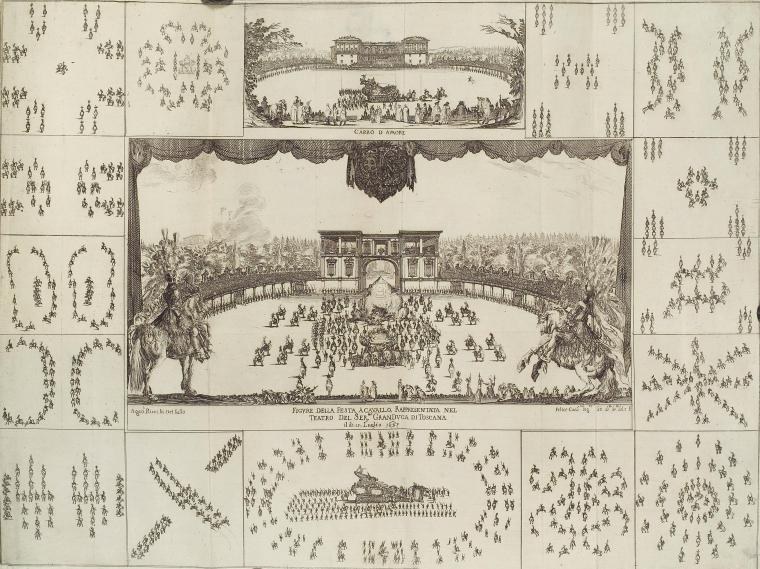
This is a large-format engraving—likely 16th or 17th century—divided into multiple panels showing the choreography and formation of a horse ballet. The central panel depicts the main spectacle: a formal arena or tilting ground ringed with spectators, where mounted riders arrange themselves in precise geometric patterns. A classical pavilion or reviewing stand occupies the far end, with what appears to be nobility or patrons observing from an elevated position. Surrounding this central image are eight smaller panels, each showing a different bird's-eye view of the formation patterns the horses and riders must execute: dense rectangular columns, circular arrangements, diagonal lines, and interlocking squares. The composition suggests this is a technical manual or commemorative record of a specific performance, with the smaller diagrams functioning as choreographic notation. All figures are rendered in fine lines with cross-hatching for tone; the landscape beyond the arena is indicated by scattered trees and distant buildings, establishing a courtly or aristocratic setting.
The dancing
The mounted riders sit upright in formal posture, maintaining rigid control of their horses as they move in synchronized formation. The horses themselves are shown in profile or three-quarter view, their bodies aligned and moving as units within the larger geometric patterns. There is no evidence of individual gesture or dance vocabulary—the focus is on collective precision and the visual geometry created by the group's arrangement. The diagrams use small schematic figures on horseback to show how riders must position themselves relative to one another and the space.
The dance depicted
This depicts a horse ballet (or *balletto a cavallo*), a courtly spectacle that flourished in Renaissance and early Baroque Europe, particularly in Italy and the Habsburg courts. Horse ballets were elaborate displays of military horsemanship stylized as dance, combining dressage, geometric formations, and theatrical pageantry. They were performed for nobility as demonstrations of courtly refinement, royal power, and the harmonious order of the state. The diagrams and central scene show that the focus is entirely on the collective formation and symmetry achieved by the mounted group—the aesthetic goal was visual harmony and mathematical precision, not the movement of individual dancers. These spectacles were typically accompanied by music and sometimes narrative elements, though this engraving documents only the spatial choreography.
How it was made
This is an engraving—identified by the fine parallel lines (hatching) used to model tone and shadow, and the precision of the line work. The composition is divided into a large central rectangle surrounded by eight smaller rectangular panels, all arranged symmetrically on the page, suggesting this is a comprehensive technical or commemorative document. The quality of the engraving—its clarity, scale, and multipart structure—indicates it was produced for a educated, wealthy audience, likely court members, military engineers, or collectors of courtly spectacle. Such prints served both as records of actual performances and as models for future events.
About this work
This is a technical and commemorative engraving of a horse ballet, one of the most elaborate and expensive courtly entertainments of the Renaissance and Baroque periods. It documents both the spectacle itself and the geometric choreography required to stage it, offering a rare window into how these performances were conceived, notated, and transmitted. The work sits at the intersection of dance history, military science, courtly ceremony, and graphic design—it records a form of movement that has vanished from practice but survives only in such prints and textual accounts.
The engraving demonstrates that dance in the Renaissance court was not confined to the human body: it extended to horses, vehicles, and masses of moving figures arranged in space. It is an invaluable document of a lost performance tradition and of how Renaissance and Baroque courts understood and visualized choreography.
How to look at it
Examine the central arena scene first to understand the overall spectacle and its formal setting; then study the eight surrounding diagrams as a notational system, reading them as choreographic instructions that translate the visual splendor into reproducible patterns. Notice how each diagram shows a different moment or configuration, and how the small figures on horseback are positioned to show the spatial relationships within each formation. The engraving's organization—central image surrounded by diagrammatic panels—reflects the Renaissance desire to combine visual splendor with rational, geometric order. Pay attention to the precision of the line work and the care taken to render both the spectacle and its underlying structure, suggesting this was a prestigious commission and a valued document.
The period
Horse ballets flourished in the late 16th and 17th centuries, particularly in Italy (where they developed from military exercises and courtly tournaments) and in the courts of the Habsburgs, Bavaria, and France. They emerged during a period when the European court was experimenting with elaborate forms of spectacle that merged military display, artistic performance, music, and machinery. The Renaissance fascination with geometry, harmony, and the mathematical ordering of space is directly reflected in the formations shown here. Simultaneously, human ballet was developing in Italian courts (and would soon be exported to France), and horse ballet should be understood as a parallel—and competing—form of courtly dance, one that commanded enormous resources and was considered a supreme demonstration of princely magnificence. These performances often commemorated peace treaties, royal weddings, or military victories, and commemorative prints like this were crucial to their circulation and legacy.
Where it lives
The work is held in the New York Public Library collection. It is catalogued as a print without further attribution or date assignment, indicating it entered a public collection at some point, but the specific circumstances of its acquisition are not recorded here.
Dance in this work
Questions about this work
What is a horse ballet?
A horse ballet was a Renaissance and Baroque courtly spectacle in which mounted riders and elaborately trained horses performed synchronized movements in geometric formations, usually accompanied by music and narrative. Unlike human ballet, which emphasized the dancer's body, horse ballets prioritized collective precision, symmetry, and the visual patterns created by large groups of moving figures. They were enormously expensive and were commissioned by princes and kings as demonstrations of power, refinement, and control.
How was this engraving used?
This appears to be both a commemorative record of an actual performance and a technical manual for reproducing or planning similar events. The central image captures the spectacle itself, while the surrounding diagrams serve as choreographic notation, showing how the riders must arrange and move. Such prints were distributed among the nobility and court circles to spread knowledge of the performance and to serve as models for future productions.
Why did horse ballets disappear?
Horse ballets were extremely costly to stage and required specialized facilities, trained animals, and large audiences of nobility. As the 18th century progressed, human ballet became dominant, professionalized, and more commercially viable. Horse ballets survived longest in Vienna and other Habsburg courts but gradually faded from courtly practice, leaving only prints, descriptions, and archival records as evidence of their former prominence.
Is this dance?
Yes, though not dance as we usually think of it. Horse ballet merged military drill, horsemanship, choreography, and spectacle into a unified courtly art form. The geometry, synchronization, and intentional movement patterns are choreographic, even though the primary mover is the horse rather than the human dancer's body.
More Ballet artwork