49 works in this view — arrow keys or swipe to move between them.
Dance in Art · 2019
Black Crook waltzes
Unknown artist
- Medium:
- Lithograph
- Dance:
- Waltz
- Era:
- Early 1800s (Waltz Revolution)
- Source:
- New York Public Library
- Rights:
- Public domain — free to use, share and adapt.
- Recorded as:
- public_domain
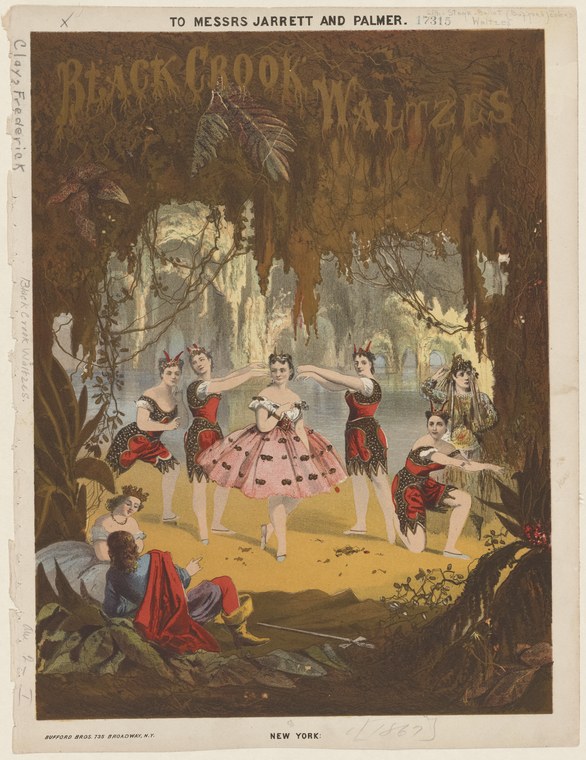
The Black Crook was the longest-running Broadway musical of the 19th century and established the model for American musical theater as a vehicle for dance spectacle. This image is documentary evidence of what that spectacle looked like—the corps formation, the principal-and-attendants hierarchy, the Romantic ballet vocabulary—and of how it was marketed to audiences. For dancers and choreographers, it shows the aesthetic grammar of 1860s commercial dance production.
What you are looking at
A theatrical scene set in a woodland grotto, with hanging vines and luminous moss-covered rocks framing a clearing. At center, a female dancer in a prominent pink tulle skirt with dark ornamental details strikes an attitude, surrounded by five attendant figures in red and black costume. Two figures recline on the forest floor in the foreground, one draped in a flowing red cloak. The lighting is naturalistic yet theatrical, with strong contrast between the shadowed forest and the bright clearing where the dancers perform. The composition suggests a moment of spectacle—the central figure elevated and framed, the attendants arranged in a loose semicircle, gazing toward her. The whole scene has the flavour of romantic-era stage spectacle, with attention to picturesque natural setting and hierarchical arrangement of figures around a principal dancer.
The dancing
The central dancer stands in a balletic posture with one leg extended in attitude and arms raised in a classical port de bras. The five surrounding figures are posed in various attitudes of attention and grace—some with arms extended, others with weight shifted in contemplative stances. All stand upright and formal. The two figures in the foreground are horizontal, reclining on the ground in attitudes of repose or tableaux vivant. The postures throughout are refined and posed rather than captured mid-motion, emphasizing tableau and formal arrangement over kinetic momentum.
The dance depicted
This is almost certainly a scene from *The Black Crook*, the 1866 American musical spectacular that ran for over 1,000 performances and became legendary for its integration of dance spectacle into theatrical narrative. The title confirms this. The image captures a moment of divertissement—a set-piece dance display within the narrative, likely from one of the famous 'waltz' sequences that were central to the show's appeal. The central figure appears to be a prima ballerina, and the attendants function as a corps de ballet. The Black Crook was celebrated for importing European Romantic ballet conventions to Broadway and for its elaborate stage machinery, painted scenery, and corps work. The woodland grotto setting is characteristic of the show's supernatural and picturesque aesthetics.
How it was made
A lithograph, as recorded. The technique allowed for color reproduction and wide circulation as a promotional or commemorative print. Lithography in the 1860s was a standard medium for theatrical prints, allowing producers to distribute images of stage scenes to audiences and to create durable souvenirs. The strength of color—especially the vibrant pink of the central skirt and the rich brown of the forest—suggests a hand-colored or well-inked print, consistent with theatrical promotion. Such prints were sold in theater lobbies and by street vendors, making them accessible to a broad urban audience and serving as documentation of stage spectacle for those who attended and those who did not.
About this work
This lithograph documents a scene from *The Black Crook*, the 1866 American musical that became a watershed moment for dance in American popular theater. The image captures the romantic and spectacular aesthetic that defined the production—a corps de ballet arranged around a principal dancer in an idealized natural setting, rendered in the chromatic warmth of hand-colored lithography. The work is both a record of a specific theatrical moment and a window into how American audiences of the Gilded Age experienced ballet and choreographed spectacle. It belongs in a dance history collection because it shows what Americans saw when they encountered large-scale dance production in the mid-19th century, and it demonstrates the visual conventions through which dance was promoted and remembered in the pre-photographic popular marketplace.
How to look at it
Note the careful composition: the central dancer is literally lifted above the others, both by posture and by the geometry of the surrounding figures, who direct attention toward her. The woodland setting is not merely decorative—the grotto framing suggests magic and supernatural elevation, a convention of Romantic ballet that The Black Crook explicitly deployed. The waltz title suggests that this ensemble movement had a musical and kinetic unity in performance, even though the static image shows only poses. Observe how the lithographer has rendered the skirts with careful attention to volume and decoration: the tulle and ornament of the principal's skirt is the visual center, and the subordinate figures' costumes are rendered as costume rather than as fabric with weight and movement.
The period
The 1860s in America saw a rapid professionalization and Americanization of theatrical dance. Before The Black Crook, serious ballet was largely confined to imported European companies and elite urban audiences. The Black Crook (1866) changed that by embedding ballet spectacle into a narrative musical comedy aimed at mass audiences. The production coincided with the height of Romantic ballet in Europe—Giselle and Swan Lake had premiered decades earlier—but arrived in America when European ballet culture was beginning to decline. The show's combination of melodrama, spectacular scenery (designed to showcase new gas-lit theater technology), acrobatics, and waltz-based ensemble choreography created a distinctly American theatrical idiom. This lithograph reflects the visual culture of Gilded Age theater promotion, when printed images were the primary way audiences could remember and recommend performances.
Where it lives
The print is held in the New York Public Library collection and carries the inscription 'To Messrs Jarrett and Palmer'—likely addressed to the show's producers, suggesting this may be a presentation copy or promotional item distributed by or to them. It was published in New York, where The Black Crook had its legendary run.
Dance in this work
Questions about this work
What is The Black Crook?
The Black Crook was an American musical comedy that premiered in New York in 1866 and became the longest-running Broadway show of the 19th century, with over 1,000 performances. It combined melodrama, spectacle, acrobatics, and large-scale ensemble ballet choreography in ways that were revolutionary for American commercial theater. The show made ballet accessible to mass audiences and established the template for the modern American musical.
Why are there waltz references in the title?
The waltz was central to The Black Crook's choreography and musical identity. The show featured extended waltz sequences danced by the corps de ballet and principals, and audiences came partly to see elaborate ensemble waltzes performed in theatrical costume and setting. The waltz was fashionable in European Romantic ballet, and The Black Crook brought that vocabulary to American commercial dance.
Who were Jarrett and Palmer?
Jarrett and Palmer were the producers of The Black Crook. The inscription 'To Messrs Jarrett and Palmer' on this print suggests it was presented to them as a promotional or commemorative item. They were significant figures in 19th-century American theatrical production.
How do we know this is from The Black Crook and not another production?
The title printed on the lithograph explicitly identifies it as 'Black Crook Waltzes.' The iconography—the woodland grotto, the corps arrangement, the tulle costumes, the picturesque natural setting—is consistent with documented scenes from the production.
More Waltz artwork