49 works in this view — arrow keys or swipe to move between them.
Dance in Art
Acrobatic — Plate 87
Gregorio Lambranzi
- Medium:
- Copper-plate engraving
- Dance:
- Notation/Choreography
- Era:
- 1700s (Enlightenment/Minuet Era)
- Collection:
- Nuova e curiosa scuola de' balli theatrali (1716)
- Source:
- Library of Congress
- Rights:
- Public domain — free to use, share and adapt.
- Recorded as:
- Public Domain
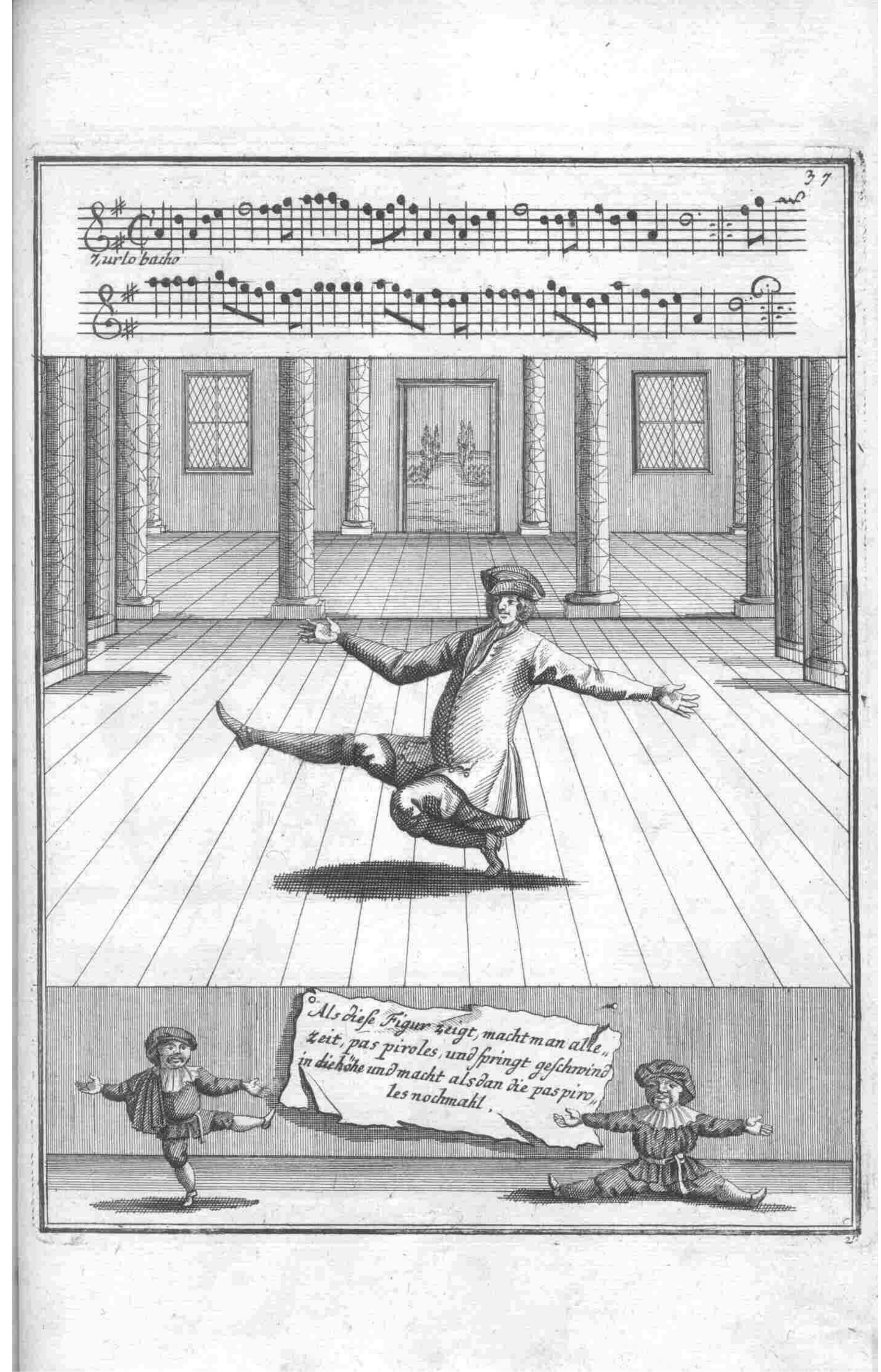
This work is a rare and direct historical record of how an advanced acrobatic movement was performed and taught in early 18th-century European theatre. Lambranzi's manual is one of very few surviving choreographic documents that combine image with music and notation, making it invaluable for understanding both the physical vocabulary of theatrical dance and the way movement was transmitted to performers before video existed.
What you are looking at
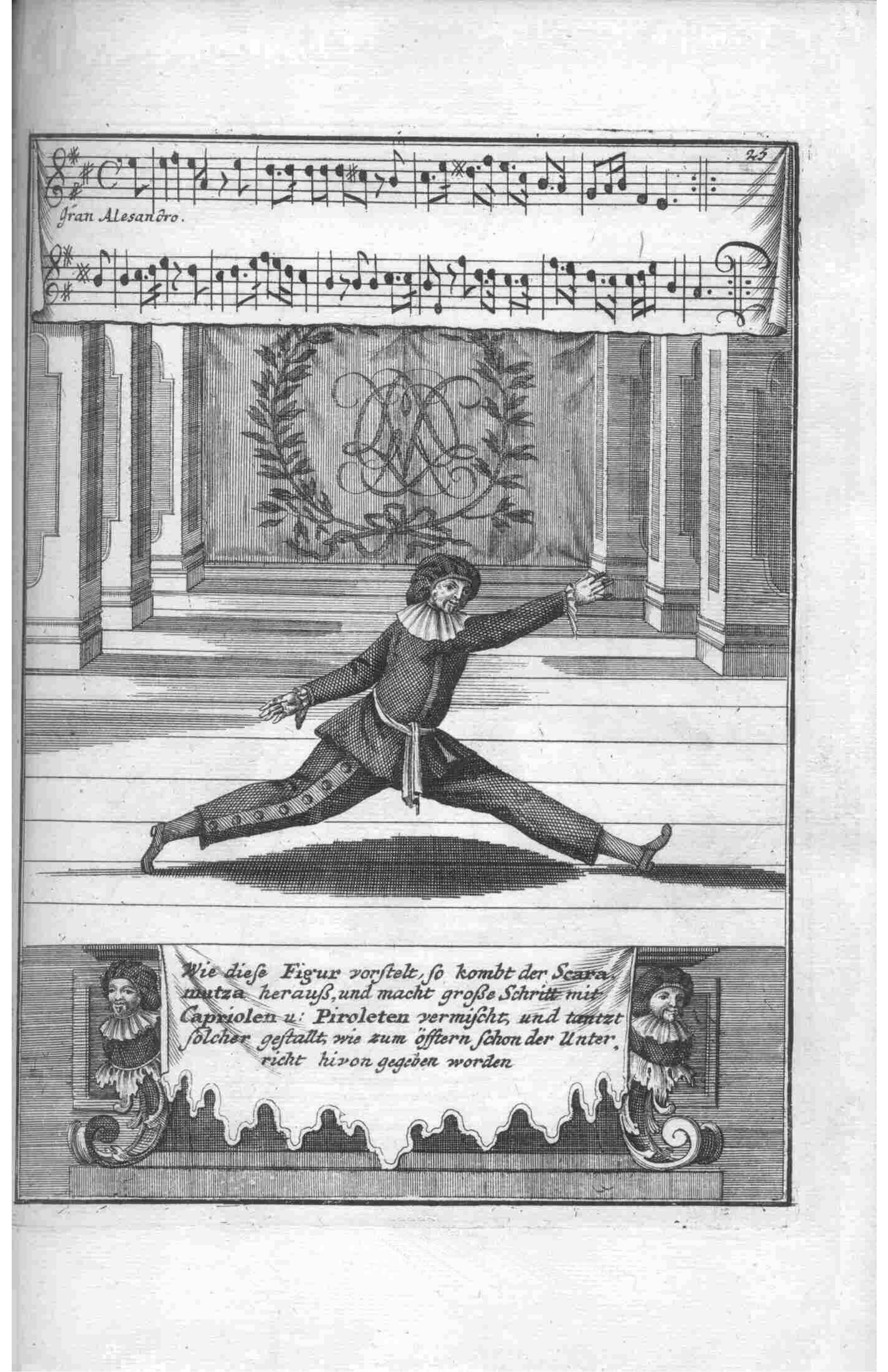
A male dancer in a deep forward split performs on a bare stage enclosed by classical columns and draped curtains. He wears a tunic-style coat, breeches, and a flat cap, costumed as if for commedia dell'arte or comic theatrical performance. His arms extend outward for balance, one raised higher than the other, and his body angles back from the extended legs with the control required of an acrobat. The stage is defined by a coffered ceiling and diamond-patterned floor receding in perspective. Below the stage scene, two small winged figures—possibly putti or allegorical sprites—flank a banner of German verse, gesturing as if in commentary on the acrobatic feat above.
The dancing
A single male dancer executes a full front split with the rear leg extended behind and the front leg stretched forward at a right angle to his body. His torso remains upright and engaged, with weight distributed through both legs; his arms are held high and symmetrically apart for counterbalance. The depth of the split and the apparent ease of the position demonstrate exceptional flexibility and control. The performer's gaze is forward and confident, and his posture shows no strain despite the extreme extension.
The dance depicted
This is theatrical acrobatic dance of the early 18th century, performed within a staged entertainment context. The split—a virtuoso feat of flexibility—would have been an exhibition of physical skill prized in commedia dell'arte and related theatrical traditions. The musical notation at the top of the plate suggests this acrobatic pose was choreographed or timed to a specific musical phrase, indicating it was a composed piece of theatre rather than improvised gymnastics. The figure's costume and comedic theatrical setting suggest this was entertainment for an educated urban audience familiar with commedia stock characters.
How it was made
This is a copper-plate engraving, a medium that permitted fine detail and wide circulation. Engraving allowed the artist to render both the complex musculature and control required for the split and the architectural setting with precision. The pairing of musical notation with movement image indicates this plate served as a choreographic record—a teaching tool for performers learning theatrical dance and acrobatics. The technique's durability and reproducibility made it ideal for a published manual of dance instruction.
About this work
This is a plate from Gregorio Lambranzi's *Nuova e curiosa scuola de' balli theatrali* (Nuremberg, 1716), one of the most important illustrated dance manuals of the early modern period. It documents a virtuoso acrobatic split as performed in the context of theatrical entertainment. The plate combines musical notation, choreographic image, and explanatory verse—a comprehensive record of how a specific movement was executed, timed, and understood within early 18th-century theatre practice. This approach to recording dance as a combination of notation, visual demonstration, and musical accompaniment was influential and unusual for its time.
How to look at it
The image freezes the split at its deepest point—the moment of greatest extension—chosen to demonstrate the full range of motion rather than a transitional moment. Attend to the angle of the torso relative to the legs: the performer maintains a nearly vertical spine despite the extreme hip extension, showing the muscular control and flexibility that made this feat remarkable. The raised arms and confident expression convey that this is a controlled display of skill rather than a struggle; the theatrical costuming and staged setting confirm this is entertainment designed to impress. The proportional spacing and perspective of the architecture frames the figure monumentally, treating the acrobatic body as worthy of the same formal architectural setting as a history painting.
The artist
Gregorio Lambranzi was an Italian dancing master and choreographer active in Nuremberg in the early 18th century. His *Nuova e curiosa scuola de' balli theatrali* (New and Curious School of Theatrical Dances), published in 1716, was one of the most comprehensive and visually ambitious dance manuals of the period, containing 110 plates illustrating theatrical dances and acrobatic movements. The work combined Lambranzi's practical knowledge as a performer and teacher with engraved plates that served both as performance record and instructional text. His approach—pairing movement with music and narrative context—was influential in establishing how theatrical dance could be documented.
The period
Early 18th-century European theatre was experiencing a transition: the commedia dell'arte tradition was evolving into more formalized theatrical dance, while court dance and theatrical dance were beginning to diverge. Acrobatic skill and physical spectacle remained central to theatrical entertainment, valued equally with balletic grace. Lambranzi's manual appeared during a period when the emerging ballet d'action was gaining prestige, yet theatrical dance in comedy and popular entertainment still demanded the versatility shown here—flexibility, strength, balance, and a comic sensibility. The publication in Nuremberg, a major artistic and trading center, reflects the German-speaking regions' active engagement with Italian theatrical traditions.
Where it lives
This plate is from Lambranzi's *Nuova e curiosa scuola de' balli theatrali*, a bound collection of 110 copper-plate engravings published in Nuremberg in 1716 and held by the Library of Congress. The manual served as both a performance record and an instructional text for theatrical dancers and choreographers, and copies circulated throughout Europe.
Dance in this work
Questions about this work
How do we know this was an actual dance move and not just an acrobatic stunt?
The musical notation at the top of the plate is the key evidence. It shows that this split was choreographed to a specific musical phrase, indicating it was a composed theatrical movement timed to music rather than a standalone gymnastic feat. The fact that it appears in a choreographic manual alongside other theatrical dances confirms it was a recognized part of the theatrical vocabulary of the period.
What kind of performer would have done this?
This would have been performed by a theatrical dancer trained in both commedia dell'arte and acrobatic skills. The costume suggests a comic or stock character type. Such dancers were highly skilled professionals who trained from childhood and were prized for their combination of physical virtuosity, comic timing, and ability to improvise within a structured narrative.
Why did Lambranzi include acrobatic moves like this in a dance manual?
In the early 18th century, theatrical dance and acrobatics were not separate categories. Theatrical entertainment valued physical spectacle and virtuosity alongside grace and elegance. Lambranzi's manual documented the full range of skills a professional theatrical dancer needed to master, from balletic movements to splits, tumbling, and other feats of flexibility and strength.
Is this considered ballet?
Not in the modern sense. While this manual influenced the development of ballet, this movement exists in a broader category of theatrical dance. The split, the comic costume, the theatrical setting, and the combination with other acrobatic movements place this in the tradition of commedia dell'arte and theatrical entertainment rather than court or classical ballet as it developed later.
More Notation/Choreography artwork