30 works in this view — arrow keys or swipe to move between them.
Dance in Art
Stuttgart Ballet Ballet Evening
Unknown artist
- Dance:
- Ballet
- Rights:
- Not recorded. Do not assume this image is free to reuse — check the source record.
This image captures a key moment in European ballet's modernization—the integration of acrobatic group work and structural abstraction into theatrical form. For dancers and choreographers, it demonstrates how ensemble partnering techniques expanded ballet's expressive and physical possibilities beyond the duet or classical line. For dance historians, the photograph provides rare visual evidence of Stuttgart Ballet's experimental practice during a formative period.
What you are looking at
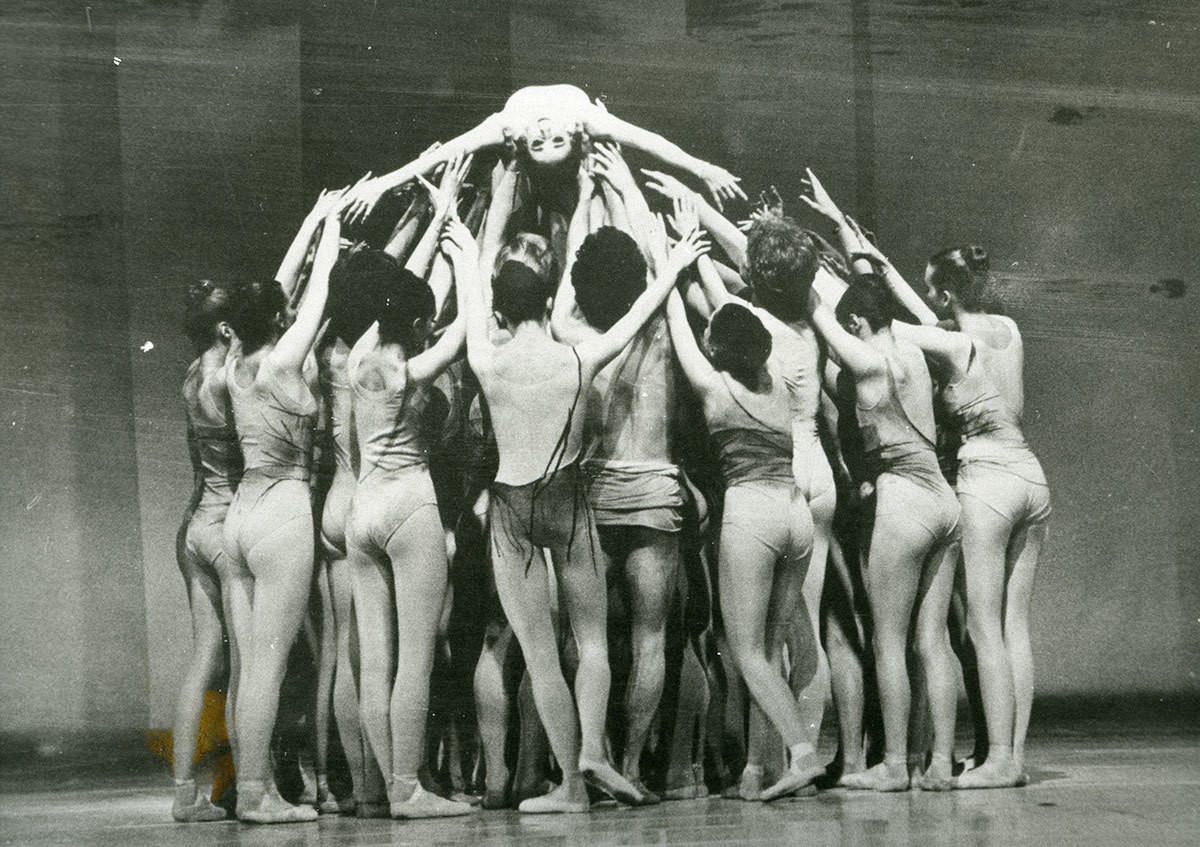
A group of dancers stands in a tight formation on a stage or studio floor with a plain backdrop, their bodies arranged in a sculptural composition. A single dancer sits elevated at the center-top of the group, supported by the raised arms and hands of the surrounding dancers who press upward around and beneath this central figure. The elevated dancer wears a light-colored dress or costume and has pale hair or a light head covering. The surrounding dancers wear dark, simple practice clothes—leotards or tunics—creating strong visual contrast with the figure above. The floor appears to be a reflective stage surface; the lighting is theatrical and even, creating sharp shadows beneath the clustered bodies. The image is a black-and-white photograph, suggesting mid-twentieth-century documentation.
The dancing
Eight or nine dancers form a dense, collaborative structure with the central figure held aloft at shoulder height or above, supported by the fully extended arms of those surrounding. The supporting dancers are in a slight lunge or standing position with arms thrust upward in a unified gesture; their bodies lean inward toward the center, creating a pyramid or fountain effect. The lifted dancer sits with legs crossed or tucked, arms extended or held to the sides, positioned at the apex of the composition. The framing is symmetrical and deliberately architectural, emphasizing group effort and weight-sharing rather than individual virtuosity.
The dance depicted
This appears to be a moment from modern or contemporary ballet choreography, likely from a Stuttgart Ballet production given the catalogue record. The image documents a lift or aerial group sequence in which multiple dancers create a human platform or sculptural form—a common device in early-to-mid twentieth-century modern ballet and contemporary work. The lift demonstrates ensemble technique and the integration of acrobatic or partner elements into theatrical ballet vocabulary. Without clearer archival information, the specific choreography cannot be identified, but the formal, experimental character of the composition suggests works from the 1950s–1970s period when such structural, geometric partnering became prominent in European ballet.
How it was made
This is a black-and-white photograph, likely taken during a performance or dress rehearsal. The image shows strong contrast and sharp focus on the clustered forms, suggesting studio or stage lighting conditions and professional documentation. The photograph appears to have been part of a press or archival record—consistent with mid-twentieth-century theatre documentation practices. As a photograph, it captures a momentary stillness within a live dance event, freezing the dynamic balance and geometric composition that would be nearly impossible to sustain for long on stage.
About this work
This photograph documents an ensemble lift or sculptural group formation from a Stuttgart Ballet production, though the specific work, choreographer, and date remain unknown. The image is a striking example of mid-twentieth-century ballet experimentation with group partnering, weight-sharing, and architectural composition on stage. It represents a moment when ballet companies, particularly in Germany and across Europe, began incorporating modern dance's emphasis on communal physical effort and formal sculptural form into classical vocabulary. The photograph is historically significant as documentation of this formal innovation and as evidence of how ballet companies visualized and preserved their experimental work during an era of rapid stylistic change.
How to look at it
Notice the precise geometry of the composition: the pyramid structure, the radial distribution of supporting arms, and the centered elevation of the single lifted figure. The photographer chose to capture the moment of full suspension and balance, not the transition into or out of the lift. Observe how the contrast between the light-clad lifted dancer and the dark practice clothes of supporters creates visual hierarchy and emphasizes the center figure as the composition's apex. The stillness and formality of the pose—held long enough to photograph—suggest this was a deliberate choreographic moment, not an incidental passage.
The period
The Stuttgart Ballet, under direction by John Cranko (1961–1973) and later others, became known for bold fusion of classical ballet with modern dance vocabulary and experimental partnering. This photograph likely dates from the 1960s–1970s, a period when European ballet companies were actively responding to the innovations of contemporary dance and seeking new forms of spectacle and human expression on stage. The formal, geometric quality of the lift reflects broader mid-century modernist aesthetics that valued structure, abstraction, and the visualization of physical and social systems through the body.
Where it lives
The photograph is held in the Europeana digital collection, a pan-European digital library aggregating cultural heritage materials from institutions across Europe. Its original holding institution and accession number are not recorded in the available catalogue data.
Dance in this work
Questions about this work
Is this a real lift or a trick photograph?
This is a real lift executed by trained ballet dancers. The technique of suspending a dancer on the raised and locked arms of multiple supporters is part of advanced ballet and contemporary partnering vocabulary. The photograph captures the moment of achieved balance and stability, not the more precarious transitions.
What ballet is this from?
The specific work is not identified in the available record. The catalogue notes only 'Stuttgart Ballet Ballet Evening,' suggesting it may come from a mixed repertory program or gala performance. Without additional documentation, the choreographer and title cannot be determined from the image alone.
When was this taken?
The photograph style and the evidence of mid-twentieth-century ballet practice suggest a date between the 1950s and 1970s, most likely the 1960s–1970s. No precise date is recorded. The Stuttgart Ballet's most experimental period in ensemble work occurred during John Cranko's tenure (1961–1973).
Why are the dancers wearing different costumes?
The lifted dancer wears a light-colored stage costume, while the supporters wear practice clothes (leotards or tunics). This contrast may reflect the rehearsal context or a mixed-costume dress rehearsal, or it may be an intentional design choice to emphasize the hierarchical structure of the composition.
More Ballet artwork