History & Cultural Context
Pendet is a Balinese dance of flower offering. In its temple form, dancers carry offerings to purify a temple or ceremony space; in its best-known modern form, a small group of women dancers welcomes guests and ends by scattering flower petals over them [1][2][3].
Two forms The Balinese scholar I Made Bandem, quoted by The Jakarta Post, describes pendet as "a sacred temple dance," a devotional dance "performed by both male and female dancers, including the temple's priests" [2]. Wikipedia describes it as part of piodalan temple ceremonies, performed to welcome the gods [1]. Good News From Indonesia calls the original worship form Tari Pendet Wali and stresses that it was not a welcome dance [3]. The welcome form is the version most visitors see; Wikipedia classes it as balih-balihan, the entertainment category of Balinese dance [1].
Origins and history No source consulted gives a date for the sacred Pendet. Wikipedia and Le Petit Journal call it one of the oldest Balinese dances without dating it [1][4]. The welcome Pendet has named creators. The choreographer I Wayan Dibia, quoted by The Jakarta Post, credits the late I Wayan Rindi and Ni Ketut Reneng with creating the contemporary Pendet in the 1950s [2]; Good News From Indonesia and Le Petit Journal give the year as 1950 [3][4]. Wikipedia says it began as a welcome dance for four dancers in tourism shows at hotels in Denpasar, and that in 1961 I Wayan Beratha raised the number of dancers to five [1]. According to Good News From Indonesia, Rindi was born in 1917 and died in 1976, studied with teachers including I Nyoman Kaler, and never claimed ownership of the dance [3]. The Jakarta Post calls 1962 "the Pendet's golden age," when Rindi and Beratha (spelled Berata in that article) prepared a mass Pendet for the Asian Games in Jakarta [2]. The paper puts the cast at more than 3,000 Balinese girls dancing before 1,460 athletes from 16 countries; Wikipedia and Le Petit Journal give about 800 dancers [1][2][4]. The same article reports that the Pendet's popularity then waned and that a newer welcome dance, the Gabor, took its place, while Pendet movement shaped later welcome dances including Panyembrahma, Sekar Jagat and Dibia's Puspa Wresti (1982) [2].
The dance The Jakarta Post describes the contemporary Pendet as danced by four women, each carrying a shallow bowl of flower petals. They enter, bow and clasp their hands in a traditional sign of respect, and at the end circle the stage showering the guests with petals; the piece runs about seven minutes [2]. Dibia notes one visible difference between the forms: in the sacred Pendet the dancers clasp their hands above their heads, in the contemporary dance in front of their chests [2]. Wikipedia names the bowl as the bokor, a small silver bowl holding flower petals and incense, and describes the steps as the basic movements of Balinese dance [1]. Le Petit Journal describes quick walking steps, inward-turned hands with curled, undulating fingers, and expressive use of the neck and eyes [4].
Music Wikipedia and Le Petit Journal name gamelan with gongs as the accompaniment [1][4]. No source consulted gives a meter or tempo, so none is stated here.
The 2009 Malaysia controversy In August 2009, The Jakarta Post reported that a television spot for the Discovery Channel series "Enigmatic Malaysia" used Pendet footage, which Balinese read as a claim that the dance belonged to Malaysia's heritage. Street protests followed; the channel and the Malaysian firm that paid for the spot reportedly apologized to the Indonesian government, and the spot was reportedly withdrawn [2].
The dance today Le Petit Journal reports that Pendet is regularly performed to greet arrivals at airports and hotels, and that it remains bound up with the spiritual life of Bali's Hindu community [4]. Wikipedia notes it is performed at social events as well as ceremonies [1].
Uncertainties The age of the sacred Pendet is undated in every source consulted. Sources disagree on who danced the sacred form: Wikipedia says young girls, Bandem says men and women including priests [1][2]. The 1962 Asian Games cast is given as about 800 or more than 3,000 [1][2][4]. The creators' home villages differ by source (Sumertha, Lebah and Kedaton, Banjar Lembah) [1][2][3], and Rindi's birth and death years rest on one popular source [3]. An earlier version of this page gave an origin of 1000 BC; no source supports it, and it has been removed.
Sources [1] Wikipedia, "Pendet dance" (citing IndonesiaKaya and NOW! Bali). https://en.wikipedia.org/wiki/Pendet_dance [2] I Wayan Juniartha, "Pendet dance rocks cradle," The Jakarta Post, August 28, 2009. https://www.thejakartapost.com/news/2009/08/28/pendet-dance-rocks-cradle [3] Thomas Benmetan, "I Wayan Rindi, Sosok Legendaris Pencipta Tari Pendet yang Mendunia," Good News From Indonesia, December 1, 2016. https://www.goodnewsfromindonesia.id/2016/12/01/i-wayan-rindi-sosok-legendaris-pencipta-tari-pendet-yang-mendunia/ [4] Odyl Devaux-Zeller, "Tari Pendet, la grâce balinaise," Le Petit Journal Jakarta, 2025 (updated 2026). https://lepetitjournal.com/jakarta/comprendre-indonesie/tari-pendet-la-grace-balinaise-401875
Pendet Playlists
Curated collections on the LODance YouTube channel — performances to watch, lessons to learn from, and the right music to practice with. Tap a collection to play.
▶ Performances · Open on YouTube →
Pendet Music & Tempo
Drawn from 22 Pendet tracks in the LODance music library.
Example tracks at practice tempo
- Tari Pendet Pangkung — Bali Gamelan Sound
- Pendet — Gong Kebyar of Peliatan
- Pendet — Terompong beruk, Gong kebyar
- Pendet Penyambutan — Mekar Bhuana
- Pendet Penyambutan Dance — Anonymous
- Pendet — Semara Ratih
What to Wear
Attire guidance for Pendet and other Global Southeast Asian Court & Folk dances. Each card below is sized to the moment — class, practice, social, or competition — because the wardrobe shifts as the stakes do.
Reading the cards
In Class
Comfortable practice wear. Some traditions emphasize bare feet and specific hand positioning that requires unencumbered arms.
Social Dancing
Traditional attire specific to each culture's dance tradition for performances and cultural events.
Competition
Full traditional costume — Thai classical: ornate gold headdress and fitted costume; Balinese: elaborate wrapped fabrics and gold accessories.
Shoes
Traditionally barefoot across most Southeast Asian classical and folk forms. The connection to earth and precise foot placement are integral to the art forms.
In Practice
Most forms practice barefoot from day one — the foot's contact with the floor is part of the technique, not removable equipment.
Price Range
- Budget: Loose practice clothing from existing wardrobe; no shoes needed.
- Mid: Practice-grade traditional pieces $100–400.
- Premium: Full court-tradition costumes (Thai classical, Balinese, Javanese) $1,000–6,000+ depending on goldwork and accessories.
Quick Tips
- •Suede-soled shoes allow controlled sliding and pivoting — essential for most partner dances.
- •Avoid rubber soles on dance floors; they grip too much and can cause knee injuries.
- •Bring a separate pair of clean shoes for the dance floor to keep it in good condition.
Sources & Further Reading
Cultural & Historical Context
Pendet emerged from Indonesia (Bali). Understanding the cultural roots, musical traditions, and social circumstances of this era enriches appreciation for the dance's characteristics and significance.
Primary Source Documents
The Library of Dance contains public-domain primary sources for dance history. Copyrighted modern syllabi are indexed with purchase links to their respective copyright owners. Search by dance name or codifier to discover primary source documents.
Last reviewed: November 2026 — This dance profile synthesizes historical research, cultural documentation, and contemporary practice knowledge to provide authoritative context.
More in Global Southeast Asian Court & Folk
Khon
Masked classical dance-drama based on Ramayana epic; features slow, controlled movements and elaborate costumes.
Legong
Graceful classical dance traditionally performed by young girls, depicting stories from Balinese-Javanese courtly literature such as the Malat; characterized by synchronized hand, eye, and body movements.
Kecak
Balinese "monkey chant": a seated male chorus chants interlocking "cak" rhythms while dancers enact Ramayana episodes.
Topeng
Masked dance-drama form depicting various social characters; combines storytelling with intricate footwork.
Reog
A centuries-old Javanese dance-drama from Ponorogo, East Java, Indonesia, built around the Dadak Merak — a massive mask combining a tiger's (or lion's) head with a towering fan of peacock feathers, balanced by a single performer. Staged at festivities, weddings, and community ceremonies.
Gandrung
Folk dance with swaying movements and flirtation between dancers; performed at celebrations.
Jaipong
Contemporary Javanese dance fusion combining traditional movements with modern music.
Baris
Warrior dance performed by men depicting martial prowess; features sharp, energetic movements.
Sanghyang
Sacred trance dance ritual believed to invoke spirits; performed to protect villages.
Tinikling
Folk dance depicting rice bird movements; performed with two people manipulating bamboo poles.
Singkil
Maranao folk dance of Lake Lanao, Mindanao, performed by stepping in and out of crisscrossed bamboo poles clapped together in syncopated rhythm. It dramatizes an episode of the Darangen epic in which Princess Gandingan crosses an earthquake-stricken forest, gracefully avoiding falling trees represented by the clashing poles.
Maglalatik
Men's folk dance performed with coconut shell armor depicting warrior movements.
Cariñosa
Courtship dance for couples blending Spanish and Filipino movements; performed with fan and handkerchief.
Zapin
Folk dance with Arab influences performed in pairs with hip and leg movements.
Joget
Social dance for couples combining Portuguese and Malay traditions; performed to lively music.
Robam Tep Apsara
Celestial nymph dance based on Angkor temple carvings; UNESCO Masterpiece of Intangible Heritage (2003).
Ramvong
Social circle dance performed at celebrations; blends traditional and modern movements.
Ramthai
Thai classical court and theatrical dance — khon, lakhon and ram/rabam — built on codified hand gestures and slow, gliding movement, accompanied by the piphat ensemble.
Morlam
Traditional Lao folk performance incorporating song, speech, and dance movements.
Global Southeast Asian Court & Folk in art
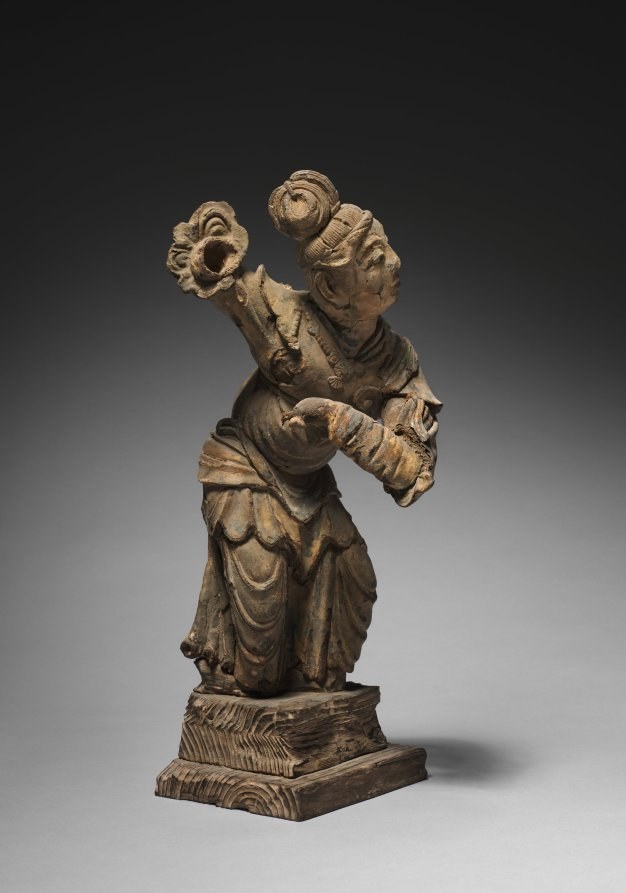
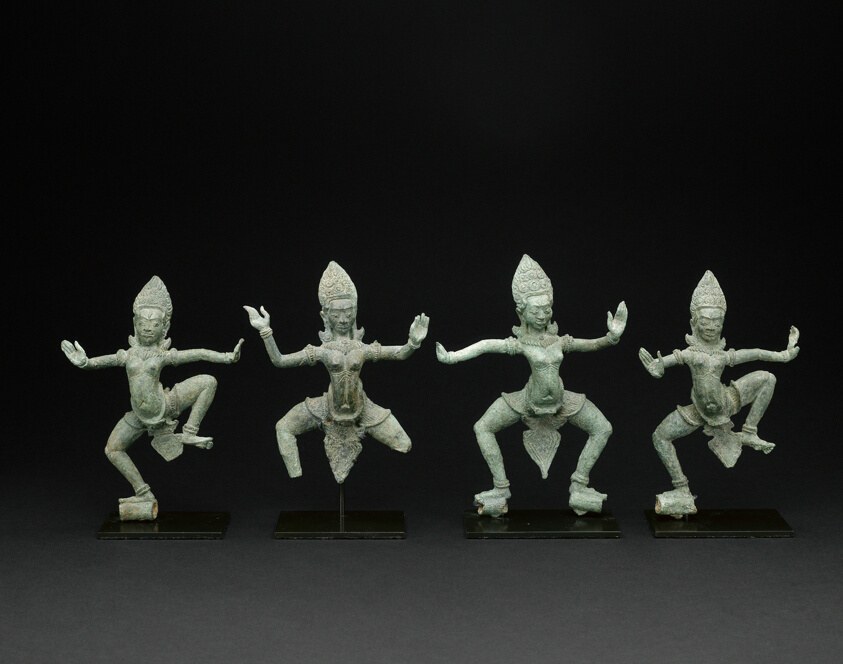
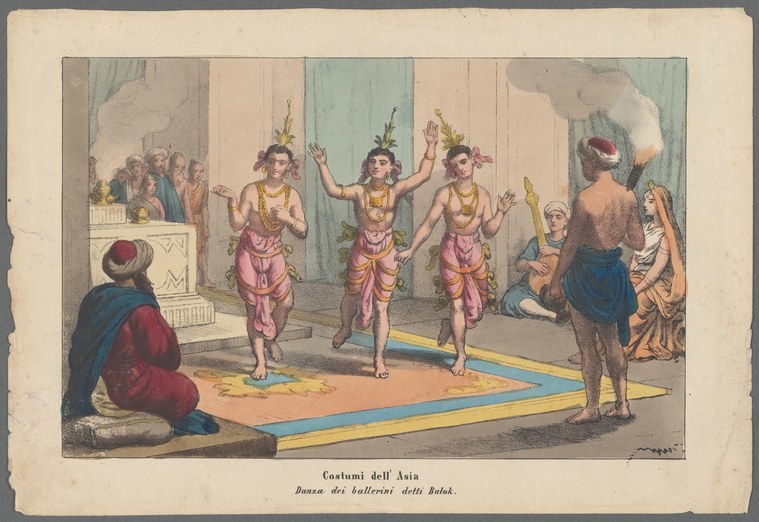
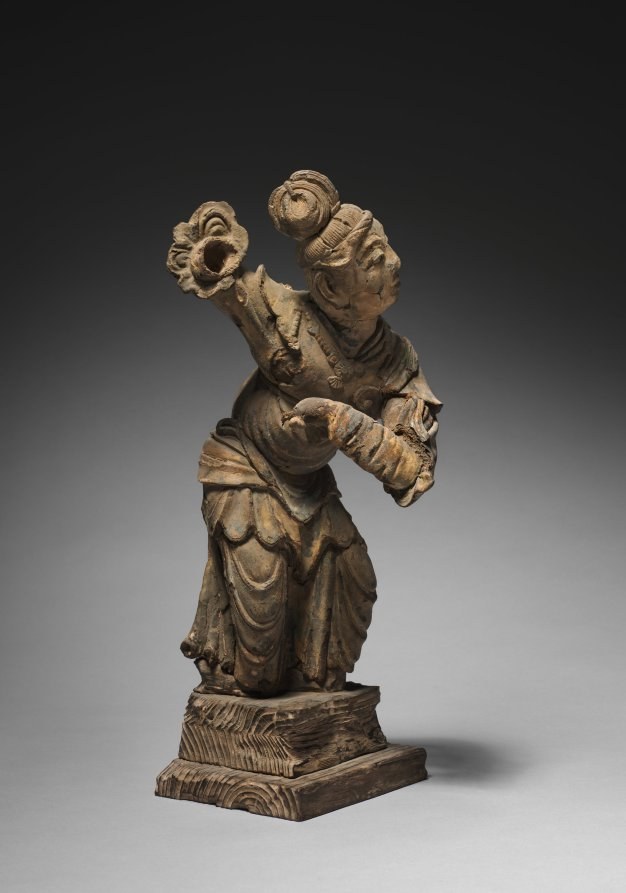
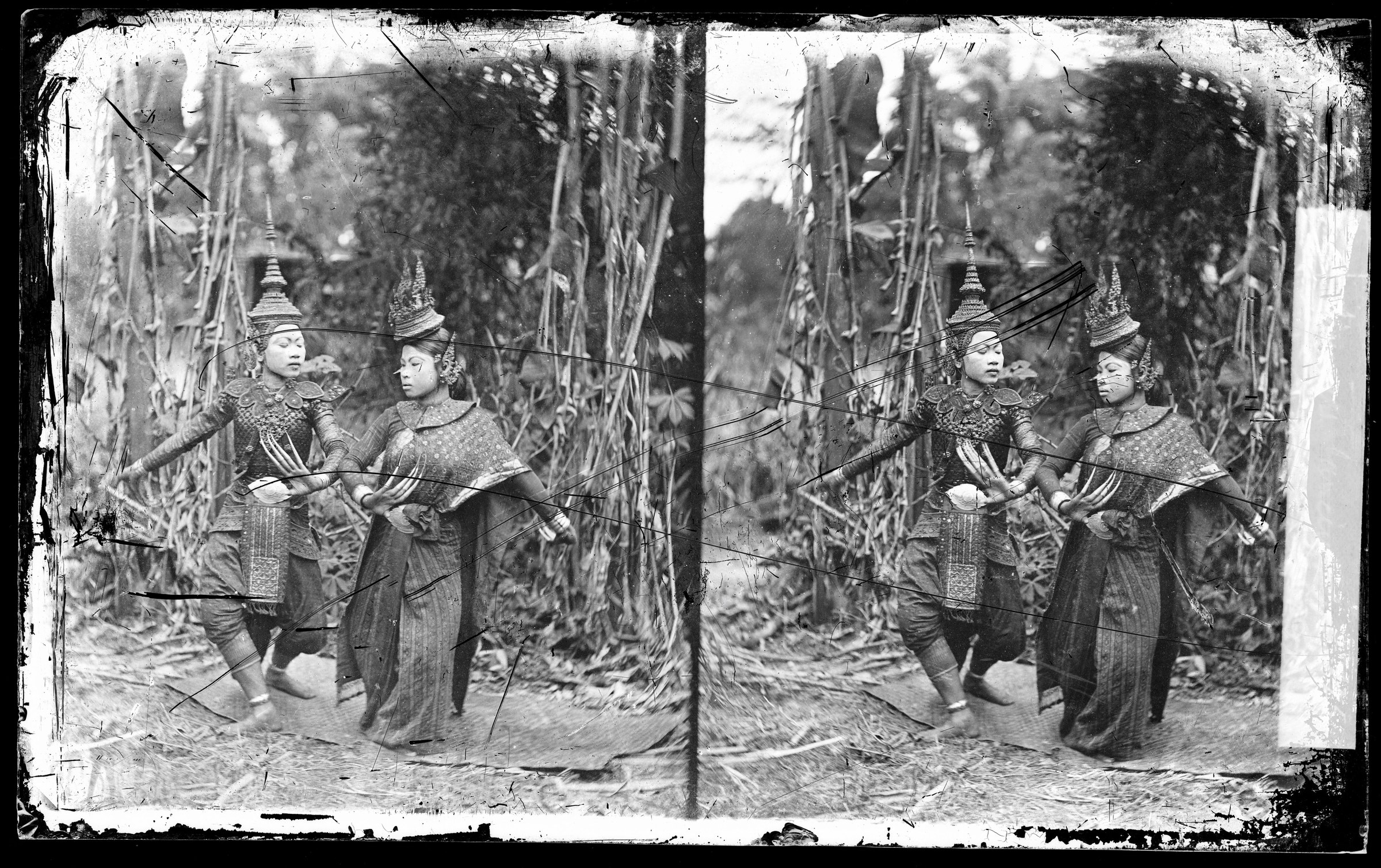
Browse the gallery →Works from the wider Global Southeast Asian Court & Folk tradition — we have not yet identified enough that depict Pendet specifically.
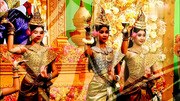
[Pictures] Cambodia Folk Dance | Aspara
cambodia
https://creativecommons.org/licenses/by-sa/4.0/
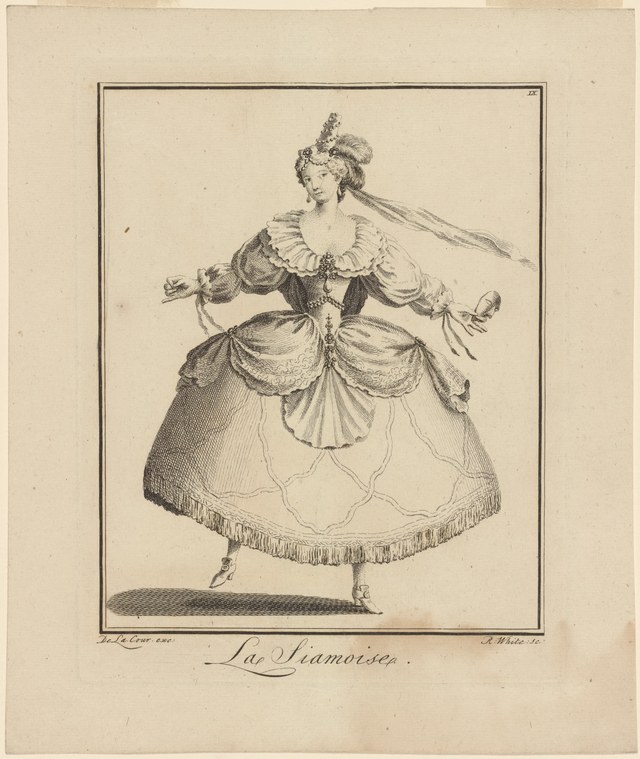
La Siamoise
Unknown artist
Public Domain
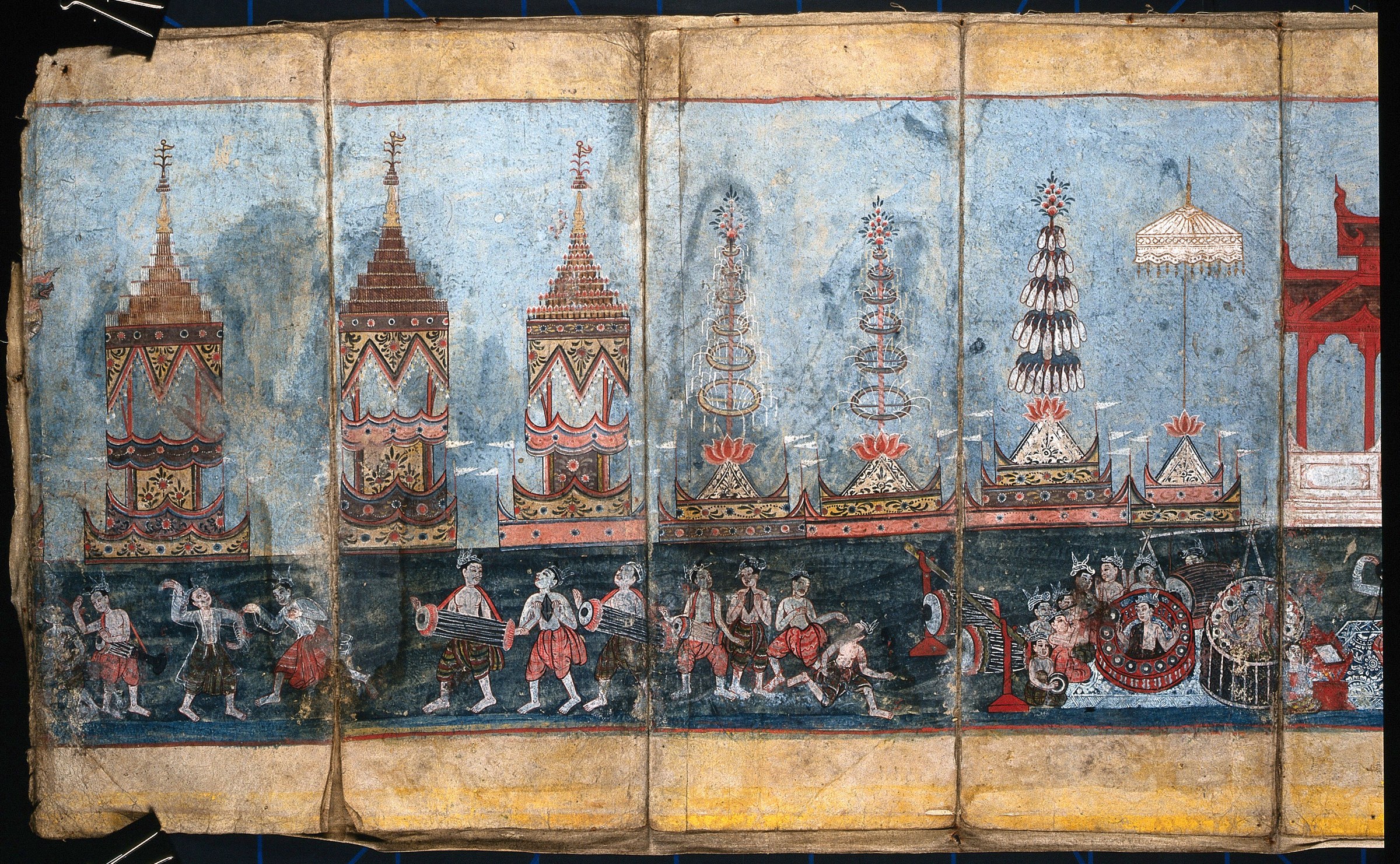
Burma: a sanctuary (?) with towers, temples, musicians and dancers. Gouache painting.
Unknown artist
Public Domain Mark
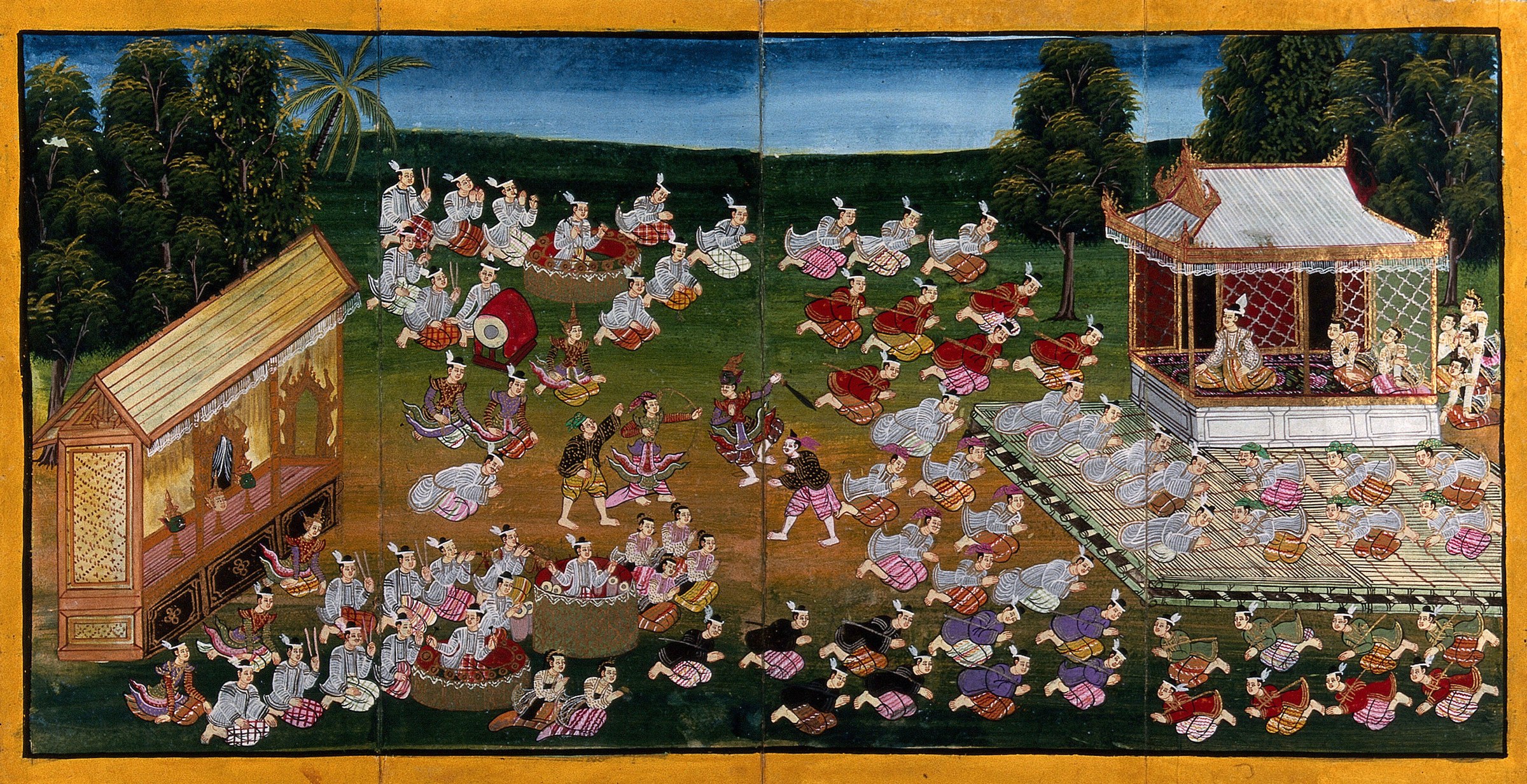
Burma: musicians and dancers perform while courtiers pay homage to a king. Gouache painting.
Unknown artist
Public Domain Mark
Continue Exploring
Lineage of Dance
500 years of dance evolution
Champions of Dance
Winners of marquee national & world titles
Language of Dance
161 dance terms & translations
Listening of Dance
Tempo, timing & musicality tools
Gallery of Dance
5,700+ artworks from museum collections
Attire of Dance
Evolution of dance dress across eras